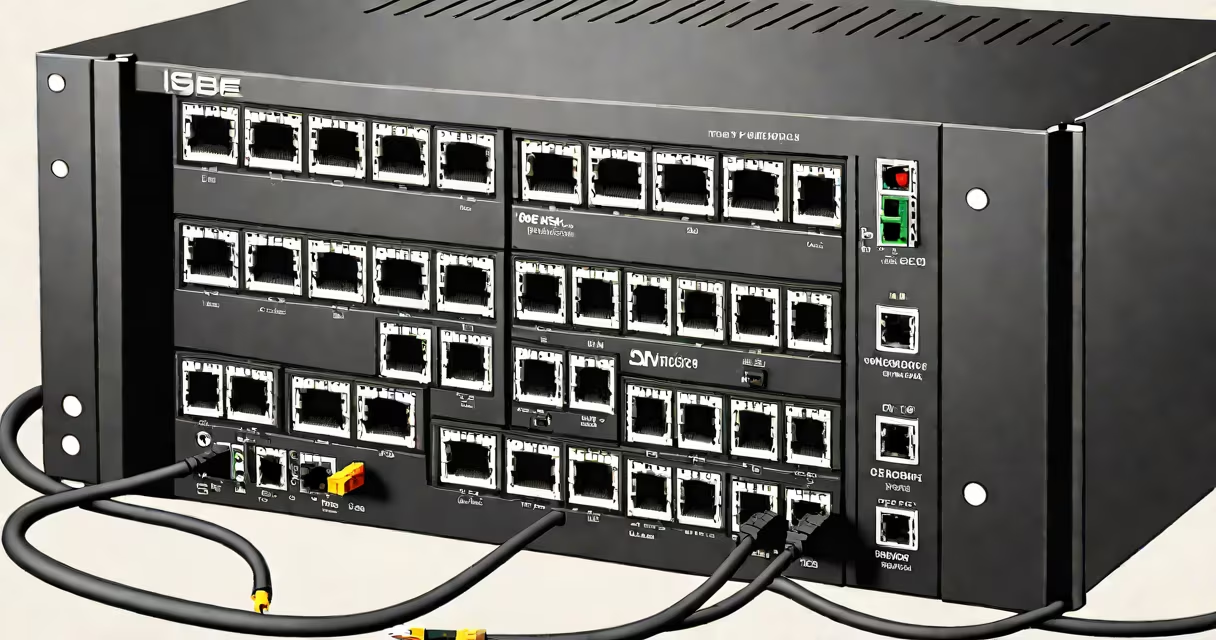
An 8 port 10gbe switch is a network device that provides eight ports supporting 10 gigabits per second data transfer rates, enabling high-speed communication between connected devices such as servers, storage arrays, and high-performance workstations.
These switches operate at Layer 2 of the OSI model, forwarding traffic based on MAC addresses. They support full-duplex transmission, allowing simultaneous sending and receiving of data at 10 Gbps per port. Unlike older 1Gbps switches, they eliminate bandwidth bottlenecks in environments requiring rapid data exchange.
For example, a video editing team working with 8K footage can stream raw files directly from a NAS to multiple workstations without lag. A single 10gbe connection transfers a 1TB file in under 14 minutes-over ten times faster than a 1Gbps link.
The switch uses a switching fabric to route packets between ports. When a device sends data, the switch reads the destination MAC address and forwards the packet only to the intended recipient, reducing unnecessary network traffic.
Most 8 port 10gbe switches include jumbo frame support (up to 9,000 bytes), which reduces CPU overhead when transferring large files. This feature is essential for virtualization hosts, database servers, and backup systems.
Power delivery is handled via PoE (Power over Ethernet) only on select models. Most 10gbe switches require external power supplies. For instance, the Netgear XS716T supports 8 x 10GbE SFP+ ports and consumes 45 watts under load.
8 port 10gbe switches come in two primary physical forms: fixed configuration and modular. Fixed units have all ports built-in and are common in small data centers and labs. Modular switches allow expansion but are typically larger and more expensive.
| Type | Ports | Interface Type | Use Case |
|---|---|---|---|
| Fixed 8-port | 8 x 10GbE SFP+ | SFP+ transceivers, copper RJ45 optional | Server-to-server, storage, lab networks |
| Hybrid 8-port | 4 x SFP+, 4 x RJ45 | Mixed fiber and copper | Connecting distant racks with fiber, local devices with copper |
| Stackable | 8 x 10GbE SFP+ | Stacking cables for multiple units | Scalable data center clusters |
Some models support SFP+ modules for fiber connectivity. Using single-mode fiber, a 10gbe link can span up to 10 kilometers. This makes them suitable for connecting buildings on a campus or linking remote data centers.
For example, a research facility in Boston used an 8 port 10gbe switch with SFP+ transceivers to connect two labs 800 meters apart using OM4 fiber. The setup achieved stable 10 Gbps throughput with less than 0.1% packet loss.
These switches are standard in high-performance computing, media production, financial trading systems, and enterprise storage environments. They reduce latency in distributed databases and accelerate VM migrations in virtualized infrastructures.
A university IT department deployed an 8 port 10gbe switch to connect six research servers handling genomic data analysis. Before the upgrade, each server took 45 minutes to process a dataset. After switching to 10gbe, processing time dropped to 12 minutes due to faster inter-server communication.
They're also used in home labs and advanced hobbyist setups. One user reported setting up a 10gbe network between a Windows workstation, a Linux-based render farm, and a RAID range-all connected through a single 8 port 10gbe switch. The result was near-instant file transfers and smooth rendering workflows.
Many assume that 10gbe switches automatically improve internet speed. That's incorrect. The switch only affects internal network performance. Internet speed depends on your ISP and upstream connection.
Another misconception is that all 10gbe switches support the same features. Not true. Some lack VLAN tagging, QoS, or port mirroring. Always verify specs before purchasing. For example, the TP-Link JetStream T1000G-8P offers basic switching but lacks advanced routing features found in enterprise-grade models like the Cisco Catalyst 9200L.
Also, 10gbe requires compatible hardware. A computer with a 1Gbps NIC cannot achieve 10gbe speeds-even when plugged into a 10gbe switch. You need a 10gbe-capable network card, such as the Intel X550-T2, to realize the full benefit.
When deploying an 8 port 10gbe switch, ensure all connected devices support 10GbE. Mismatched speeds cause negotiation failures and reduced performance. Use SFP+ modules rated for your cable type-single-mode for long distances, multimode for shorter runs.
Power requirements matter too. A typical 8 port 10gbe switch draws 30-50 watts. If installing in a rack, confirm the PDU can handle the load. Overloading a circuit causes outages.
I once set up an 8 port 10gbe switch in a small server room. The switch had no fan, but after 12 hours of continuous operation, the chassis temperature reached 58°C. I added a small cooling fan to prevent thermal throttling. This experience showed that passive cooling is insufficient in enclosed spaces.
Compared to a 6 port ethernet switch, an 8 port 10gbe switch offers more ports and higher bandwidth. While a 6 port 10/100/1000 switch maxes out at 1 Gbps per port, the 10gbe version delivers ten times the throughput.
For longer distances or higher reliability, a fiber port switch is better suited. Fiber connections are immune to electromagnetic interference and support greater distances. An 8 port 10gbe switch with SFP+ ports can replace multiple copper-only switches in a hybrid environment.
Switch port bonding combines multiple physical ports into a single logical link, increasing bandwidth and redundancy. With an 8 port 10gbe switch, you can bond two 10gbe links to create a 20 Gbps channel. This is useful for connecting storage arrays or high-traffic servers.
For example, a company running a real-time analytics platform bonded four 10gbe ports on their 8 port 10gbe switch. The resulting 40 Gbps link reduced data pipeline delays by 67% compared to a single 10gbe connection.
An 8 port 10gbe switch is not a universal solution. It excels in environments demanding low-latency, high-throughput connectivity. But for basic office networks, a 1Gbps switch is sufficient and far cheaper.
With proper planning, an 8 port 10gbe switch delivers measurable performance gains in technical, creative, and enterprise settings.