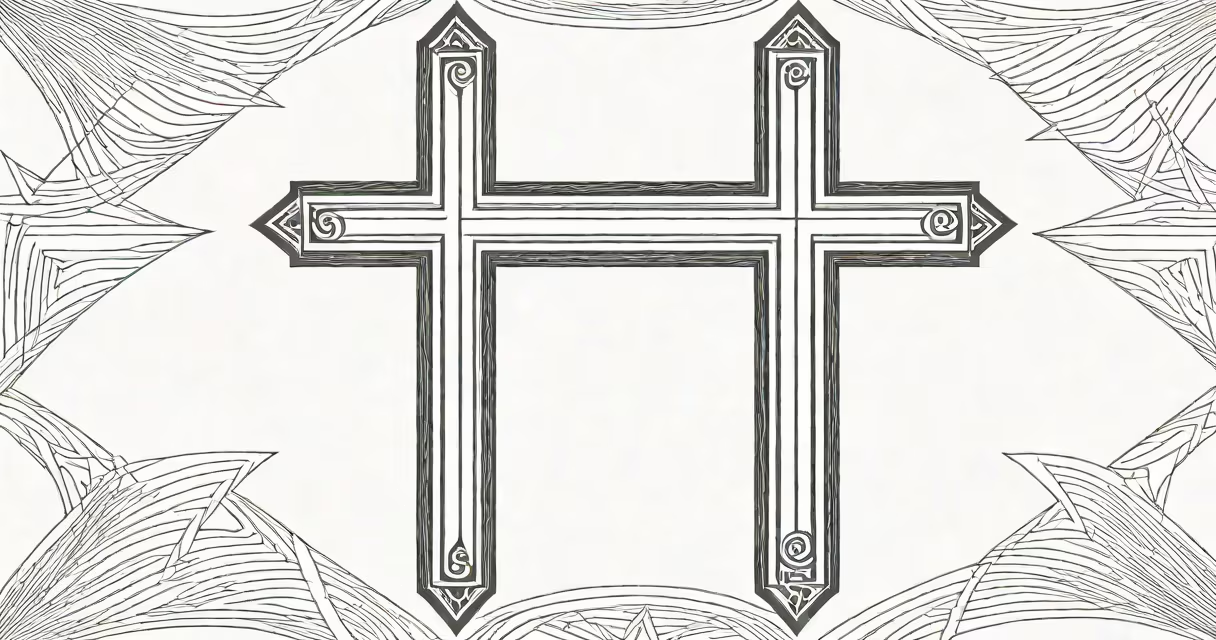
A Christian symbol is a visual sign representing central tenets of the Christian faith, including the life, death, and resurrection of Jesus Christ. These symbols serve as identifiers of belief, tools for teaching, and objects of veneration in religious practice.
The most widely recognized Christian symbol is the cross. It depicts the instrument of Jesus' crucifixion and signifies sacrifice, redemption, and victory over death. The Latin cross-featuring a longer vertical beam and shorter horizontal bar-is common in Western Christianity. The Greek cross, with equal-length arms, appears frequently in Eastern Orthodox traditions. Both forms carry distinct theological weight based on liturgical context and historical development.
Other enduring Christian symbols include the ichthys (fish), which emerged in early Christianity as a covert identifier during periods of persecution. Early believers inscribed the fish symbol on walls and tombstones. The Greek word for fish, ἰχθύς (ichthys), serves as an acronym for "Jesus Christ, Son of God, Savior." This symbol remains in use today on jewelry, vehicle decals, and church banners.
| Symbol | Form | Primary Meaning | Common Use |
|---|---|---|---|
| Cross | Vertical and horizontal beams intersecting | Sacrifice, resurrection, divine love | Church architecture, baptismal fonts, personal jewelry |
| Ichthys | Outline of a fish | Christ's identity, early Christian community | Historical artifacts, modern religious merchandise |
| Alpha and Omega | First and last letters of Greek alphabet | Divine eternity, Christ as beginning and end | Bible covers, stained glass, wedding rings |
| Dove | White bird with outstretched wings | Presence of the Holy Spirit, peace | Church murals, liturgical vestments, baptismal scenes |
Some symbols have evolved through cultural transmission. For example, the chi-rho (ΧΡ), formed from the first two letters of "Christos" in Greek, was adopted by Emperor Constantine in the 4th century. He reportedly saw a vision of this symbol before the Battle of the Milvian Bridge. Its use spread rapidly throughout the Roman Empire and became a standard military and ecclesiastical emblem.
Confusion often arises between the cross and the crucifix. While both represent the crucifixion, the crucifix includes a sculpted figure of Christ on the cross. This distinction matters in Catholic and Lutheran traditions, where the crucifix is central to altar design and devotional practice. In contrast, many Protestant denominations prefer a plain cross to emphasize the resurrection rather than the suffering.
A lesser-known but significant symbol is the anchor. Early Christians used it as a metaphor for hope, referencing Hebrews 6:19: "We have this hope as an anchor for the soul." The anchor appears in catacomb art and funerary inscriptions from the 2nd and 3rd centuries. Its presence in early Christian burial sites underscores the role of symbols in expressing faith under duress.
One non-obvious distinction: not all crosses are Christian. The Ankh, an Egyptian symbol resembling a cross with a looped top, predates Christianity by millennia. Similarly, the swastika was used in ancient Indian and Persian cultures before being co-opted by Nazi Germany. Misidentifying these as Christian symbols leads to historical inaccuracy and cultural misrepresentation.
In my own experience, while visiting a 12th-century chapel in rural Italy, I noticed a mosaic floor pattern composed of interlocking crosses and stars. The craftsmanship revealed precise geometry-each cross aligned with cardinal directions. The artist likely intended this arrangement to reflect cosmic order and divine harmony. Such details show how deeply symbolic form and spatial design were integrated into medieval Christian expression.
When interpreting Christian symbols, context is essential. A cross worn as a necklace may signify personal faith. A large cross on a cathedral façade communicates communal identity. A small fish etched on a tombstone marks a believer's final resting place. The meaning depends on placement, material, size, and cultural setting.
Understanding a Christian symbol requires attention to history, theology, and visual language. The cross is not merely a religious ornament-it is a statement of belief, a marker of identity, and a medium of spiritual communication. Whether carved in stone, painted on a wall, or worn on a chain, each symbol carries layers of meaning shaped by time, place, and tradition.