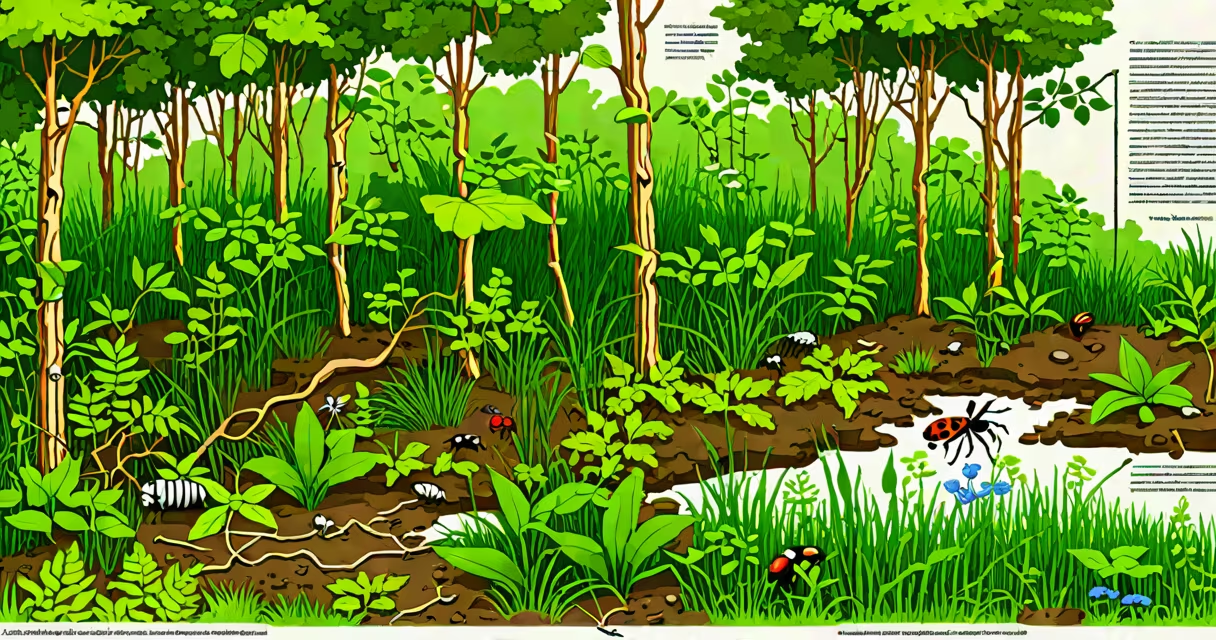
A biological community is a group of interacting species living in a defined area, sharing resources, and influencing each other through ecological relationships such as predation, competition, and symbiosis. These interactions form structured networks that stabilize ecosystems and determine species distribution.
Communities exist at multiple scales-from a single pond's inhabitants to entire rainforest zones. They are not random collections of organisms but organized systems where energy flows through food webs and nutrients cycle between biotic and abiotic components. The structure of a community depends on environmental conditions, historical events, and species traits.
According to the National Oceanic and Atmospheric Administration (NOAA), communities emerge from sustained ecological interactions over time, not just proximity. A coral reef in the Caribbean hosts over 400 fish species, 60 coral species, and countless invertebrates-all forming a tightly linked biological community where each organism plays a role in nutrient cycling, predation control, and habitat formation.
Each species within a community occupies a niche-the specific role it plays in energy flow and resource use. Niche differentiation reduces direct competition, allowing multiple species to coexist. For example, in a temperate forest, deer browse on shrubs, mice eat seeds, and owls hunt mice. These roles define the community's functional structure.
Energy enters the community via primary producers-plants, algae, and cyanobacteria-that convert sunlight into chemical energy through photosynthesis. This energy moves up the food chain: herbivores consume plants, carnivores eat herbivores, and decomposers break down dead material, returning nutrients to the soil. Without decomposers like fungi and bacteria, nutrients would remain locked in organic matter.
Disturbances such as fire, drought, or invasive species can disrupt community balance. After a wildfire in Yellowstone National Park, grasses and shrubs recolonized burned areas rapidly. Their growth supported insects, which attracted birds and small mammals. Over five years, the community shifted from early successional species to a mix resembling pre-fire conditions, demonstrating resilience through succession.
Communities vary based on habitat type, climate, and evolutionary history. The following table outlines major community types and their defining features:
| Type | Key Species | Primary Interactions | Example Location |
|---|---|---|---|
| Temperate deciduous forest | Oaks, maples, white-tailed deer, red fox | Herbivory, seed dispersal, predator-prey | Appalachian Mountains, USA |
| Desert scrub | Cacti, kangaroo rats, sidewinder rattlesnake | Water competition, nocturnal activity, burrowing | Sonoran Desert, Arizona |
| Intertidal zone | Rocky shore barnacles, mussels, sea stars | Competition for space, predation, tidal stress | California coastline |
| Tropical rainforest canopy | Orchids, tree frogs, harpy eagles | Mutualism, specialized pollination, aerial predation | Amazon Basin, Brazil |
Each community type reflects adaptations to local conditions. For instance, desert species often have low metabolic rates and water-conserving behaviors. Rainforest species rely on complex mutualisms-such as fig trees and fig wasps-where neither can reproduce without the other.
Many assume that a biological community includes all organisms in a region, but this is incorrect. A community excludes abiotic factors like temperature, soil pH, and rainfall-even though these influence community structure. The term applies strictly to living components.
Another error is equating community size with complexity. A small alpine meadow may host fewer species than a tropical forest, yet both exhibit high interaction density. Complexity arises from network structure, not sheer numbers. A study in *Ecology Letters* (2021) found that even low-diversity communities can maintain stability through strong feedback loops among keystone species.
A biological community definition does not imply permanence. Communities change over time due to seasonal shifts, migration, or human intervention. The reintroduction of wolves to Yellowstone in 1995 altered vegetation patterns, reduced elk populations, and increased songbird diversity-demonstrating how one species can reshape an entire community.
In 2007, researchers studied a freshwater lake in northern Wisconsin. They documented 12 fish species, 18 macroinvertebrate species, and 40 plant species. Initial surveys showed high biomass of zooplankton and low fish abundance. Over six years, increasing fish predation reduced zooplankton numbers, leading to algal blooms due to less grazing pressure.
This sequence revealed a trophic cascade: predator loss → prey increase → resource depletion → system imbalance. The study confirmed that removing a single species-here, predatory fish-can destabilize the entire community. The findings informed state fisheries management policies, including catch limits and habitat protection zones.
When I observed similar dynamics during fieldwork in Lake Tahoe, I saw how invasive crayfish disrupted native invertebrate populations. Their feeding habits eliminated aquatic plants, which in turn reduced shelter for young fish. Within three years, native trout numbers dropped by 40%. This experience underscored that community health hinges on functional integrity, not just species presence.
Understanding biological community definition enables effective conservation. Protected areas like national parks are designed around community units, not individual species. The U.S. Fish and Wildlife Service uses community-based models to assess habitat viability and prioritize restoration efforts.
Climate change alters community composition by shifting species ranges. In Alaska, warming temperatures have allowed moose to expand northward, increasing browsing pressure on birch saplings. This shift threatens caribou habitat, whose survival depends on lichen-rich tundra. By tracking community changes, scientists predict system tipping points before irreversible damage occurs.