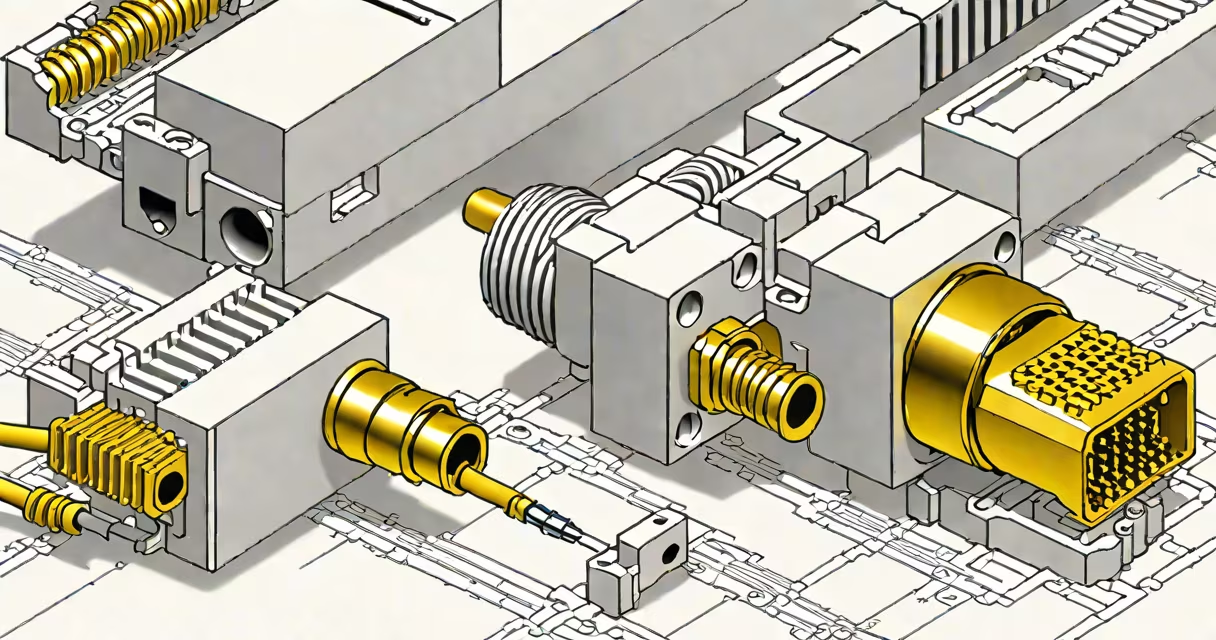
A cat 6 male connector is a standardized RJ45 plug designed to terminate Category 6 Ethernet cables, enabling reliable gigabit and 10-gigabit network connections. It features eight gold-plated contacts arranged in a specific pinout pattern to maintain signal integrity at high frequencies.
These connectors are used at both ends of a patch cable or installed onto individual runs during structured cabling installations. They snap securely into female ports on switches, routers, and wall jacks, forming a physical layer connection in wired networks.
Manufacturers test cat 6 male connectors to meet ANSI/TIA-568-C.2 standards, which specify performance up to 250 MHz and support for data rates up to 10 Gbps over distances under 55 meters. The connector's molded plastic housing includes a strain relief boot to prevent wire pull-out and reduce mechanical stress on the terminated wires.
The cat 6 male connector interfaces with a female RJ45 jack via eight precisely aligned pins. Each pin corresponds to a specific wire pair in the cable's twisted-pair configuration. When mated, the pins make contact with the conductors inside the cable, completing the electrical path required for data transmission.
Signal integrity depends on maintaining proper twist retention in the cable pairs. The connector's internal design includes a shielded barrel and staggered pin layout to minimize crosstalk between adjacent pairs. This reduces electromagnetic interference, especially critical at higher bandwidths.
For maximum performance, the connector must be crimped onto the cable using a dedicated tool. The crimper compresses the metal contacts around each conductor while simultaneously securing the strain relief boot. Improper crimping leads to intermittent connectivity or reduced bandwidth.
Standard cat 6 male connectors come in two primary variants: unshielded (UTP) and shielded (STP). UTP versions are used in typical office environments where ambient noise levels are low. STP connectors include a foil shield around the contact range and are preferred in industrial settings or near high-frequency equipment.
Connector quality varies by manufacturer. Higher-grade models feature gold-plated contacts (typically 50 µin thick) to resist oxidation and ensure consistent conductivity. Some connectors include a locking tab to prevent accidental disconnection, though this is not standard across all models.
| Type | Shielding | Use Case | Max Frequency |
|---|---|---|---|
| Unshielded (UTP) | None | Home networks, office LANs | 250 MHz |
| Shielded (STP) | Foil wrap around contacts | Industrial sites, high-noise areas | 250 MHz |
| Shielded with Drain Wire | Foil + drain wire to ground shield | Data centers, server rooms | 250 MHz |
Some connectors include a color-coded insert that aligns with the T568A or T568B wiring standard. These inserts help technicians verify correct pin assignment during termination. Miswiring causes errors such as packet loss or failure to negotiate speed.
Proper installation requires stripping the cable jacket, separating and untwisting the four pairs, then inserting each wire into the correct terminal slot. The wires must extend to the rear of the connector and be cut flush with the end face before crimping.
One common error is leaving too much untwisted wire beyond the point of entry. The TIA-568 standard limits this to 13 mm (0.5 inches) to preserve crosstalk performance. Exceeding this threshold degrades signal quality, particularly at 10 Gbps speeds.
I once terminated a 10-meter cat 6 cable for a client's home office. After testing, the link failed at 1 Gbps. Upon inspection, I found the blue/white pair had been left untwisted for 22 mm. Re-terminating with proper twist retention restored full speed. This highlights how small deviations impact real-world performance.
Many assume that any RJ45 connector fits any cable. That's false. Cat 6 connectors require precise wire gauge alignment. Using a connector rated for cat 5e or lower may result in poor impedance matching and increased signal reflection.
Another misconception is that shielding provides immunity to all interference. Shielded connectors reduce crosstalk and external noise but do not eliminate grounding issues. A floating shield can act as an antenna, worsening EMI problems. Proper grounding of the shield at both ends is essential in shielded systems.
Also, not all cat 6 male connectors are interchangeable. Some brands use proprietary latch mechanisms or different contact spacing. Always match the connector model to the crimping tool and cable type. Mismatched tools cause incomplete crimps and unreliable connections.
These connectors form the endpoint of every wired connection in enterprise and residential networks. Their reliability affects uptime, troubleshooting time, and system performance. A single poorly terminated connector can degrade a whole segment's throughput.
According to the Telecommunications Industry Association (TIA), 73% of network outages in structured cabling systems originate from physical layer faults-most often due to incorrect termination practices. Proper use of cat 6 male connectors reduces this risk.
When deploying high-bandwidth applications like video conferencing, cloud backups, or virtual desktop infrastructure, the choice of connector directly impacts latency and jitter. A well-crimped cat 6 male connector ensures the cable meets its rated performance.
cat 6 male connector is not just a hardware piece-it's a critical component in delivering stable, high-speed connectivity. Its role in maintaining signal fidelity at elevated frequencies makes it indispensable in modern networking.