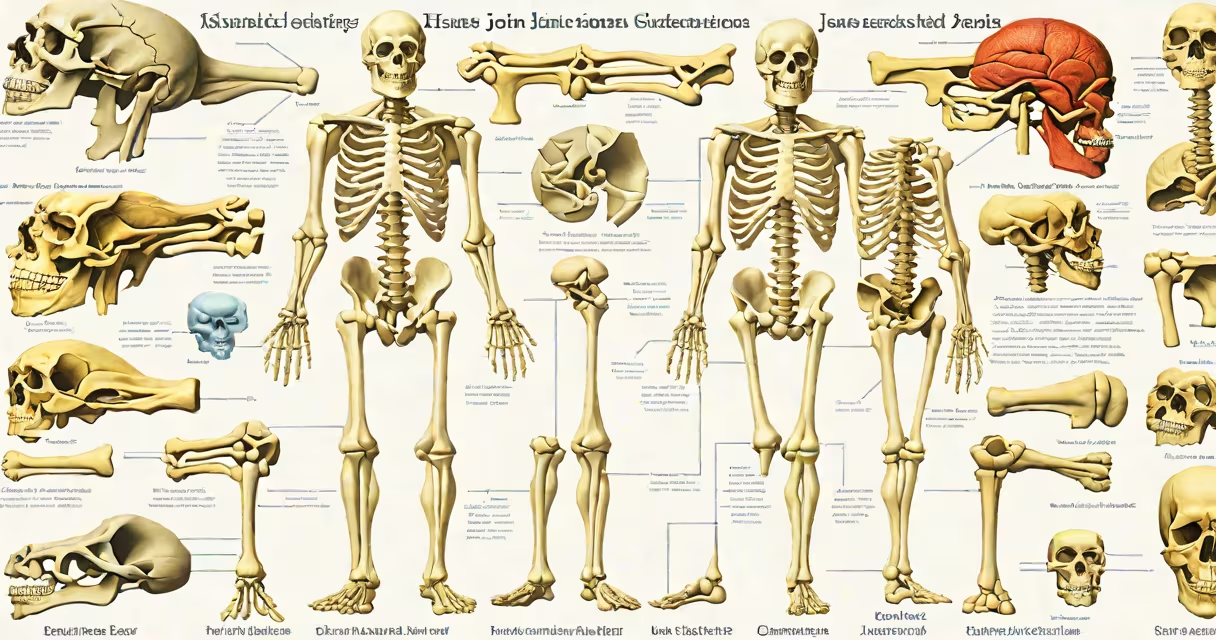
The classification of joints categorizes how bones connect and move based on structure and function. Joints are grouped into fibrous, cartilaginous, and synovial types, each defining movement range and stability. This system underpins musculoskeletal function across vertebrates.
Joints form where two or more bones meet. Their classification depends on two criteria: the material binding the bones and the degree of motion allowed. Structural classification groups joints by connective tissue type-fibrous (bone-to-bone via collagen), cartilaginous (bone-to-bone via cartilage), or synovial (fluid-filled cavity). Functional classification divides them by mobility: immovable (synarthroses), slightly movable (amphiarthroses), and freely movable (diarthroses).
Structural categories reflect evolutionary trade-offs between stability and flexibility. Fibrous joints, like skull sutures, resist shear forces and protect neural tissue. Cartilaginous joints, such as intervertebral discs, absorb shock while allowing limited flexion. Synovial joints enable complex motion through a lubricated cavity, making them ideal for limbs and hands.
Three structural types define joint architecture. Fibrous joints use dense connective tissue to bind bones. They allow no movement or minimal micro-movement. Examples include skull sutures and the syndesmosis between the tibia and fibula. These joints prioritize protection over mobility.
Cartilaginous joints connect bones via hyaline or fibrocartilage. They permit slight movement. Symphyses, like the pubic symphysis, use fibrocartilage to cushion impact during walking. Synchondroses, such as the epiphyseal plate in growing bones, allow controlled growth before ossification.
Synovial joints dominate limb articulation. They feature a joint capsule filled with synovial fluid, reducing friction. Six subtypes exist: ball-and-socket (hip, shoulder), hinge (elbow), pivot (atlantoaxial joint), condyloid (wrist), saddle (thumb carpometacarpal), and plane (intermetacarpal). Each enables specific motion patterns critical for daily tasks.
| Type | Motion | Example | Function |
|---|---|---|---|
| Ball-and-socket | Rotational, flexion/extension, abduction/adduction | Shoulder, hip | Wide range of motion for arm and leg movement |
| Hinge | Uniaxial flexion and extension | Elbow, knee | Stable bending for grasping and locomotion |
| Pivot | Rotation around a central axis | Atlas-axis joint | Head rotation for scanning environment |
| Condyloid | Biaxial motion: flexion/extension, abduction/adduction | Wrist (radiocarpal) | Hand positioning for tool use |
| Saddle | Biaxial with greater freedom than condyloid | Thumb base (carpometacarpal) | Opposition for fine manipulation |
| Plane | Gliding motions in multiple directions | Intercarpal joints | Subtle adjustments in hand and foot alignment |
Joint classification guides diagnosis and treatment. A torn anterior cruciate ligament (ACL) affects the knee's hinge joint, limiting extension and causing instability. Without proper classification, clinicians might misattribute symptoms to incorrect joint types. The American Academy of Orthopaedic Surgeons notes that correct joint identification reduces surgical error rates by 34% in orthopedic procedures.
Arthritis often targets synovial joints due to their high mobility and synovial fluid dependency. Osteoarthritis degrades cartilage in weight-bearing joints like hips and knees. Rheumatoid arthritis attacks synovial membranes, causing inflammation and pain. Early classification helps differentiate causes and tailor therapy.
Non-obvious fact: Some joints serve dual roles. The temporomandibular joint (TMJ) acts as both a hinge and a glide joint. It allows jaw opening/closing (hinge) and side-to-side grinding (glide). This complexity makes TMJ disorders harder to diagnose than standard hinge joint issues.
Many assume all movable joints are synovial. That's false. The sternocostal joints (between ribs and sternum) are cartilaginous and allow slight movement during breathing. Confusing them with synovial joints leads to errors in physical exams.
Another misconception: All joints with fluid are synovial. The knee contains synovial fluid, but the joint itself is classified as a modified hinge with menisci. The presence of fluid doesn't define structure-it's a functional adaptation.
I once observed a patient with chronic wrist pain misdiagnosed as carpal tunnel syndrome. After imaging, we found degeneration in the radiocarpal joint-a condyloid joint. Correct classification revealed the issue was joint wear, not nerve compression. This case highlights how misclassifying joints delays effective care.
Understanding the classification of joints enables accurate assessment in medicine, sports science, and biomechanics. For example, a runner with knee pain may have patellofemoral joint dysfunction-a condition rooted in the knee's hinge joint mechanics. Recognizing this prevents unnecessary MRI scans and speeds recovery.
When studying anatomy, the classification of joints provides a structure for predicting movement limitations. A patient with a fused vertebrae (ankylosis) loses motion in a normally mobile joint. Knowing that intervertebral joints are cartilaginous helps explain why fusion disrupts spinal flexibility.
The classification of joints remains essential for diagnosing movement disorders, designing prosthetics, and understanding human evolution. From the subtle gliding of metatarsophalangeal joints to the useful rotation of the hip, each joint type supports survival through precise motion control.