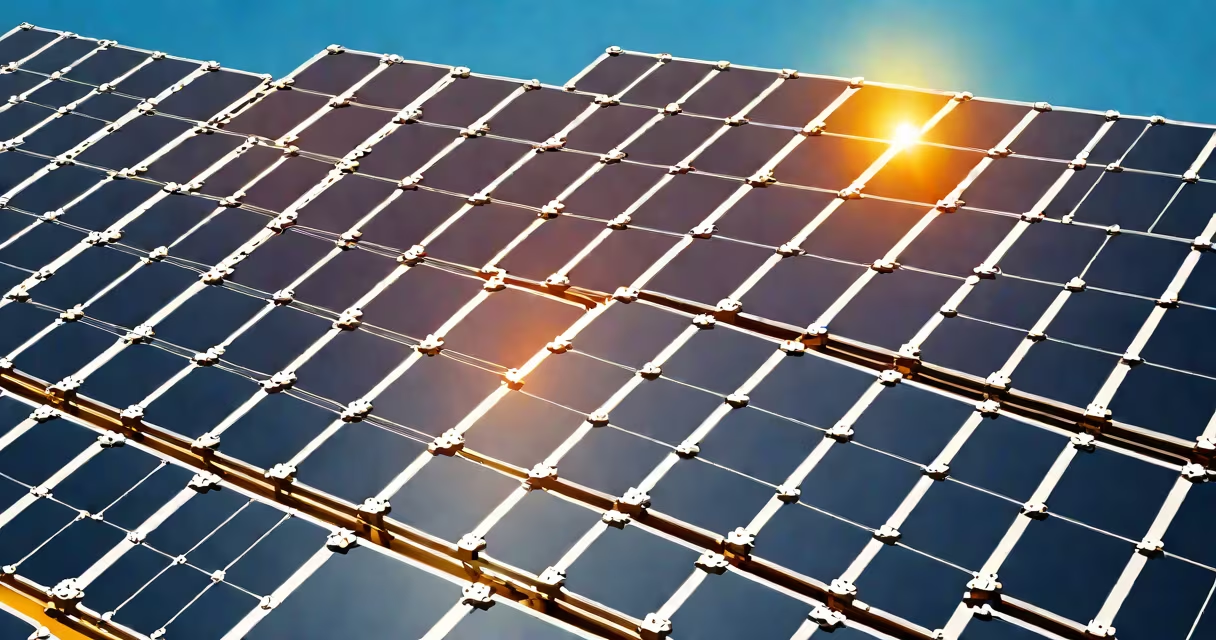
A photovoltaic cell is a semiconductor device that converts sunlight directly into electricity through the photovoltaic effect. It generates direct current (DC) when exposed to light, forming the basic unit of solar panels used in residential, commercial, and utility-scale installations.
Photovoltaic cells operate by absorbing photons from sunlight, which excite electrons in a semiconductor material. This creates electron-hole pairs that are separated by an internal electric field, producing a flow of electric current. The most common material used is crystalline silicon, though alternatives like cadmium telluride and perovskite are emerging.
These cells are the foundation of solar power systems. A single cell produces around 0.5 volts under standard test conditions. Multiple cells are connected in series and parallel within a module to achieve usable voltage and current levels. A typical rooftop solar panel contains 60 to 72 cells.
When sunlight strikes a photovoltaic cell, photons transfer energy to electrons in the semiconductor. If the photon's energy exceeds the bandgap of the material, it frees an electron, creating a mobile charge carrier. The cell's p-n junction-a boundary between positively doped (p-type) and negatively doped (n-type) semiconductor layers-creates an electric field that drives electrons toward the n-side and holes toward the p-side.
This separation establishes a voltage difference across the cell. When external circuitry connects the two sides, electrons flow from the n-side to the p-side through the load, generating usable current. The process is instantaneous and requires no moving parts or fuel.
Efficiency depends on material quality, light intensity, temperature, and angle of incidence. Modern commercial silicon cells average 15% to 22% efficiency. Lab prototypes have reached over 47% under concentrated sunlight, but real-world performance is lower due to environmental factors.
Most photovoltaic cells fall into three categories based on the semiconductor material used:
| Type | Material | Typical Efficiency | Common Use |
|---|---|---|---|
| Monocrystalline | Single-crystal silicon | 18%-22% | Rooftop solar, high-efficiency applications |
| Polycrystalline | Multicrystalline silicon | 15%-17% | Residential and small commercial systems |
| Thin-Film | Cadmium telluride (CdTe), copper indium gallium selenide (CIGS), amorphous silicon | 10%-13% | Large-scale solar farms, building-integrated PV |
Monocrystalline cells are cut from single silicon ingots, giving them a uniform appearance and higher efficiency. Polycrystalline cells are cast from molten silicon, resulting in a speckled blue look and slightly lower efficiency. Thin-film cells are deposited in layers on substrates like glass or plastic, making them lightweight and flexible but less efficient.
An often-overlooked fact: perovskite cells, a newer class of materials, have achieved lab efficiencies above 25% in less than a decade. They're promising for low-cost, high-performance solar tech, though stability and scalability remain challenges.
Photovoltaic cells are deployed in diverse settings. Residential rooftops use arrays of panels to offset grid consumption. Utility-scale solar farms cover hundreds of acres and feed power into transmission grids. Off-grid systems power remote homes, water pumps, and communication towers.
For example, the Solar Star project in California uses over 1.7 million photovoltaic modules to generate 579 megawatts of capacity-the largest solar installation in the U.S. as of 2023. Each module contains 60 cells, each producing ~0.5 watts under standard conditions. Total output reaches ~1.5 gigawatt-hours daily during peak sun hours.
Portable solar chargers for phones and laptops rely on small photovoltaic cells. Even spacecraft use them: the International Space Station's solar arrays generate over 80 kilowatts of power, powered by thousands of individual cells.
People often confuse photovoltaic cells with solar thermal collectors. While both use sunlight, solar thermal systems heat fluids to drive turbines, whereas photovoltaic cells produce electricity directly. Thermal systems are used for heating and industrial processes; photovoltaic systems are for electricity generation.
Another misconception is that photovoltaic cells work equally well in all weather. In reality, performance drops in cloudy or cold conditions. High temperatures reduce voltage output-each degree Celsius above 25°C can lower efficiency by 0.3% to 0.5%. Snow covering panels can block light entirely, reducing output to near zero until cleared.
Some assume all solar panels are interchangeable. But panel efficiency, degradation rate, warranty length, and manufacturer reliability vary. A 2022 study by the National Renewable Energy Laboratory (NREL) found that panels degrade at rates between 0.25% and 0.8% per year, affecting long-term yield.
I installed a 5-kilowatt photovoltaic system on my home roof in 2021. After a year of monitoring, the system produced 6,800 kilowatt-hours annually-enough to cover 85% of our household usage. During winter months, output dropped to 40% of summer levels due to shorter days and snow accumulation. Cleaning the panels twice a year restored performance.
The system's inverter converted DC from the cells into AC for home use. Net metering allowed us to send surplus power back to the grid, earning credits that offset bills during low-production periods.
Photovoltaic cells are not batteries. They generate electricity only when illuminated. They do not store energy-storage requires separate devices like lithium-ion batteries. The term "solar cell" is synonymous with "photovoltaic cell," though "photovoltaic" emphasizes the conversion mechanism.
Each cell's output is limited by physical constraints. The Shockley-Queisser limit sets the theoretical maximum efficiency for a single-junction silicon cell at 33.7% under unconcentrated sunlight. Multi-junction cells, used in space satellites, exceed 40% efficiency but are too expensive for mass deployment.
Environmental impact matters. Manufacturing silicon cells consumes significant energy and emits CO₂. However, lifecycle analysis shows that a typical panel offsets its carbon footprint within 1.5 to 2 years of operation. Over 25 years, it produces 20 times more clean energy than was used to make it.
For context, the U.S. Energy Information Administration reports that solar photovoltaic generation grew from 1.2 terawatt-hours in 2010 to 160 terawatt-hours in 2023-an increase of over 13,000% in 13 years.
Understanding the definition of photovoltaic cell clarifies its role in renewable energy. It is not a panacea, but a proven, scalable technology central to decarbonizing electricity systems. As materials science advances, efficiency and durability will improve, expanding access to clean power worldwide.