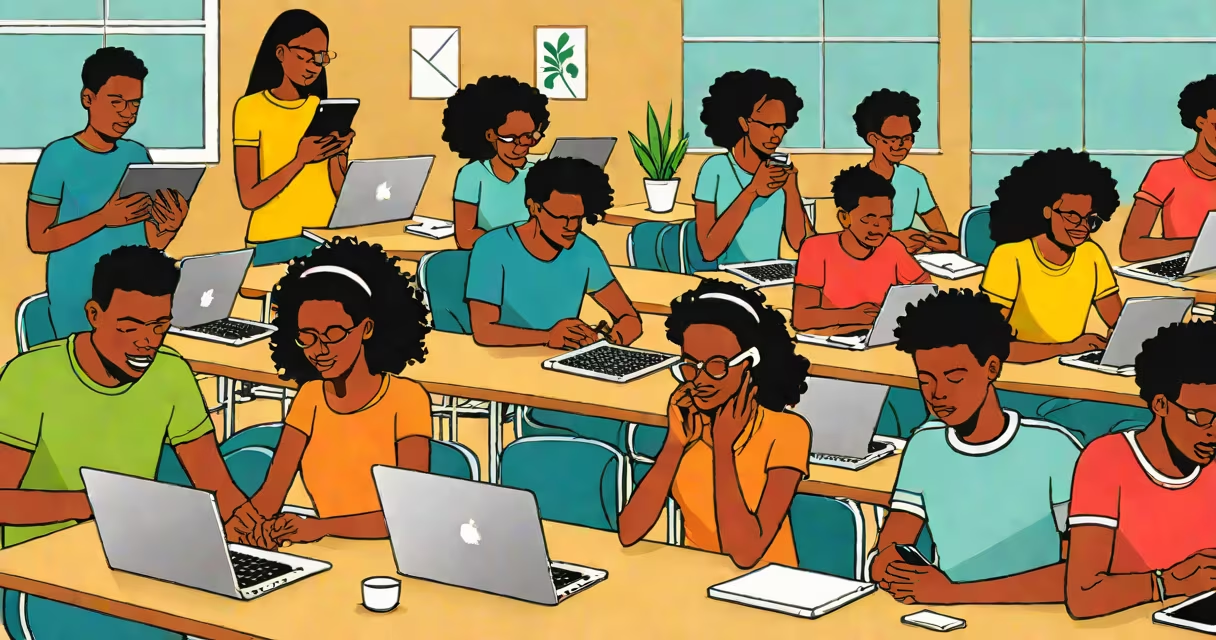
Digital natives are individuals born between the late 1990s and early 2010s who have grown up surrounded by digital technology, including the internet, smartphones, social media, and video games. Their lives are shaped by constant access to digital tools, making technology feel natural and intuitive.
This term was first introduced by educator Marc Prensky in 2001, who contrasted digital natives with "digital immigrants"-those who adopted technology later in life. Prensky argued that digital natives process information differently due to early exposure, favoring visual, interactive, and multitasking modes over traditional linear reading or listening.
According to the Pew Research Center, 95% of U.S. teens aged 13 to 17 have access to a smartphone, and 45% say they are online almost constantly. These behaviors reflect the lived reality of digital natives, whose identities, relationships, and learning styles are deeply intertwined with digital environments.
Digital natives interact with the world through screens. They learn by watching tutorials, searching for solutions on YouTube, and sharing ideas via TikTok or Instagram. Their attention spans are shorter on average-research from the University of California, Irvine, shows that people under 30 switch tasks every 45 seconds on average, compared to 60 seconds for older adults.
They expect instant feedback. A student might submit a paper and immediately check for comments, not waiting for a teacher's weekly review. This immediacy shapes their expectations in education, work, and personal interactions.
For example, a high school student in Austin uses a combination of Google Classroom, Zoom, and a shared Notion document to complete a group project. She checks messages during class, edits in real time, and posts updates to a group chat. This smooth blend of tools reflects how digital natives manage collaboration-not through formal meetings, but through asynchronous, device-based coordination.
Digital natives often display strong visual-spatial reasoning skills. A study published in *Computers & Education* found that adolescents who played video games regularly scored higher on spatial cognition tests than peers who did not. This is not because gaming makes them smarter, but because frequent interaction with 3D environments strengthens mental mapping abilities.
They also tend to multitask across devices. A 2022 report from Common Sense Media showed that 60% of teens aged 14-18 use multiple screens simultaneously-watching a livestream while texting friends and scrolling through a news feed. This behavior is not distraction; it's a mode of engagement shaped by design and habit.
Digital natives aren't uniformly skilled in digital literacy. While they may go through apps easily, many struggle with critical evaluation of online content. A Stanford study found that 82% of middle school students couldn't distinguish between sponsored content and real news on social media. This gap separates digital fluency from digital wisdom.
One widespread myth is that digital natives are inherently better at technology. That's false. Being born into a digital world doesn't guarantee competence. A teenager may stream videos daily but lack basic cybersecurity awareness-like recognizing phishing emails or managing passwords securely.
Another confusion arises between digital natives and digital immigrants. The latter group includes anyone who adopted technology later in life, such as parents or older teachers. But the term "immigrant" implies difficulty adapting, which oversimplifies the reality. Many adults today use technology effectively and are not hindered by age. The distinction is less about ability and more about developmental context.
A third error is assuming all digital natives are the same. Age, socioeconomic status, and geography create variation. A child in rural Iowa with limited broadband access experiences digital life differently than a teen in Seoul with fiber-optic speeds and government-supported tech education. Digital access matters as much as birth decade.
Digital natives span several generations, though the term most commonly applies to those born between 1995 and 2010. This cohort includes Millennials' younger siblings and Gen Z. They differ from earlier groups:
| Group | Birth Years | Technology Exposure | Learning Style |
|---|---|---|---|
| Digital Immigrants | 1950-1980 | Adopted computers and internet later | Linear, text-based, sequential |
| Digital Natives | 1995-2010 | Grew up with digital tools | Visual, interactive, multitasking |
| Digital Immigrants (Newer) | 2010-present | First devices were touchscreens | Gesture-based, app-centric, voice-enabled |
The youngest members of this cohort-born after 2010-are sometimes called "digital natives 2.0," but they're still in the early stages of development. Their habits are forming around AI assistants, augmented reality, and personalized algorithms.
In education, schools are shifting toward blended learning models. A public high school in Denver redesigned its science curriculum around interactive simulations and peer-led digital labs. Teachers reported higher engagement among students who had grown up with digital tools. One student noted, "I don't read the textbook-I watch a 3-minute animation and then test my understanding in a quiz."
In business, companies targeting Gen Z use platforms like Snapchat and TikTok for marketing. A cosmetics brand launched a campaign where users created filters based on product colors. Over 1.2 million filters were generated in one month, showing how digital natives co-create value in real time.
When designing websites or apps for this audience, clarity and speed matter more than formality. A banking app that loads in under 1.5 seconds and uses icons instead of dense text sees 40% higher retention among users aged 16-24, according to a 2023 UX study by Nielsen Norman Group.
Digital natives are not synonymous with "tech-savvy" or "social media users." Many people who use Instagram daily are not digital natives-they may have picked up the habit later in life. Age of adoption matters more than frequency of use.
Also, being a digital native doesn't mean someone understands how technology works. A student might use AI tools to write essays without knowing how training data influences outputs. This gap highlights the difference between using technology and understanding it-a core issue in digital literacy.
Understanding the digital natives definition is not about labeling a generation-it's about recognizing how environment shapes cognition, behavior, and opportunity. The tools they use aren't just accessories; they're extensions of identity, learning, and connection.