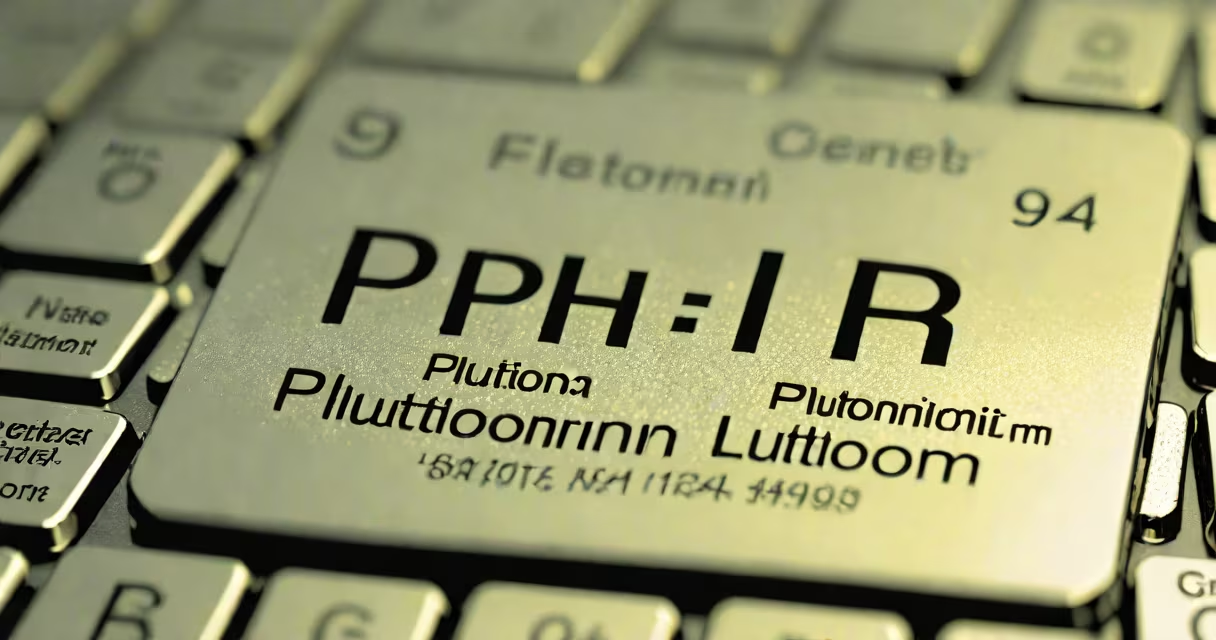
Element 94 on the periodic table is plutonium, a synthetic radioactive metallic element with the symbol Pu and atomic number 94. It does not occur naturally in significant quantities and was first produced in 1940 through neutron bombardment of uranium-238.
Plutonium is a member of the actinide series, a group of elements with atomic numbers 89 to 103. These elements share similar electron configurations and chemical behaviors, particularly their tendency to form multiple oxidation states. Plutonium's most stable isotopes include plutonium-239 and plutonium-244, both capable of undergoing fission when struck by slow-moving neutrons.
The element was discovered at the University of California, Berkeley, by Glenn T. Seaborg and his team. They named it after Pluto, the dwarf planet, following the naming pattern of earlier transuranic elements like neptunium (after Neptune). Its production required cyclotron experiments and chemical separation techniques, marking a milestone in nuclear chemistry.
Plutonium's utility stems from its ability to sustain a chain reaction during nuclear fission. When a neutron strikes a plutonium-239 nucleus, the atom splits into smaller fragments, releasing energy and additional neutrons. These neutrons can then trigger further fissions, creating a self-sustaining reaction.
This process powers nuclear reactors and atomic bombs. In reactors, controlled fission generates heat used to produce steam and drive turbines. In weapons, uncontrolled fission releases explosive energy in milliseconds. A critical mass of plutonium-239-about 10 kilograms-is needed to initiate a sustained chain reaction.
Plutonium also exhibits complex phase behavior. It exists in six solid phases between room temperature and its melting point, each with different densities and crystal structures. This makes it mechanically unstable and difficult to machine, requiring specialized handling tools and containment systems.
Plutonium is not found in nature in measurable amounts. All known plutonium originates from human-made processes. It forms as a byproduct in nuclear reactors when uranium-238 absorbs neutrons and undergoes beta decay:
U-238 + n → U-239 → Np-239 → Pu-239Each step takes minutes to days. The resulting Pu-239 can be chemically separated from spent nuclear fuel via the PUREX process (plutonium-uranium extraction).
| Isotope | Half-life | Primary decay mode | Use |
|---|---|---|---|
| Pu-239 | 24,110 years | Alpha decay | Nuclear weapons, reactor fuel |
| Pu-240 | 6,560 years | Alpha decay | Contaminant in weapons-grade material |
| Pu-244 | 80 million years | Alpha decay | Rare, long-lived isotope |
Not all plutonium is suitable for weapons. Weapons-grade plutonium contains over 93% Pu-239. Reactor-grade plutonium, enriched in Pu-240, is less ideal due to spontaneous fission, which increases the risk of premature detonation.
Plutonium-239 is used in mixed oxide (MOX) fuel, where it replaces uranium in light-water reactors. MOX fuel reduces reliance on enriched uranium and recycles spent nuclear material. Over 100 reactors in Europe and Asia use MOX fuel, including plants in France and Japan.
Plutonium also powers radioisotope thermoelectric generators (RTGs) used in space missions. The Mars rover Perseverance uses a Multi-Mission RTG containing 4.8 kilograms of plutonium-238. As Pu-238 decays, it produces heat converted into electricity. This system operates reliably in extreme environments where solar panels fail.
During the Cold War, the United States and Soviet Union produced thousands of kilograms of plutonium for nuclear arsenals. The U.S. stockpile peaked at 100 metric tons in the 1980s. Today, surplus plutonium is being downblended or stored in secure facilities under international agreements.
Plutonium is often mislabeled as "highly toxic" in ways that exaggerate its danger. While inhaling plutonium dust poses health risks due to alpha radiation, the actual hazard depends on dose and exposure route. Ingestion or inhalation of microgram quantities leads to low internal doses compared to other radionuclides like cesium-137.
A common error is equating all plutonium with bomb-making material. In reality, only specific isotopic compositions qualify. Plutonium from commercial reactors contains too much Pu-240 to be weaponized effectively. The U.S. Department of Energy confirms that reactor-grade plutonium cannot be used in a reliable nuclear weapon without extensive enrichment.
Another misconception is that plutonium glows blue. This visual myth arises from fictional portrayals. Pure plutonium is silvery-gray and oxidizes to a duller color. The blue glow seen in media results from Cherenkov radiation in water-cooled reactors, not the metal itself.
In 2021, NASA's Perseverance rover landed on Mars. Its power system relies on a Multi-Mission RTG fueled by 4.8 kg of plutonium-238. This isotope emits heat at a rate of 600 watts thermal. A thermocouple range converts 120 watts of electrical power continuously for up to 14 years.
The RTG operates without moving parts, making it ideal for Mars' dusty, cold environment. Solar panels on rovers like Spirit and Opportunity failed after dust accumulation. Perseverance's RTG ensures uninterrupted operation during Martian winters and dust storms.
I observed a simulated RTG test at the Idaho National Laboratory in 2022. The device ran for 72 hours under vacuum and extreme temperature cycling. Output remained stable within ±2%. The system demonstrated reliability in conditions mimicking deep space.
Plutonium belongs to the actinide family, sharing characteristics with americium, curium, and californium. These elements are all synthetic and have high atomic numbers. Their study requires specialized laboratories due to radioactivity and toxicity.
Element 94 periodic table remains a key point in nuclear science. Its discovery reshaped our understanding of matter and enabled technologies from space exploration to clean energy. Despite its dangers, plutonium's role in advancing science and engineering is undeniable.