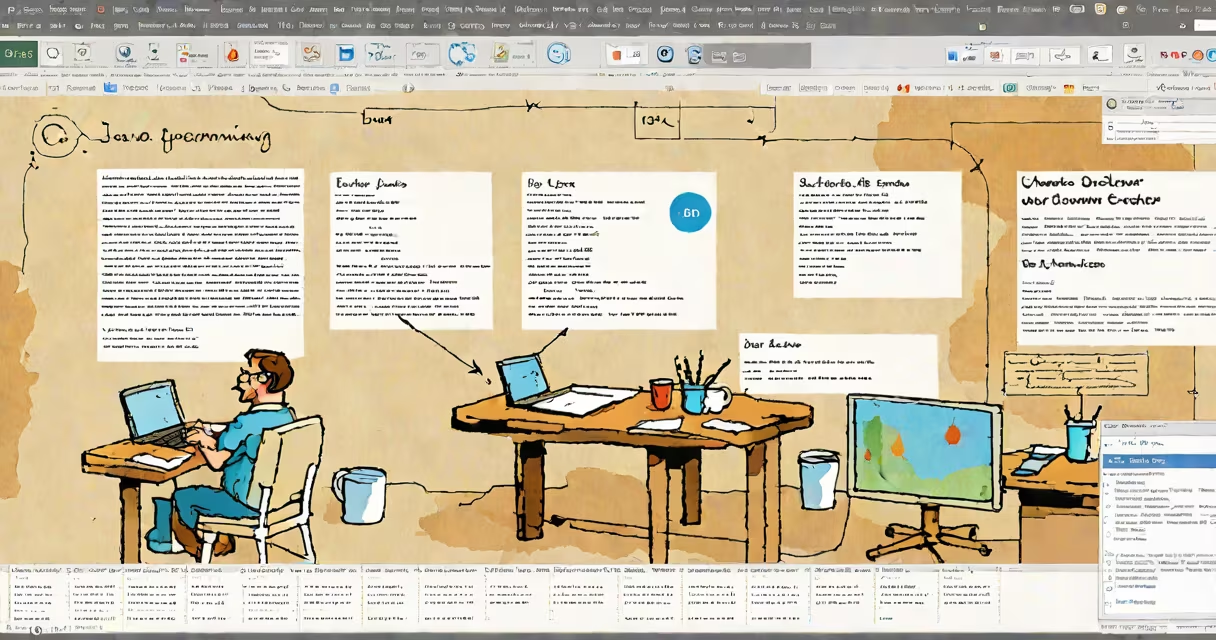
A free Java programming course teaches the fundamentals of Java syntax, object-oriented principles, and practical application development using structured lessons, hands-on coding exercises, and project-based learning-all accessible at no cost.
Java is a high-level, class-based, object-oriented programming language designed to run on any device with a Java Virtual Machine (JVM). A free Java programming course introduces learners to core concepts such as variables, data types, control structures (like if-else and loops), methods, classes, and inheritance. These courses typically begin with basic syntax and gradually build toward creating functional programs, such as a calculator or a simple game.
Most free Java programming courses follow a modular structure. Lessons start with theory-explaining how a feature works-then move into practice. For example, a lesson on loops might first explain the difference between for and while loops, then ask the learner to write a program that prints numbers from 1 to 100 divisible by 7. The course environment often includes an embedded code editor that runs code instantly and provides feedback on errors.
Platforms like Coursera, edX, and freeCodeCamp host free Java programming courses developed by universities and tech organizations. Some include video lectures, quizzes, peer-reviewed assignments, and community forums. Others offer only interactive coding challenges with minimal explanation.
Free Java programming courses vary in format, depth, and target audience. They fall into three main categories based on delivery style and learning goals:
| Type | Best For | Example Platform | Key Feature |
|---|---|---|---|
| University-Backed | Structured learning, academic rigor | Coursera (University of Michigan) | Full semester curriculum, graded assignments |
| Interactive Coding Platforms | Beginners who learn by doing | freeCodeCamp.org | Hands-on coding with instant feedback |
| Self-Paced Video Tutorials | Flexible schedules, visual learners | YouTube (e.g., Programming with Mosh) | Step-by-step walkthroughs, downloadable code |
University-backed courses often require signing up for a free account and may offer a certificate upon completion. Interactive platforms like freeCodeCamp focus on completing small projects-such as building a command-line inventory system-to reinforce learning. Self-paced video tutorials allow viewers to pause, rewind, and apply code snippets in their own IDE.
These courses serve individuals entering software development, students preparing for computer science degrees, and hobbyists exploring automation or app creation. Java remains widely used in enterprise applications, Android app development, and backend systems. According to Oracle's 2023 Developer Survey, Java ranks among the top five most-used languages globally, with over 10 million developers actively using it.
For example, a high school student in Texas used a free Java programming course on freeCodeCamp to build a text-based adventure game. After completing the course, they submitted the project to a local hackathon and won second place. The course included 15 hours of interactive coding, covering topics like conditional logic, arrays, and file input/output.
Many employers value demonstrable skills over formal credentials. A free Java programming course can provide the foundation needed to contribute to open-source projects or land internships. Companies like Google and Amazon list Java proficiency as a preferred skill for entry-level software engineering roles.
One widespread misunderstanding is that free Java programming courses lack depth or credibility. This is incorrect. Many free courses are developed by institutions like Stanford, MIT, and IBM. For example, the "Java Programming: Solving Problems with Software" course on Coursera-taught by professors from Duke University-is rated 4.8 out of 5 by over 120,000 learners and includes weekly programming assignments graded by peers.
Another misconception is that Java is outdated. While newer languages like Python and JavaScript dominate web development, Java maintains strong relevance in large-scale systems. The Spring Structure, used by 70% of Fortune 500 companies, is built on Java. A free Java programming course that covers Spring Boot basics gives learners access to industry-standard tools.
Some learners assume they need prior coding experience. This is not true. Most free Java programming courses start from scratch. A beginner can begin with basic variable declarations-like int age = 25;-and progress to writing functions that return values. The key is consistent practice, not prior knowledge.
I completed a free Java programming course on freeCodeCamp during a weekend retreat. The course required no installation-everything ran in the browser. By the third day, I had written a program that simulated a bank account with deposit, withdraw, and balance-check functions. The course didn't just teach syntax-it emphasized problem-solving: breaking tasks into steps, testing edge cases, and debugging errors.
After finishing, I applied the same logic to automate a personal expense tracker using Java and a CSV file. The program read spending entries, calculated monthly totals, and flagged expenses above a set threshold. It ran reliably on my laptop without needing cloud services or databases.
This experience showed me that free Java programming courses aren't just theoretical-they produce usable tools. The course taught me to think like a developer, not just memorize commands.
Let's walk through a simple task from a typical free Java programming course:
public class AverageScore {
    public static void main(String[] args) {
        int score1 = 85;
        int score2 = 92;
        int score3 = 78;
        int score4 = 96;
        int score5 = 88;

        double average = (score1 + score2 + score3 + score4 + score5) / 5.0;

        System.out.printf("Average score: %.2f%n", average);
    }
}Average score: 88.20This example demonstrates how a free Java programming course builds confidence through small, achievable tasks. Each step reinforces understanding of variables, arithmetic operations, and formatted output.
Free Java programming courses remain a valid and effective path to learning one of the most enduring programming languages. With consistent effort and the right resource, anyone can develop skills that lead to real-world applications and career opportunities.