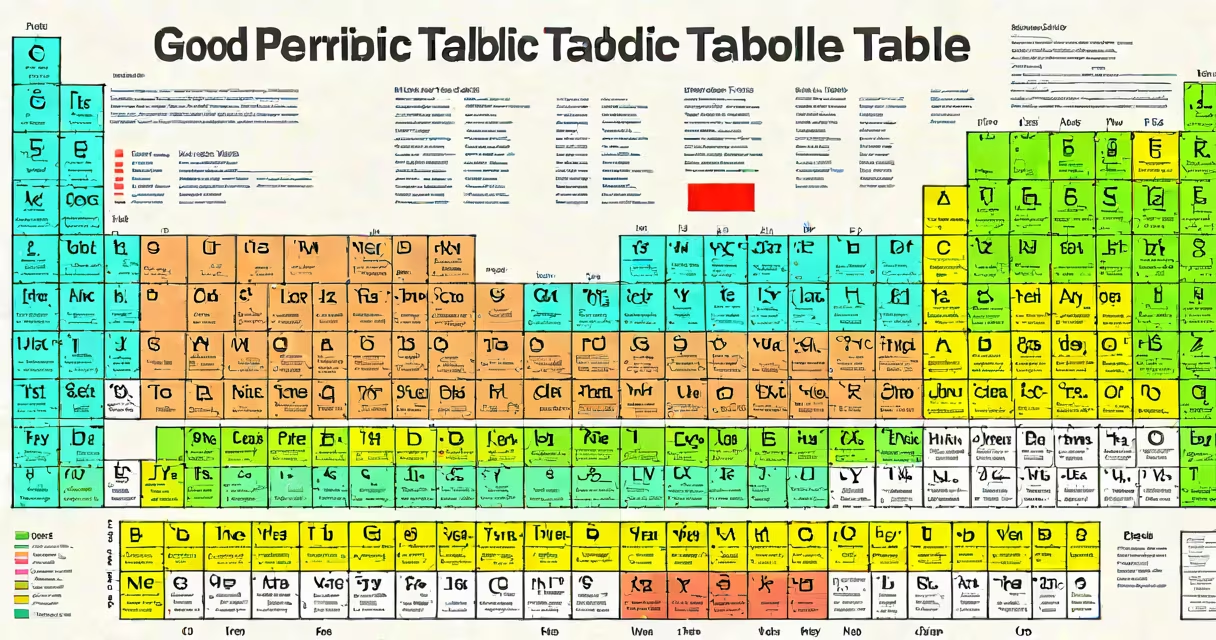
A good periodic table arranges elements by increasing atomic number, groups them by similar chemical behavior, and displays key physical and electronic properties. It serves as a foundational reference in chemistry, enabling prediction of element reactivity, bonding patterns, and material behavior.
Modern science relies on accurate periodic tables to model atomic structure and support research in materials science, pharmaceuticals, and environmental analysis. A well-designed version includes electron configurations, electronegativity values, and oxidation states-features absent in basic or outdated versions.
The International Union of Pure and Applied Chemistry (IUPAC) standardizes element symbols and atomic weights. A good periodic table reflects these standards, ensuring consistency across educational institutions and laboratories worldwide.
Elements are ordered left to right and top to bottom based on atomic number-the number of protons in the nucleus. This arrangement reveals periodic trends: ionization energy increases across a period, while atomic radius decreases. Electronegativity peaks in the upper right (fluorine), and metallic character declines toward the same region.
Vertical columns (groups) share valence electron counts. Group 1 elements (alkali metals) have one valence electron and form +1 ions. Group 17 (halogens) have seven valence electrons and gain one electron to achieve stability. These patterns allow chemists to predict bond formation and reaction outcomes.
Horizontal rows (periods) reflect increasing principal quantum numbers. As each period begins, a new electron shell fills. Transition metals in Period 4 (e.g., iron, copper) fill d-orbitals, leading to variable oxidation states and catalytic activity.
Accuracy in atomic mass, electron configuration, and group assignment separates a good periodic table from a flawed one. For example, the atomic weight of chlorine is 35.45-not 35 or 36-and using a rounded value distorts stoichiometric calculations.
Color-coding enhances usability. Most reputable tables assign colors to categories: alkali metals (red), alkaline earth (orange), transition metals (blue), halogens (green), noble gases (purple). This visual cue helps students identify element families quickly.
Some tables include additional data: melting points, densities, and common compounds. A high-quality version may list isotopes or show rare-earth elements with notes on extraction challenges. The Royal Society of Chemistry's online table includes clickable entries linking to detailed profiles.
| Type | Features | Best For |
|---|---|---|
| Standard | Atomic number, symbol, name, atomic mass | Classroom basics |
| Extended | Electronegativity, electron configuration, phase at room temp | High school and college courses |
| Interactive | Clickable elements, 3D orbital views, real-time data updates | Research, advanced study |
One underappreciated feature is consistent formatting. Misaligned group labels or inconsistent decimal places in atomic masses cause confusion. A good table uses uniform font size, spacing, and alignment-critical when comparing multiple elements side-by-side.
Many assume the periodic table is static. In reality, it evolves. Elements 113 (nihonium), 115 (moscovium), 117 (tennessine), and 118 (oganesson) were added between 2016 and 2017 after confirmation by IUPAC. Older tables omit them entirely.
Another error: treating the periodic table as purely alphabetical. It's not. Hydrogen sits above lithium despite having lower atomic number. Its placement reflects unique behavior-it forms covalent bonds like carbon and can lose or gain an electron, unlike typical metals.
Some users confuse "group" with "period." Groups are vertical columns (e.g., Group 1 = Li, Na, K); periods are horizontal rows (e.g., Period 2 = Li to Ne). Mixing these leads to incorrect predictions about reactivity.
In drug development, chemists use periodic tables to design molecules with specific electronic properties. For instance, replacing hydrogen with fluorine in a compound can increase metabolic stability. Fluorine's high electronegativity alters electron distribution, reducing susceptibility to oxidative breakdown.
Consider ibuprofen synthesis. The molecule contains carbon, hydrogen, oxygen, and a benzene ring. Using a good periodic table, a student identifies that carbon's tetravalency allows four bonds, oxygen's high electronegativity creates polar bonds, and hydrogen's low atomic mass affects molecular vibrational modes.
When calculating molar mass: - Carbon (C): 12.01 g/mol × 13 atoms = 156.13 g/mol - Hydrogen (H): 1.008 g/mol × 22 atoms = 22.176 g/mol - Oxygen (O): 16.00 g/mol × 2 atoms = 32.00 g/mol Total: 210.306 g/mol
Without a correct periodic table, this sum would be off by 0.5% or more-enough to invalidate lab results.
I once used a hand-drawn table during a high school lab. It listed sodium's atomic mass as 23.0 instead of 22.99. The resulting percent yield calculation was 97.3%, but correcting the mass dropped it to 96.8%. Small errors compound in multi-step processes.
Reputable sources include the Royal Society of Chemistry's interactive table and the National Institute of Standards and Technology (NIST) database. Both update atomic weights annually based on new isotope measurements.
For educators, the American Chemical Society offers free downloadable PDFs with curriculum-aligned annotations. These include teaching tips and common student misconceptions.
Online tools like the G in periodic table guide explain how certain elements behave in reactions involving nitrogen or sulfur. They're useful for students preparing for AP Chemistry exams.
When selecting a printed version, verify that it cites IUPAC's 2021 recommendations. Avoid editions that label francium as "rare" without noting its radioactivity and half-life of 22 minutes-critical context for understanding its instability.
A good periodic table is not just a chart-it's a predictive tool, a learning aid, and a scientific standard. It enables accurate communication across disciplines and ensures consistency in global research. Always verify your source against IUPAC and NIST guidelines.