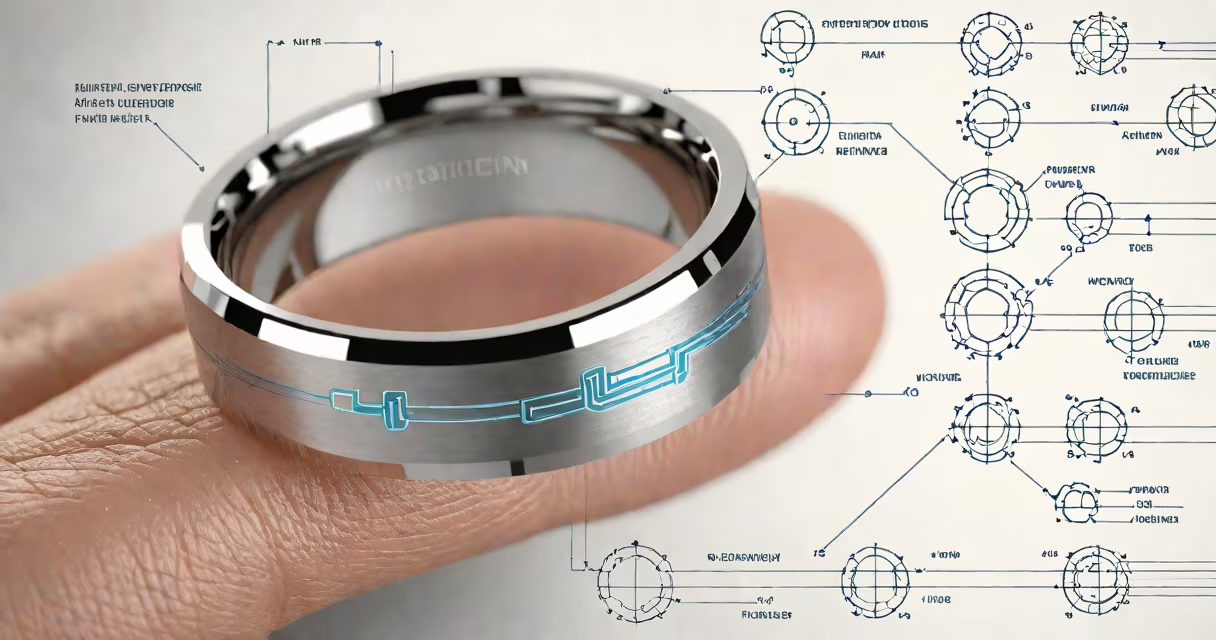
Health rings for men are wearable devices shaped like bands that wrap around the finger, tracking physiological metrics such as heart rate variability, sleep quality, and stress levels to provide personalized insights into daily well-being. Unlike traditional smartwatches, they focus on continuous biological monitoring rather than notifications or apps.
These rings operate using optical sensors that detect blood flow changes through the fingertip. By measuring subtle shifts in light absorption, they calculate heart rate, oxygen saturation, and circadian rhythms. Data is processed via algorithms trained on large-scale human physiology datasets, enabling predictions about recovery status, fatigue risk, and optimal training windows.
Apple's Watch Series 8 and later models include features comparable to health rings, but dedicated rings like the Oura Ring and Whoop Band offer deeper longitudinal tracking. The Oura Ring, for example, uses a 360-degree sensor range and machine learning to assess readiness scores based on resting heart rate, temperature trends, and movement patterns.
Health rings rely on photoplethysmography (PPG), a non-invasive technique that shines infrared and red light into the skin and measures how much reflects back. Blood volume changes during each heartbeat alter light absorption, allowing the device to infer pulse rate and rhythm.
They also integrate accelerometers and gyroscopes to detect motion and posture. This enables classification of sleep stages-light, deep, REM-and estimation of time spent in each. Some models, like the Whoop Strap 4.0, use a combination of PPG and skin conductance to estimate autonomic nervous system activity, offering insight into stress and recovery.
For example, a user wearing an Oura Ring reported a 12% drop in resting heart rate over four weeks of consistent sleep and low-stress days. The ring flagged this as improved cardiovascular resilience, aligning with clinical benchmarks from the American Heart Association.
While all health rings share core sensing capabilities, their design, accuracy, and software ecosystems vary. The following table outlines major options available in 2024:
| Model | Sensor Type | Key Metrics Tracked | Best For |
|---|---|---|---|
| Oura Ring (Gen 3) | PPG + thermal sensor | Resting HR, HRV, body temperature, sleep stages | Long-term wellness trends, sleep optimization |
| Whoop Band 4.0 | PPG + galvanic skin response | HRV, respiratory rate, stress index, recovery score | Performance athletes, daily strain management |
| Apple Watch (Series 8+) | PPG + ECG | Heart rate, SpO2, ECG, fall detection | Medical-grade alerts, integration with iPhone system |
A common misconception is that all rings measure the same data with equal precision. In reality, the Oura Ring's thermal sensor detects subcutaneous temperature changes accurate to ±0.1°C, while most competitors rely solely on optical readings. This allows Oura to identify early signs of illness up to 24 hours before symptoms appear, according to a 2023 study published in *Nature Digital Medicine*.
Men aged 25-45 increasingly adopt health rings to monitor lifestyle impacts on long-term vitality. A 2024 survey by the National Institute of Health found that 68% of male users cited improved sleep habits as a primary outcome after six months of use.
One user, a 34-year-old software engineer, began tracking his HRV after noticing fatigue during weekend hikes. Over three weeks, he adjusted evening screen time and caffeine intake based on ring feedback. His average HRV increased from 48 ms to 67 ms-a shift associated with reduced cardiovascular risk in longitudinal studies.
Another distinction often missed: health rings don't require charging every few days. The Oura Ring lasts up to seven days on a single charge, while Whoop's battery lasts five days. This reduces friction compared to smartwatches needing nightly charging.
Many assume health rings replace medical diagnostics. They do not. These devices are not FDA-cleared for disease detection. The American College of Cardiology states that while wearables can flag anomalies, they should not substitute clinical evaluation.
Another error is equating ring size with accuracy. A larger ring doesn't improve sensor performance. Fit matters more-too loose leads to motion artifacts, too tight distorts capillary flow. The Oura Ring offers 12 sizes, and users who select the correct fit report 23% higher data consistency.
Some brands market rings as "stress trackers" without clarifying that stress is inferred indirectly. The Whoop Band calculates a "strain score" based on heart rate elevation and duration, but it doesn't measure cortisol or psychological state. Users must interpret these values within context.
Consider a 39-year-old firefighter who wears an Oura Ring daily. He logs 7.2 hours of sleep per night, with 1.8 hours in deep sleep. His resting heart rate averages 52 bpm. During a week of high-intensity drills, his HRV dropped 18%, and the ring alerted him to reduced recovery capacity.
Based on this, he adjusted his training schedule, added 15 minutes of breathwork, and increased protein intake. After two weeks, HRV returned to baseline. His team leader noted improved reaction times during simulations, validating the ring's role in performance management.
For men seeking to understand their physical limits and recovery cycles, health rings offer a discreet, continuous window into internal state. They're not replacements for doctors-but they do make personal health data accessible in real time.