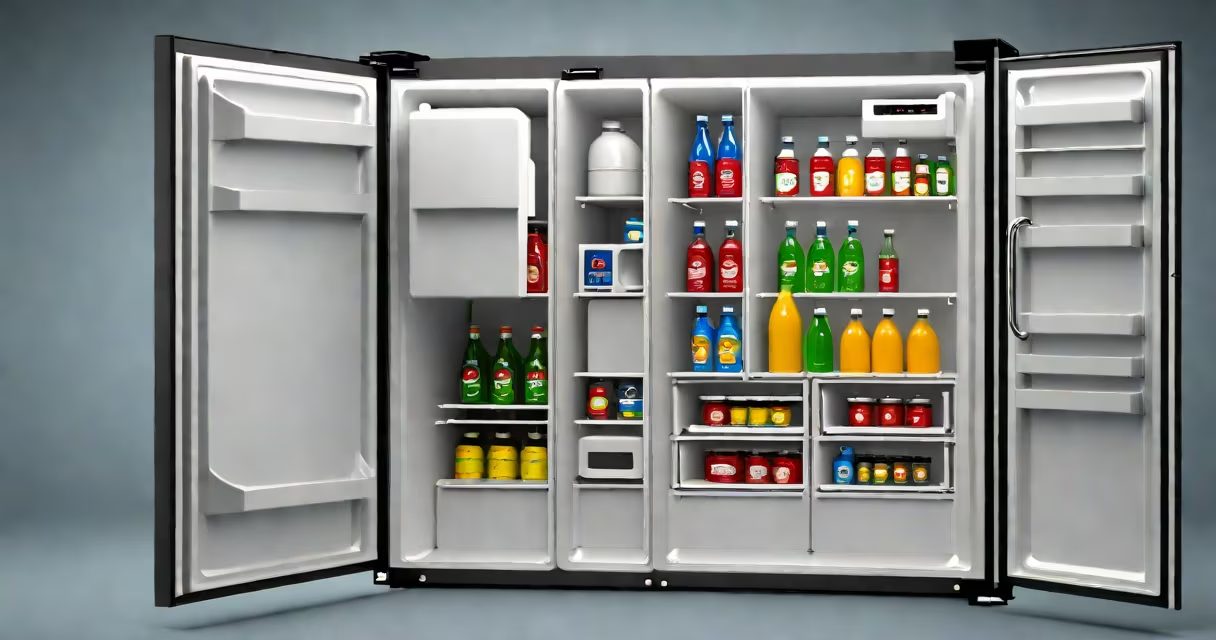
A refrigerator maintains cold temperatures inside by moving heat from its interior to the external environment using a closed-loop system powered by a compressor and a circulating refrigerant. This process relies on the principles of thermodynamics and phase change, specifically the evaporation and condensation of a fluid under pressure.
The core mechanism is the vapor-compression refrigeration cycle. A refrigerant-typically a hydrofluorocarbon like R-134a-circulates through sealed tubes. As it changes state from liquid to gas and back, it absorbs heat inside the fridge and releases it outside. The cycle repeats continuously to sustain low internal temperatures.
Refrigerators don't create cold-they remove heat. The compressor pressurizes the gaseous refrigerant, raising its temperature. This hot, high-pressure gas flows into the condenser coils on the back or bottom of the unit, where it releases heat to the room and condenses into a liquid. The liquid then passes through an expansion valve, which reduces pressure and causes rapid cooling. The cold liquid enters the evaporator coils inside the fridge, where it absorbs heat from the air and food, turning back into a gas. The cycle completes as the gas returns to the compressor.
The refrigerator's operation depends on four essential parts: the compressor, condenser, expansion valve, and evaporator. Each plays a distinct role in managing energy transfer.
The compressor is the engine of the system. Located at the back or bottom, it draws in low-pressure refrigerant vapor and compresses it into a high-pressure, high-temperature gas. Modern compressors are hermetically sealed and run on alternating current (AC) power. They consume roughly 100-200 watts during operation, depending on size and efficiency rating.
The condenser consists of metal coils often visible on the back or side of the appliance. As the hot refrigerant gas flows through these coils, it loses thermal energy to the surrounding air. Fans may assist airflow to speed up heat dissipation. The condenser converts the gas back into a liquid, completing the heat rejection phase.
The expansion valve controls the flow of liquid refrigerant into the evaporator. It reduces pressure suddenly, causing the refrigerant to flash into a low-pressure mist. This phase change triggers intense cooling-similar to how sweat cools skin when it evaporates. The valve is calibrated to maintain precise flow based on load and ambient conditions.
The evaporator sits inside the fridge compartment, usually behind the rear panel. Cold refrigerant absorbs heat from the air and stored items, lowering their temperature. As it absorbs heat, the refrigerant turns into a gas. A fan circulates air over the evaporator coils to distribute cool air evenly. Without proper airflow, cold spots form and efficiency drops.
| Component | Function | Typical Location | Energy State Change |
|---|---|---|---|
| Compressor | Pressurizes refrigerant gas | Back or bottom of unit | Gas → High-pressure gas |
| Condenser | Releases heat to room | Back or sides | High-pressure gas → Liquid |
| Expansion valve | Reduces pressure and cools fluid | Between condenser and evaporator | Liquid → Low-pressure mist |
| Evaporator | Absorbs heat from fridge interior | Inside fridge, behind wall panels | Low-pressure liquid → Gas |
Heat transfer alone cannot move thermal energy against a temperature gradient. To pull heat from a cold space (inside the fridge) to a warmer one (outside), work must be done. The refrigerant's phase change enables this by storing large amounts of energy during evaporation and releasing it during condensation.
For example, R-134a absorbs about 160 kJ/kg of heat when it evaporates at -20°C. That's nearly 10 times more than water vaporizing at 100°C (2257 kJ/kg), but at much lower temperatures. This makes it ideal for cooling applications below freezing.
Without phase change, cooling would require massive amounts of electrical energy. Instead, the refrigerant acts as a carrier, transferring heat efficiently. A typical household refrigerator uses 100-300 watts while maintaining an internal temperature of 4°C (39°F).
Many assume that the freezer compartment is colder because it's "freezing," but the actual cooling happens in the evaporator, which is located in both the fridge and freezer sections. The freezer is colder simply because the thermostat sets a lower temperature threshold.
A frequent error is blocking airflow around the condenser coils. Dust buildup or placing the fridge too close to a wall restricts heat dissipation. This forces the compressor to run longer, increasing energy use by up to 30%. Cleaning the coils every six months improves efficiency and extends lifespan.
Another misunderstanding: people think the refrigerator runs constantly. In reality, a thermostat cycles the compressor on and off. A standard model cycles every 10-20 minutes, depending on door openings and load. Running continuously indicates a fault-such as a failing compressor or blocked airflow.
I once diagnosed a refrigerator that wouldn't cool despite the compressor running. After checking voltage and pressure, I found a clogged expansion valve. Replacing it restored function. The issue wasn't the compressor-it was the flow control.
Traditional refrigerants like R-134a have a high global warming potential (GWP). The U.S. Environmental Protection Agency (EPA) regulates their use under the Clean Air Act. Newer models use R-600a (isobutane), which has a GWP of 3-far lower than R-134a's 1,430.
Energy Star-rated refrigerators use 15-20% less electricity than older models. For example, a 2023 Energy Star-certified 18-cubic-foot model consumes about 350 kWh/year-about 1.5 kWh per day. Older units from the 1990s used over 1,000 kWh annually.
Some commercial units use absorption refrigeration, which uses heat instead of a mechanical compressor. These systems rely on ammonia-water mixtures and are common in RVs and remote installations. However, they're less efficient and not used in standard home fridges.
Understanding how a refrigerator works reveals that it's not magic-it's physics. The vapor-compression cycle, governed by thermodynamic laws, moves heat using controlled phase changes. Knowing this helps diagnose issues, improve efficiency, and make informed choices when replacing appliances.