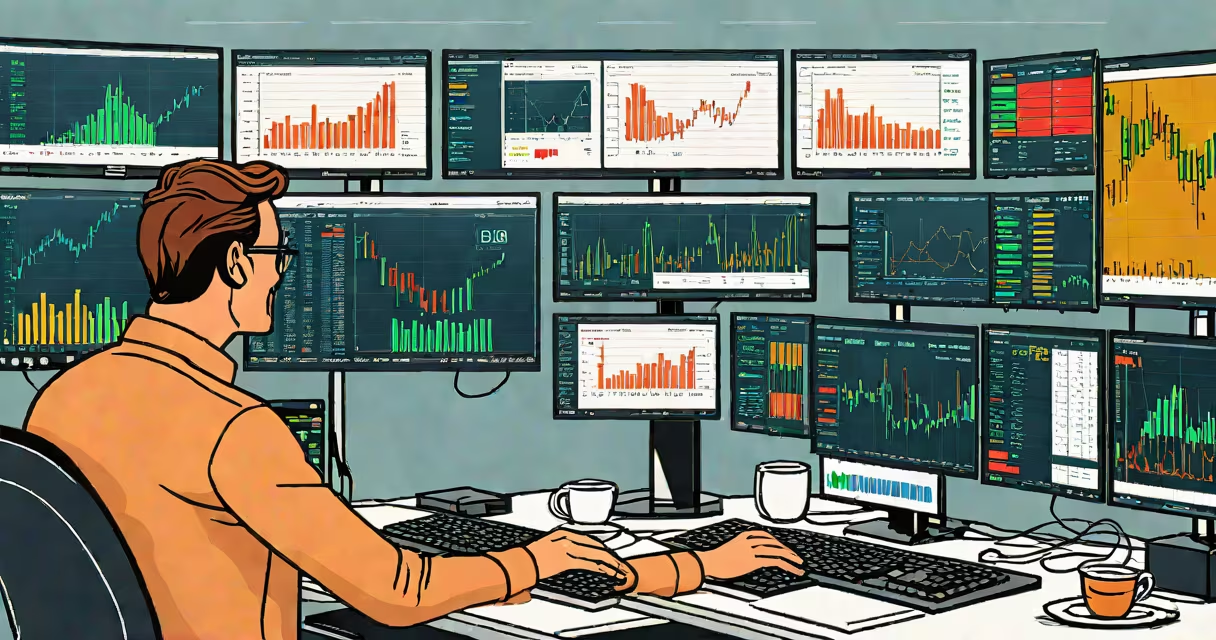
Learning to trade means developing the skills to buy and sell financial assets-like stocks, options, or currencies-with the goal of making consistent profits while managing risk. It requires understanding market behavior, setting rules for entry and exit, and practicing disciplined decision-making.
Trading is not gambling. It's a structured activity based on analysis, strategy, and emotional control. Traders use technical indicators, price patterns, news events, and economic data to make informed choices. Success depends less on predicting the future and more on executing a repeatable process under uncertainty.
The core idea is risk-adjusted returns: aiming for gains that outweigh losses over time. A single winning trade doesn't define success. Consistency matters more than big wins. Even professional traders lose 40% of their trades in a year-what separates them is strict adherence to their edge.
When you trade, you're entering a contract to exchange an asset for cash-or vice versa-based on current prices. Prices move due to supply and demand, which respond to information: earnings reports, interest rate changes, geopolitical events, or shifts in investor sentiment.
For example, if a company announces stronger-than-expected quarterly results, its stock price may rise within minutes. Traders who bought before the announcement profit. Those who sold short may lose money. The market reacts instantly to new facts.
Every trade has two sides: one buyer and one seller. Markets exist because people disagree on value. Your job as a trader is to identify mispricings-when the market hasn't yet reflected new information-and act early enough to benefit.
You need four things: a brokerage account, capital, education, and a plan. Brokerages provide access to markets. Most U.S. brokers require $250 minimum to open a margin account, though many allow smaller deposits for paper trading.
Capital is not the most important factor. Discipline is. Many beginners lose money not because they lack funds, but because they don't set stop-losses or follow their strategy. One study found that 70% of retail traders fail within the first two years-not due to bad markets, but poor habits.
Education begins with learning how to read charts, understand volume, and interpret moving averages. Use free tools like Yahoo Finance, TradingView, or Investopedia's tutorials. Practice with a demo account until you can explain why each trade was taken.
There are four main styles, each with different timeframes and goals:
| Type | Timeframe | Goal | Example |
|---|---|---|---|
| Day trading | Minutes to hours | Profit from intraday volatility | Selling a stock after a 2% spike caused by a news leak |
| Swing trading | Days to weeks | Capture medium-term trends | Buying a tech stock after a pullback, holding for 5 days |
| Position trading | Weeks to months | Follow macroeconomic trends | Holding gold futures during inflation spikes |
| Scalping | Seconds to minutes | Make small profits repeatedly | Executing 20 trades per day with 0.1% average gain |
Most beginners start with swing trading. It balances time commitment and opportunity. Day trading demands constant attention and carries higher risk of emotional fatigue. Scalping requires advanced tools and fast execution-often unavailable to retail traders.
A common mistake is jumping into high-frequency styles too soon. One trader I observed lost 60% of his account in six weeks trying to scalp penny stocks. He didn't understand bid-ask spreads or slippage. His strategy failed not because the market moved against him-but because he didn't account for transaction costs.
Many think trading is about picking winners. It's not. It's about probability and position sizing. The best traders don't predict correctly 80% of the time-they manage risk so well that losing trades don't destroy their accounts.
Another myth: "I'll wait for the perfect entry." That leads to missed opportunities. The market doesn't pause for perfection. Instead, successful traders define their criteria in advance-e.g., "Buy if RSI is below 30 and volume increases by 50%." They stick to the rule, even when emotions say otherwise.
Some confuse trading with investing. Investors hold assets for years, relying on fundamentals like earnings growth. Traders focus on price action and timing. You can trade stocks, but you don't have to own them long. Holding for dividends isn't part of the strategy.
In March 2023, Tesla's stock dropped 12% in two days after Elon Musk announced plans to cut staff at Twitter. A swing trader noticed the price fell below the 20-day moving average and volume spiked. They waited for confirmation: the next day, the stock bounced 4% on higher volume.
They entered a long position at $185, set a stop-loss at $178 (6% below entry), and took profit at $198 (7% above). The trade lasted five days. Net gain: 7%. Risk: 6%. Reward-to-risk ratio: 1.17.
This wasn't luck. The trader had reviewed 15 similar setups over the past month. They knew that after a sharp drop driven by news, the stock often retraced 50-70% of the move within five days. This trade fit the pattern.
Even if the trade had failed, the loss would have been capped. That's how consistency is built-not by avoiding losses, but by controlling them.
Learning to trade is not about getting rich quickly. It's about building a repeatable system that generates positive returns over time. Focus on process, not outcomes. Track every trade: entry, exit, reason, emotion.
Use tools like Excel or free platforms such as TradingView to log results. After 30 trades, analyze win rate, average gain/loss, and drawdowns. Adjust your strategy based on data, not feelings.