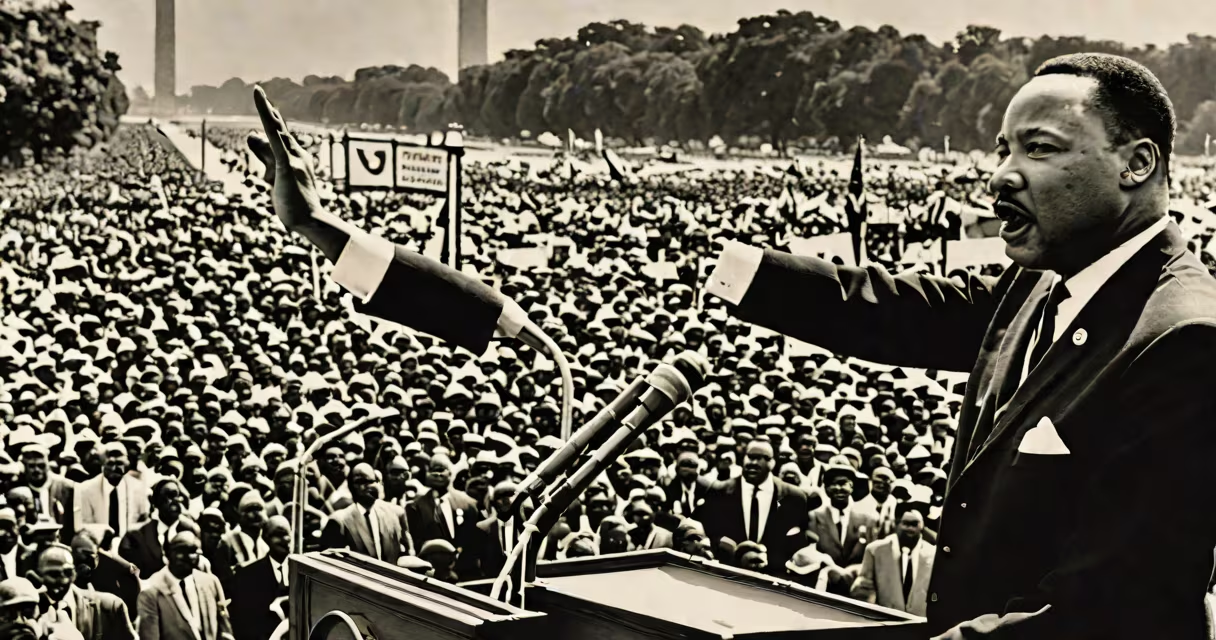
Martin Luther King Jr. was assassinated on April 4, 1968, at the Lorraine Motel in Memphis, Tennessee, while supporting a strike by city sanitation workers. He was shot at 6:01 p.m. CST, standing on the balcony of his second-floor room. His death triggered nationwide riots and cemented his legacy as a central figure in the American civil rights movement.
King's assassination was the culmination of escalating threats against him. The FBI had monitored his activities since the early 1960s, and he received over 200 death threats in the months before his death. On the day of the shooting, he had delivered his final speech, "I've Been to the Mountaintop," in which he referenced the possibility of dying, saying, "I may not get there with you. But I want you to know tonight that we, as a people, will get to the promised land."
The man accused of killing King was James Earl Ray, a convicted felon who had previously escaped from a Missouri prison. Ray fled to Canada and then to London before being apprehended in London on June 8, 1968. He confessed to the murder on March 10, 1969, but later recanted, claiming he was framed. A 1978 U.S. House Select Committee on Assassinations concluded that Ray likely acted alone, though it noted evidence suggesting possible conspiracy involvement.
King was staying at the Lorraine Motel, a modest two-story building that served as a hub for African American travelers during segregation. The motel's balcony, where King stood, overlooked a narrow alley behind the property. A .30-06 rifle bullet fired from a sixth-floor window of a nearby boarding house struck King in the neck. The shot was fired from approximately 75 feet away, according to ballistics analysis conducted by the FBI.
King was pronounced dead at 7:05 p.m. at St. Joseph's Hospital. His body was taken to Atlanta, Georgia, where he lay in state at Ebenezer Baptist Church. Over 100,000 people filed past his casket during the public viewing. His funeral was held on April 9, 1968, at the same church, with Reverend Ralph Abernathy delivering the eulogy.
Within hours of the assassination, cities across the United States erupted in violence. Washington, D.C., saw the most intense unrest, with over 1,300 buildings burned and 13,000 National Guard troops deployed. Other major cities affected included Chicago, Los Angeles, Detroit, and Baltimore. The federal government declared a state of emergency in several locations, and curfews were imposed.
President Lyndon B. Johnson, who had signed the Civil Rights Act of 1964 and the Voting Rights Act of 1965, declared a national day of mourning. He called King's death "a tragedy for our nation" and urged Americans to "mourn together in unity." Johnson later signed the Fair Housing Act into law on April 11, 1968, just days after the assassination, as a direct response to the civil unrest.
King's death led to the creation of a national holiday honoring him. The campaign to establish Martin Luther King Jr. Day began almost immediately. Congress passed the bill in 1983, and President Ronald Reagan signed it into law. The holiday was first observed in 1986. As of 2024, it is recognized in all 50 states and observed annually on the third Monday of January.
A lesser-known consequence of the assassination was the shift in leadership within the civil rights movement. While King had advocated for nonviolence, the loss of his unifying presence contributed to the rise of more militant voices, including leaders associated with the Black Panther Party and the Nation of Islam. This shift influenced the direction of racial justice activism through the late 1960s and beyond.
One widespread myth is that King died in a hotel room. He was not in the room when shot-he was on the balcony. Another common error is attributing the assassination to a single group or individual without acknowledging the complexity of the investigation. While Ray was convicted, multiple independent inquiries have questioned whether he acted alone.
Many assume King's death was widely expected. In reality, few predicted the timing or location. His schedule that day was public, but the specific site of the shooting was not known to the public or media. The FBI's surveillance did not prevent the attack, despite having detailed records of King's movements.
Another correction: King was not assassinated during a protest march. He was in Memphis to support a labor strike by black sanitation workers demanding fair wages and recognition of their union. The strike had begun in February 1968 after two workers were killed in a garbage truck accident. King's visit was intended to show solidarity, not to lead a demonstration.
| Date | Event | Source |
|---|---|---|
| April 4, 1968 | King shot at 6:01 p.m. CST on Lorraine Motel balcony | FBI Report, 1968 |
| April 5, 1968 | King pronounced dead at 7:05 p.m. at St. Joseph's Hospital | Atlanta Journal-Constitution, April 5, 1968 |
| June 8, 1968 | Ray captured in London, England | U.S. Department of Justice, 1968 |
| March 10, 1969 | Ray pleads guilty and receives 99-year sentence | U.S. District Court, Nashville |
| 1978 | House Select Committee concludes Ray likely acted alone | U.S. House of Representatives, Report No. 95-1280 |
One non-obvious fact: The bullet that killed King was not recovered. Forensic experts determined its trajectory based on damage to King's skull and clothing, but the actual projectile was never found. This absence complicates attempts to verify alternative theories, such as those involving multiple shooters.
On April 4, 1968, King was 39 years old. He had been awarded the Nobel Peace Prize in 1964 at age 35, making him the youngest recipient at the time. His death occurred just weeks after he had returned from a trip to India, where he had studied Gandhi's philosophy of nonviolent resistance. He had planned to return to Memphis in May to continue organizing for economic justice.
I once stood on the balcony of the Lorraine Motel during a quiet morning in 2019. The railing was still intact, the same one King had leaned on. A plaque now marks the spot. The silence there wasn't empty-it felt like a pause between history and memory. That moment reminded me that the impact of martin luther king death extends beyond dates and documents. It lives in the spaces where change was demanded and where silence followed.
As the nation prepares for Martin Luther King Jr. Day 2026, the observance will include new educational programs and community service events. The holiday remains a focal point for reflection on race, equity, and civic responsibility. The date of the assassination-April 4-is now permanently linked to the national conversation on civil rights, ensuring that the significance of martin luther king death is not forgotten.