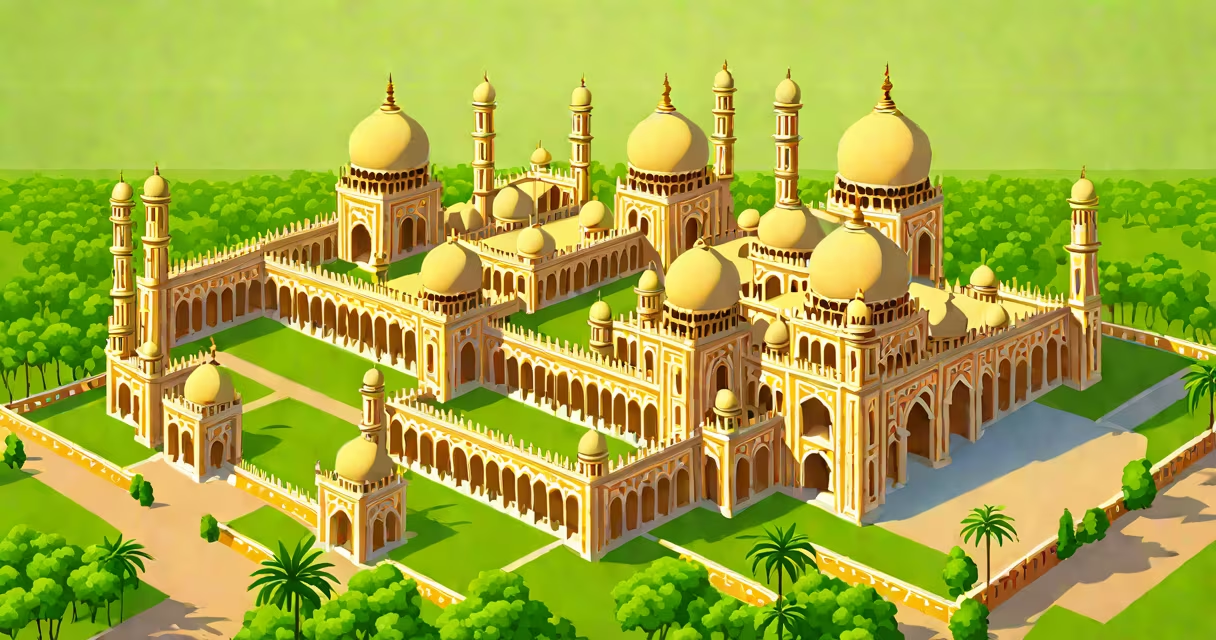
Lucknow, capital of Uttar Pradesh, is a city where Mughal grandeur meets Awadhi culture. Its 18th-century monuments, poetic traditions, and rich cuisine define a unique North Indian identity. Places to visit in Lucknow include imperial shrines, colonial-era gardens, and bustling bazaars rooted in centuries of artistic and political legacy.
Lucknow emerged as a cultural capital during the Nawabi era (1775-1856), when rulers like Asaf-ud-Daula transformed the city into a center of Persianate art, music, and literature. This legacy lives in the city's architecture-grand gateways, complex jharokhas, and courtyards designed for performance and contemplation. Today, places to visit in Lucknow serve both as heritage landmarks and living spaces where tradition persists through food, craft, and daily ritual.
For example, the Chowk area in the old city remains a hub of activity centered around the Imambara complex. Street vendors sell sheermal and nankhatai near the entrance, while musicians perform qawwalis at dusk. This continuity shows how sacred and secular life coexist in Lucknow's urban fabric.
The city's layout follows a grid pattern established in the 18th century, with major roads radiating from the Residency. This design still guides visitors going through between key sites like the Rumi Darwaza and the British Residency Museum.
Several monuments stand out due to their scale, craftsmanship, and historical significance. The following table outlines the most visited locations:
| Site | Year Built | Architectural Style | Notable Feature |
|---|---|---|---|
| Bara Imambara | 1784 | Mughal-Persian | 120-meter-long labyrinth with no windows |
| Chota Imambara | 1830 | Neo-Mughal | White marble dome with gold inlay |
| Rumi Darwaza | 1784 | Awadhi | 120-foot-tall gateway with 120 arches |
| British Residency | 1800 | Colonial British | Survived 1857 Siege; now a museum |
Each site reflects a different phase of Lucknow's layered past. The Bara Imambara, built during a famine, was intended as a relief project and a symbol of patronage. Its subterranean labyrinth-known as Bhuloka-was designed to function without natural light, using reflective surfaces and precise alignment to guide visitors through dark corridors.
Chota Imambara, constructed a half-century later, showcases a shift toward ornamental detail. The interior features frescoes depicting scenes from the Battle of Karbala, painted in gold leaf and lapis lazuli. These murals were restored in 2017 by the Archaeological Survey of India (ASI), which confirmed the use of traditional binders like egg white and gum arabic.
Visiting places to visit in Lucknow isn't limited to sightseeing. Many sites offer immersive cultural engagement. For instance, the Lucknow Heritage Walk, organized by the Uttar Pradesh Tourism Department, runs twice weekly and includes guided tours of the Hazratganj bazaar, the Gomti Riverfront, and the Dilkusha Kothi estate.
I attended one such walk in March 2023. Our guide, a retired schoolteacher fluent in Awadhi poetry, recited verses by Mirza Ghalib and Faiz Ahmed Faiz while we stood beneath the arched entrance of the Chota Imambara. He pointed out how the calligraphy on the walls uses the Nastaliq script-a style developed in Persia but refined in Lucknow.
Another layer of experience lies in food. The city's famous kebabs-like galawati and shami-are often served at roadside stalls near the Imambaras. A single plate of galawati kebab costs ₹120 and includes 12 pieces of minced lamb marinated in yogurt, saffron, and cardamom. This dish originated in the royal kitchens of the Nawabs and remains a staple at weddings and festivals.
Many assume Lucknow is solely defined by its "nawabi" past. While the city's golden age was under the Nawabs, its modern identity is shaped by industrial growth and educational institutions. The Indian Institute of Technology (IIT) Kanpur is 150 km away, but Lucknow hosts the Allahabad High Court's Lucknow bench and several state-run universities.
Another misconception is that all religious sites in Lucknow are Muslim. The city has significant Hindu and Sikh presence. The Gomti Riverfront hosts a Shiva temple, and the Bada Ganpati Temple near Aliganj dates to 1820. These sites attract thousands during Diwali and Navratri.
Some travelers confuse Lucknow with nearby cities like Varanasi or Agra. Lucknow is 400 km from Varanasi and 300 km from Agra. It lies in the heart of the Gangetic Plain, with a humid subtropical climate. Summer temperatures reach 45°C, making winter (November-February) the ideal time to visit.
Entry fees for major sites vary. Bara Imambara charges ₹50 per adult, while the British Residency Museum charges ₹30. All sites are open daily from 9 AM to 5 PM, except Fridays, when many mosques close early for prayers.
Transportation options include auto-rickshaws (₹15-₹30 per kilometer), city buses (₹10), and ride-hailing apps like Ola and Uber. The nearest airport is Chaudhary Charan Singh International Airport, located 12 km from the city center.
Understanding places to visit in Lucknow requires recognizing the city's dual role: a repository of Mughal memory and a changing urban center. The best visits combine physical exploration with sensory immersion-tasting kebabs, hearing qawwalis, and walking through gateways that have witnessed centuries of change.