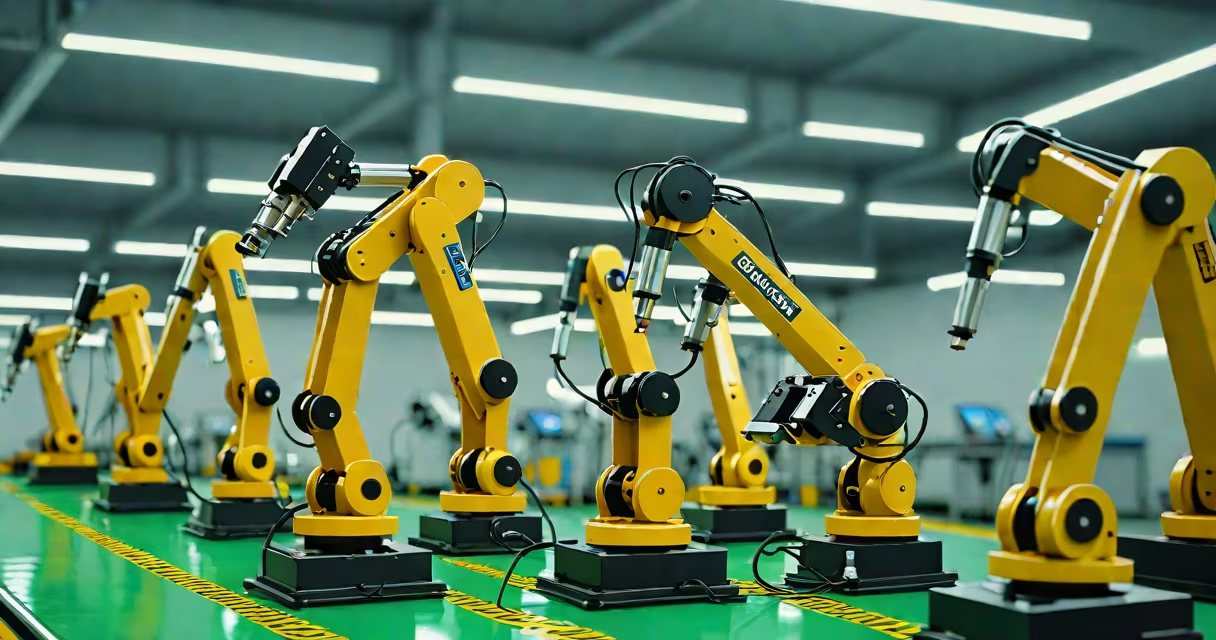
Robots in China refer to automated machines deployed across manufacturing, logistics, and service sectors, primarily in industrial settings. They perform repetitive tasks with precision, speed, and consistency, reducing labor costs and increasing output. China is the world's largest market for industrial robots, installing more units annually than any other country.
These systems operate using embedded software, sensors, and mechanical actuators. They follow programmed instructions or adapt via machine learning models trained on production data. Most industrial robots in China are articulated arms used in welding, painting, material handling, and assembly. Service robots include delivery bots, security drones, and customer interaction units in retail and hospitality.
China's adoption of robotics accelerated after 2013, when the government launched "Made in China 2025," a national strategy to upgrade manufacturing through automation and AI. By 2023, China had over 1.5 million operational industrial robots, according to the International Federation of Robotics (IFR). This number exceeds the combined total of the U.S., Japan, and Germany.
Industrial robots in Chinese factories receive commands from programmable logic controllers (PLCs) or central AI systems. A typical setup involves a robot arm mounted on a track or stationary base, equipped with grippers, welders, or spray nozzles. Sensors detect position, pressure, and temperature in real time, enabling adjustments during operation.
For example, at a smartphone assembly plant in Dongguan, a robotic arm installs camera modules onto circuit boards at a rate of 120 units per minute. The robot uses vision systems to align components within 0.05 mm tolerance. If a component is misaligned, the system triggers a rejection and logs the error for quality control.
Advanced integration allows multiple robots to coordinate on a single production line. At a Tesla Gigafactory in Shanghai, six robotic stations handle battery cell insertion, casing welding, and final testing. Data from each station feeds into a centralized monitoring dashboard, enabling predictive maintenance and real-time yield tracking.
Robots in China serve distinct roles based on function and environment. The following table outlines major categories and their usage:
| Type | Use Case | Example Location | Annual Deployment (2023) |
|---|---|---|---|
| Articulated Arms | Assembly, welding, material transfer | Shanghai automotive plants | 680,000+ |
| SCARA Robots | High-speed pick-and-place | Dongguan electronics hubs | 310,000+ |
| Mobile Robots | Warehouse logistics, internal transport | Beijing e-commerce fulfillment centers | 240,000+ |
| Service Robots | Delivery, cleaning, customer support | Shenzhen subway stations | 120,000+ |
Each type operates under different control protocols. Articulated arms rely on offline programming and teach pendants, while mobile robots use LiDAR and GPS for navigation. Service robots often integrate facial recognition and natural language processing to interact with users.
A notable example is the "Cloud Robot" deployed in Hangzhou's public libraries. These units retrieve books from shelves, scan barcodes, and deliver them to patrons via autonomous carts. Over 1,200 units were installed in 2022, reducing average retrieval time from 15 minutes to under 3 minutes.
Many assume robots in China are solely imported from Japan or Germany. In reality, domestic manufacturers like Siasun, Estun, and Epec dominate the market. In 2023, 78% of industrial robots sold in China were produced locally, according to the China Robot Industry Association.
Another misconception is that automation displaces workers en masse. While some low-skill jobs have declined, new roles in robot maintenance, programming, and system integration have emerged. A 2022 study by the National Bureau of Statistics found that for every 10 robots added per 10,000 workers, employment in advanced manufacturing rose by 3.4% over five years.
There is also confusion between industrial robots and AI-driven automation. Industrial robots execute physical tasks. AI systems analyze data, predict failures, or improve workflows. In a semiconductor fab in Xi'an, AI monitors wafer processing temperatures and adjusts robot movements in real time-this is AI-enhanced automation, not a robot acting independently.
In 2021, a car manufacturer in Chongqing replaced 45 manual welding stations with 15 robotic cells. Each robot handled three welding points per vehicle, completing the task in 47 seconds-down from 98 seconds manually. The change reduced defect rates from 2.1% to 0.4% and cut labor costs by $1.8 million annually.
The factory also integrated a cloud-based monitoring system. When a robot detected a misalignment in a door panel, it paused the line and sent an alert to maintenance staff. The issue was resolved in 12 minutes, preventing 37 defective units from being produced. Without the robot, such errors would have gone unnoticed until final inspection.
This case illustrates a key advantage: robots in China don't just replace labor-they improve quality control and reduce waste. The factory's output increased by 22% in the first year after implementation.
China plans to reach 3 million industrial robots in operation by 2025, per the Ministry of Industry and Information Technology. Growth will focus on smart factories, green manufacturing, and cross-border integration. The government offers subsidies of up to 30% for companies adopting certified robotics systems.
Internationally, robots in China are reshaping global supply chains. Electronics, automotive, and medical device exports increasingly originate from automated facilities. For instance, 87% of Apple's iPhone 15 units were assembled in Chinese factories using fully automated lines, according to Apple's 2023 environmental report.
When considering how China integrates robotics into production, remember that scale and speed are not the only metrics. Quality consistency, energy efficiency, and worker safety are equally prioritized. A factory in Guangzhou achieved ISO 9001 certification after deploying robots that reduced human exposure to hazardous chemicals by 90%.
Robots in China are not a futuristic concept-they are a current reality shaping modern manufacturing. Their deployment reflects strategic national planning, rapid technological adaptation, and measurable economic impact. As automation spreads, understanding their role in production, labor dynamics, and global trade becomes essential.