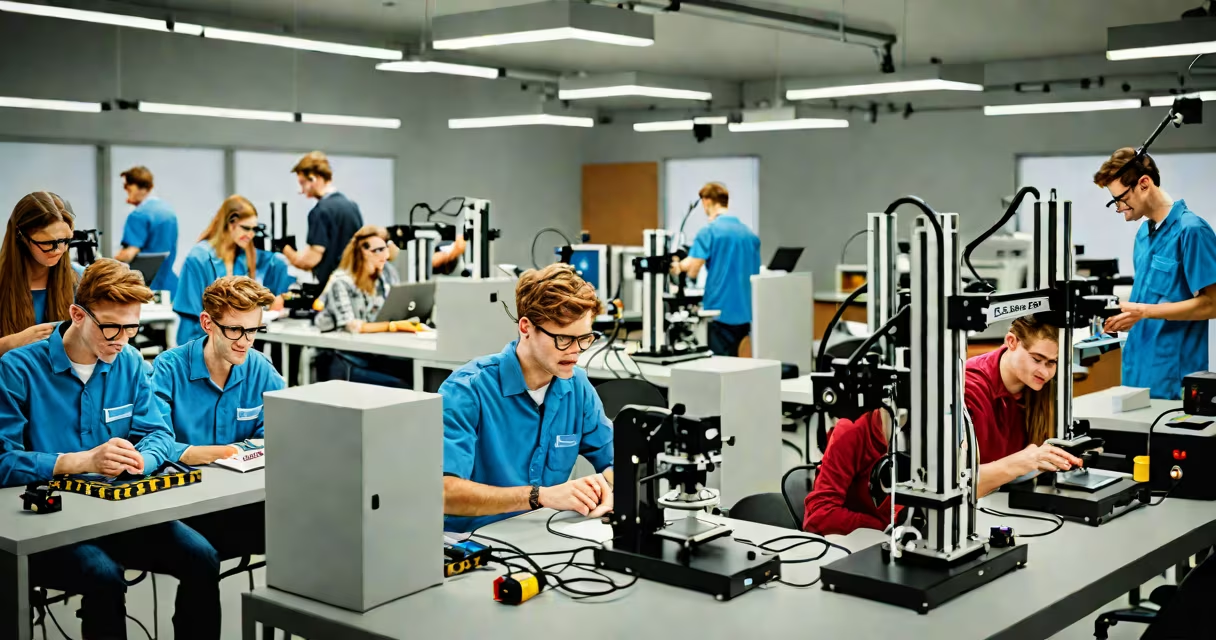
Top universities for mechanical engineering are institutions with nationally recognized programs that combine foundational theory, hands-on labs, and industry-aligned research. These schools consistently rank among the highest in academic reputation, faculty expertise, and graduate employment outcomes.
These universities train students in core areas such as thermodynamics, fluid mechanics, materials science, and robotics. They emphasize design, prototyping, and computational modeling-skills essential for careers in aerospace, automotive, energy, and biomedical sectors. Admission is highly competitive, often requiring strong performance in math and physics at the high school level.
The U.S. News & World Report 2023 ranking places MIT, Stanford, Caltech, UC Berkeley, and the University of Michigan at the top for mechanical engineering. The QS World University Rankings 2024 highlights ETH Zurich, Imperial College London, and the University of Cambridge as global leaders. These institutions share a focus on innovation, access to modern facilities, and close ties to industry partners.
Admissions to top universities for mechanical engineering typically require SAT/ACT scores above 1450 (out of 1600), AP or IB credits in calculus and physics, and strong letters of recommendation. Many schools also consider extracurricular involvement in science fairs, robotics clubs, or internships.
Once enrolled, students follow a structured curriculum. In the first two years, they take courses in statics, dynamics, heat transfer, and computer-aided design (CAD). By the junior year, they begin specializing-choosing tracks in biomechanics, mechatronics, or sustainable energy systems. Senior capstone projects often involve designing and testing prototypes under faculty supervision.
Research is central to top programs. Students may join labs focused on soft robotics, additive manufacturing, or autonomous vehicle control. For example, MIT's Computer Science and Artificial Intelligence Laboratory (CSAIL) runs projects integrating machine learning with robotic manipulation. Students gain publication experience and often present findings at conferences like ASME IMECE.
Differences between top universities for mechanical engineering lie in program structure, research focus, and career support. Some schools emphasize theoretical rigor, while others prioritize applied innovation.
| University | Program Focus | Unique Feature | Graduate Employment Rate (2023) |
|---|---|---|---|
| MIT | Robotics, AI integration | Access to the Media Lab and Lincoln Laboratory | 94% |
| Stanford | Biomechanics, startup incubation | Proximity to Silicon Valley and the StartX accelerator | 91% |
| ETH Zurich | Advanced materials, sustainable design | Strong industry partnerships in European manufacturing | 89% |
| UC Berkeley | Energy systems, environmental impact | Center for Energy and Environmental Research in the Developing World (CEREDW) | 87% |
While MIT and Caltech lead in technical depth, Stanford stands out for entrepreneurial support. Its Mechanical Engineering department offers a "Design for Impact" track that pairs senior projects with nonprofit or social enterprise goals. Similarly, ETH Zurich emphasizes sustainability through mandatory courses in life-cycle analysis and carbon footprint assessment.
A lesser-known distinction: many top universities for mechanical engineering now require proficiency in simulation tools like ANSYS or COMSOL. At the University of Michigan, incoming freshmen complete a summer workshop in finite element analysis (FEA) before beginning coursework. This early exposure ensures students can model stress distributions in structural components from day one.
People often assume that all top universities for mechanical engineering offer identical curricula. In reality, program culture varies. For example, Caltech's small class sizes and emphasis on independent research contrast sharply with the large-scale collaborative projects seen at UC Berkeley.
Another misconception is that international students face equal admission odds. Data from the National Science Foundation shows that foreign applicants to top U.S. mechanical engineering programs are accepted at rates 12-18 percentage points lower than domestic applicants, even when GPA and test scores are comparable. This gap stems from visa constraints and limited funding availability.
Some confuse "mechanical engineering" with "automotive engineering." While both fields study motion and forces, automotive engineering focuses specifically on vehicles-designing engines, transmissions, and safety systems. Top universities for mechanical engineering include automotive-related courses, but they do not limit their scope to transportation. A student at Georgia Tech, for instance, might work on prosthetic limbs or wind turbine blades, not just cars.
In 2022, I worked as a teaching assistant for a senior design course at the University of Illinois Urbana-Champaign. One team developed a low-cost prosthetic hand using 3D printing and servo motors. Their prototype reduced production cost from $1,200 to $180. The project was later presented at the American Society of Mechanical Engineers (ASME) conference and received a regional innovation award.
This example illustrates how top universities for mechanical engineering turn classroom theory into real solutions. Students learn to balance material strength, joint mechanics, and power efficiency-all within budget and timeline constraints. The process mirrors industry workflows, preparing graduates for roles in product development and systems engineering.
Top universities for mechanical engineering remain the gold standard for training engineers who solve complex physical problems. Their programs blend theory, experimentation, and real-world application. Graduates enter industries ranging from space exploration to medical device development, equipped with problem-solving frameworks grounded in physics and mathematics.