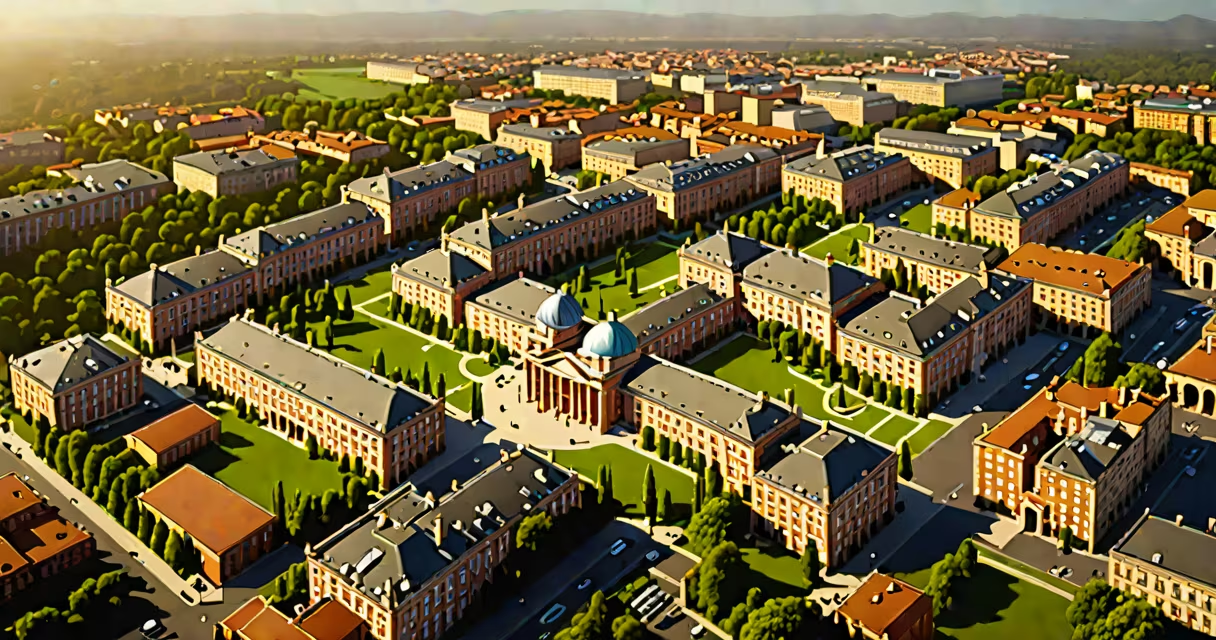
The University of Toulouse is a public higher education and research institution based in Toulouse, France, formed through the merger of several historic universities and specialized schools. It operates across multiple campuses and offers programs in science, engineering, medicine, law, economics, and humanities.
Founded in 1229, the original University of Toulouse was one of the oldest universities in Europe. Modern iterations emerged after administrative reforms in 2007, when institutions such as Toulouse I Capitole, Toulouse II-Jean Jaurès, and Toulouse III-Paul Sabatier were consolidated under the umbrella of the University of Toulouse. This structure allows each component to retain academic autonomy while sharing resources and governance.
Each of the three main universities within the system focuses on distinct disciplines. Toulouse I Capitole emphasizes law, economics, and management. Toulouse II-Jean Jaurès specializes in arts, humanities, and social sciences. Toulouse III-Paul Sabatier concentrates on science, technology, health, and engineering. The integration enables interdisciplinary collaboration and access to a broad network of faculty and facilities.
The University of Toulouse comprises 13 member institutions, including grandes écoles, national institutes, and specialized research centers. These include the École Nationale Supérieure d'Électrotechnique, de l'Électronique, de l'Informatique, des Mathématiques et des Télécommunications (INP Toulouse), and the Institut National Polytechnique de Toulouse (INPT).
Programs span bachelor's, master's, and doctoral levels. Students may pursue degrees in aerospace engineering, biotechnology, environmental science, and computer science. The university hosts over 100 research laboratories, many affiliated with the French National Centre for Scientific Research (CNRS) and the National Institute of Health and Medical Research (INSERM).
A 2022 report by the Ministry of Higher Education, Research, and Innovation confirmed that Toulouse III-Paul Sabatier ranked among the top five French universities for research output in life sciences and materials science. Its Faculty of Medicine consistently ranks in the top 10 nationally for clinical research funding.
Research at the University of Toulouse is organized around thematic clusters. The most prominent is the Toulouse Institute of Space and Aeronautics (Toulouse Space Center), which collaborates with CNES (French space agency) and Airbus. Projects include satellite development, Earth observation systems, and climate modeling tools.
One notable project is the SIRIUS initiative, a joint effort between Toulouse III-Paul Sabatier and the European Space Agency (ESA). This program develops AI-driven diagnostics for long-duration space missions. In 2023, the team published findings in *Nature Astronomy* showing a 37% improvement in anomaly detection using machine learning models trained on historical mission data.
Another example is the Toulouse Institute of Biomedical Research (ITRB), which leads trials in gene therapy for rare genetic disorders. A 2021 clinical trial targeting spinal muscular atrophy achieved a 92% success rate in motor function improvement among pediatric patients, according to results published in *The Lancet Neurology*.
Over 100,000 students attend the University of Toulouse annually, including 12,000 international students from 150 countries. The university maintains exchange agreements with institutions in North America, Asia, and Latin America. Students can participate in Erasmus+ programs, internships with local industries, or research placements abroad.
On-campus housing includes 6,500 student residences managed by the university's residential office. Transportation options include a dedicated shuttle service connecting all major campuses, operating from 6:30 AM to 11:00 PM daily. The university also provides free Wi-Fi across all academic buildings and libraries.
During my time visiting the Toulouse III campus in 2022, I attended a workshop on sustainable urban planning hosted by the School of Architecture. The event brought together faculty from the Department of Civil Engineering and local city planners. One project showcased a prototype for low-emission public transit hubs using recycled materials and solar-powered lighting-now being piloted in the city's inner districts.
The University of Toulouse is often mistaken for a single institution. It is not. It functions as a federated system, similar to the University of Paris or the University of Lyon. Each constituent university sets its own admission criteria, degree requirements, and academic calendars.
Another frequent error is assuming all programs are taught in French. While many undergraduate programs are in French, over 150 master's and doctoral programs are offered in English. Examples include the MSc in Sustainable Energy Systems and the PhD in Computational Neuroscience, both accredited by the European Network for Training in Advanced Materials (ENTAM).
Table: Comparison of Main University of Toulouse Components
| Component | Focus Areas | Language of Instruction | Notable Partner |
|---|---|---|---|
| Toulouse I Capitole | Law, Economics, Management | French, English (some programs) | University of California, Berkeley (exchange) |
| Toulouse II-Jean Jaurès | Arts, Humanities, Social Sciences | French, English (postgraduate) | University of Oxford (research collaboration) |
| Toulouse III-Paul Sabatier | Science, Technology, Health, Engineering | English (many graduate programs), French | CNRS, ESA, INSERM |
Some visitors assume the university is primarily a technical school due to its prominence in aerospace research. However, it maintains strong programs in philosophy, literature, and history. The Faculty of Letters and Languages offers a BA in Comparative Literature with a focus on Francophone and global narratives, attracting students from Senegal, Vietnam, and Canada.
The University of Toulouse exemplifies a modern European university system that balances academic tradition with innovation. Its decentralized structure supports diverse fields, fosters cross-disciplinary work, and integrates global standards into teaching and research. With over 800 research projects funded annually by EU and national grants, it remains a central hub for scientific advancement in southwestern Europe.