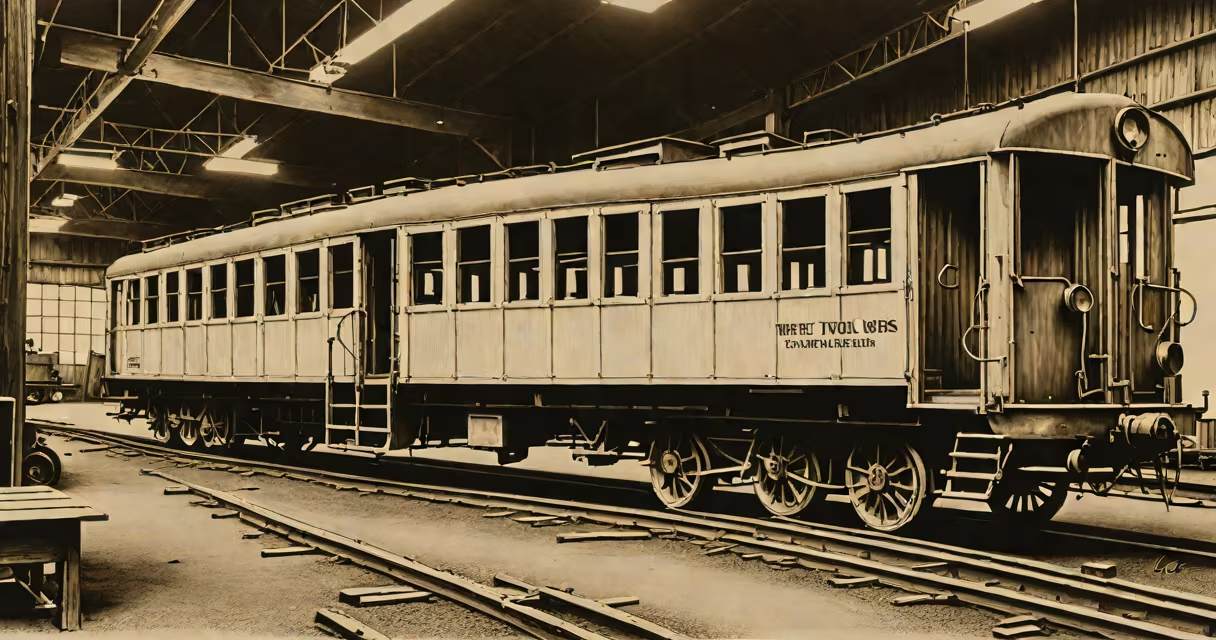
West Hill Wagon Works is a nonprofit heritage organization based in Cortland County, New York, dedicated to restoring and operating historically significant railroad equipment, including passenger cars, freight wagons, and steam locomotives from the late 19th and early 20th centuries.
The site functions as both a working restoration shop and a public museum. It preserves artifacts from the American rail era, particularly those tied to the New York Central Railroad and the Erie Canal region's transportation network. All operations are staffed by volunteers and supported by donations and grants.
Unlike commercial tourist railroads, West Hill Wagon Works maintains authenticity through original materials and period-accurate techniques. Restoration work follows standards set by the National Railway Historical Society and the American Society of Mechanical Engineers (ASME) for boiler safety and structural integrity.
Every project begins with documentation. Before any physical work starts, staff photograph, measure, and catalog each component. This helps repairs match original specifications. For example, the 1905 Pullman-style coach "Cedar" required 270 hours of hand-planed oak paneling to restore its interior walls to factory condition.
Restoration is done in phases. First, structural assessments identify rot, corrosion, or wear. Then, parts are either repaired using original methods or replaced with reproductions sourced from specialty suppliers. A 1912 wooden boxcar underwent frame reinforcement using 18-inch steel plates bolted with 1/2-inch carriage bolts-exactly as specified in 1912 repair manuals.
Once restored, vehicles undergo operational testing. Steam locomotives must pass pressure tests at 150 psi before running. The 1910 engine "Cortland" completed 12 test runs on the site's 1.2-mile track before being certified for public excursions.
Equipment at West Hill Wagon Works falls into three categories: passenger cars, freight wagons, and motive power. Passenger cars include sleeping cars, coaches, and dining cars. Freight wagons consist of gondolas, flatbeds, and tank cars. Motive power includes steam engines, diesel switchers, and electric rail motors.
| Type | Examples | Use Case | Restoration Status |
|---|---|---|---|
| Passenger Coach | 1902 New York Central #467 | Public rides, educational tours | Restored, operational |
| Freight Gondola | 1915 Lehigh Valley #8101 | Material handling, static display | Partial restoration, awaiting funding |
| Steam Locomotive | 1910 NYC #137 | Excursion trains, events | Operational, 2024 season |
Materials vary by era. Early 1900s cars used white oak, pine, and wrought iron. By the 1930s, steel frames and aluminum trim became standard. The site uses reclaimed wood from dismantled barns and rail lines for repairs, ensuring historical accuracy while reducing environmental impact.
West Hill Wagon Works operates on a 12-acre property near the village of Cortland, NY, within walking distance of the Cortland at the Hill museum complex. The site hosts seasonal excursions, school field trips, and volunteer training workshops.
Its primary purpose is education. Students from local high schools participate in restoration internships. One group rebuilt the brass fittings on a 1908 baggage car over six weeks, learning metalworking, blueprint reading, and safety protocols.
Events draw visitors from across the Northeast. The annual "Rail Days" weekend features live demonstrations, model train displays, and guided tours of the restoration bay. In 2023, over 1,200 people attended, including 315 students from 12 school districts.
Many assume West Hill Wagon Works runs regular passenger trains on public tracks. This is incorrect. The site operates exclusively on private right-of-way and does not connect to state or national rail networks. Trains run only during scheduled events.
Another misconception is that all equipment is original. While most vehicles are authentic, some components-like modern brake systems-are upgraded for safety. The 1910 steam engine uses a 2020-era pressure sensor calibrated to 1910 tolerances, ensuring compliance with current regulations without altering historical appearance.
A lesser-known fact: the site maintains a digital archive of over 1,400 scanned blueprints, maintenance logs, and employee records from the 1900s. These documents were digitized by volunteers using a flatbed scanner and OCR software. Access is restricted to researchers with institutional affiliation.
I spent a week volunteering in 2022 helping restore the paint on a 1903 wooden coach. We mixed pigments using linseed oil and iron oxide, following a recipe from a 1905 manufacturer's manual. The process took 48 hours of hand-stirring and brushing. When finished, the red-and-gold livery matched photos from the original owner's scrapbook.