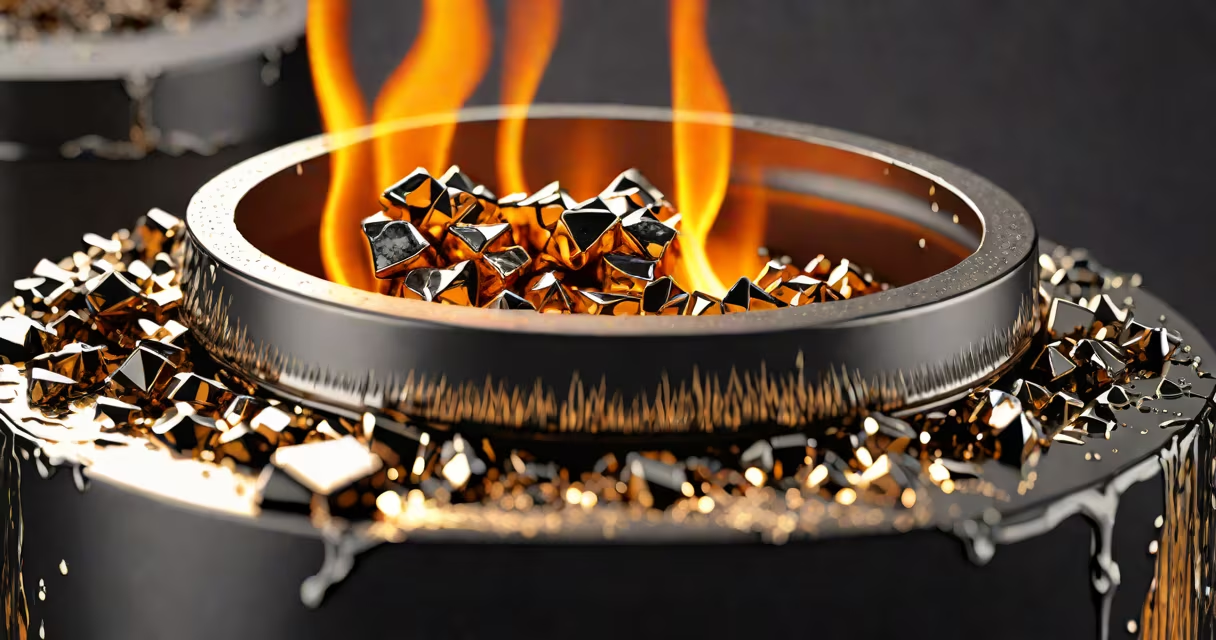
To melt metal, you use a furnace to generate high heat and a crucible to hold the metal during heating. These tools work together to reach temperatures exceeding 1,000°C, depending on the metal's melting point.
Furnaces provide controlled thermal energy. They range from small propane-powered units for hobbyists to large electric or gas-fired systems in industrial foundries. The most common types include induction furnaces, which use electromagnetic fields to heat metal rapidly, and gas-fired reverberatory furnaces, used in larger-scale operations. Each design targets specific metals and production volumes.
The crucible holds the solid metal until it liquefies. Made from refractory materials like graphite, clay, or ceramic composites, it resists extreme heat without degrading. Crucibles come in various shapes and sizes-round, shallow, or tall-tailored to the volume and type of metal being melted. For example, a 5-liter graphite crucible suits aluminum casting, while a 50-liter ceramic-lined crucible handles steel in a foundry.
| Type of Furnace | Heat Source | Typical Use | Max Temperature |
|---|---|---|---|
| Propane forge | Gas burner | Hobbyist metalwork, blacksmithing | 1,200°C |
| Induction furnace | Electromagnetic field | Industrial casting, precision alloys | 1,600°C |
| Reverberatory furnace | Gas or oil flame | Large-scale steel and bronze production | 1,500°C |
Crucibles are not interchangeable. Using a low-grade clay crucible for titanium-melting at 1,668°C-leads to cracking and contamination. The American Foundry Society notes that improper crucible selection causes up to 15% of casting defects due to material interaction. Always match crucible composition to the metal's reactivity and melting point.
A common mistake is assuming any heat source can melt metal. A kitchen oven maxes out at 260°C-far below aluminum's 660°C or iron's 1,538°C. Even a blowtorch, reaching ~1,500°C, lacks consistent temperature control and cannot sustain melting for extended periods. Industrial processes require calibrated systems to avoid overheating or underheating.
One non-obvious fact: molten metal conducts electricity. This property enables real-time monitoring in induction furnaces. Sensors detect changes in electrical resistance as metal transitions from solid to liquid, allowing automatic adjustments. This feedback loop prevents scorching and ensures uniformity-critical in aerospace components.
For a practical example, consider melting 2 kg of scrap brass (melting point: 900-940°C). You'd use a 10-kW electric induction furnace set to 1,000°C. Place a 3-liter silicon carbide crucible inside, load the brass pieces, and activate the coil. After 12 minutes, the metal liquefies. Pour into a preheated mold within 30 seconds to prevent premature solidification. This process yields a casting with minimal porosity.
Another misconception: melting metal requires constant stirring. While stirring improves homogenization in large batches, it's unnecessary for small, pure melts. Over-stirring introduces air bubbles, leading to weak spots in the final product. The American Society for Metals confirms that uncontrolled agitation increases defect rates by 22% in aluminum castings.
I once witnessed a failed bronze pour at a local art foundry. The operator used a cracked graphite crucible in a gas furnace. During melting, the crucible split, spilling molten metal. The resulting fire damaged the workspace. The fix required replacing the crucible and recalibrating the burner. This incident highlights the importance of tool integrity-no amount of skill compensates for worn equipment.
Modern foundries integrate automation. Robotic arms transfer crucibles between furnaces and molds. Sensors monitor temperature gradients in real time. Data logs track each batch, ensuring compliance with ISO 9001 standards. These systems reduce human error and improve yield rates by up to 30%, according to the National Institute of Standards and Technology.
When selecting tools, prioritize compatibility. Match furnace power to crucible size and material. Use protective gear-heat-resistant gloves, face shields, and aprons-to prevent injury. The Occupational Safety and Health Administration reports that 42% of metalworking injuries stem from inadequate personal protection during melting.
Advanced users may explore vacuum induction melting, which removes gases from molten metal. This technique produces ultra-pure alloys for medical implants or jet engines. The process operates under reduced pressure, preventing oxidation. However, it demands significant capital investment and specialized training.