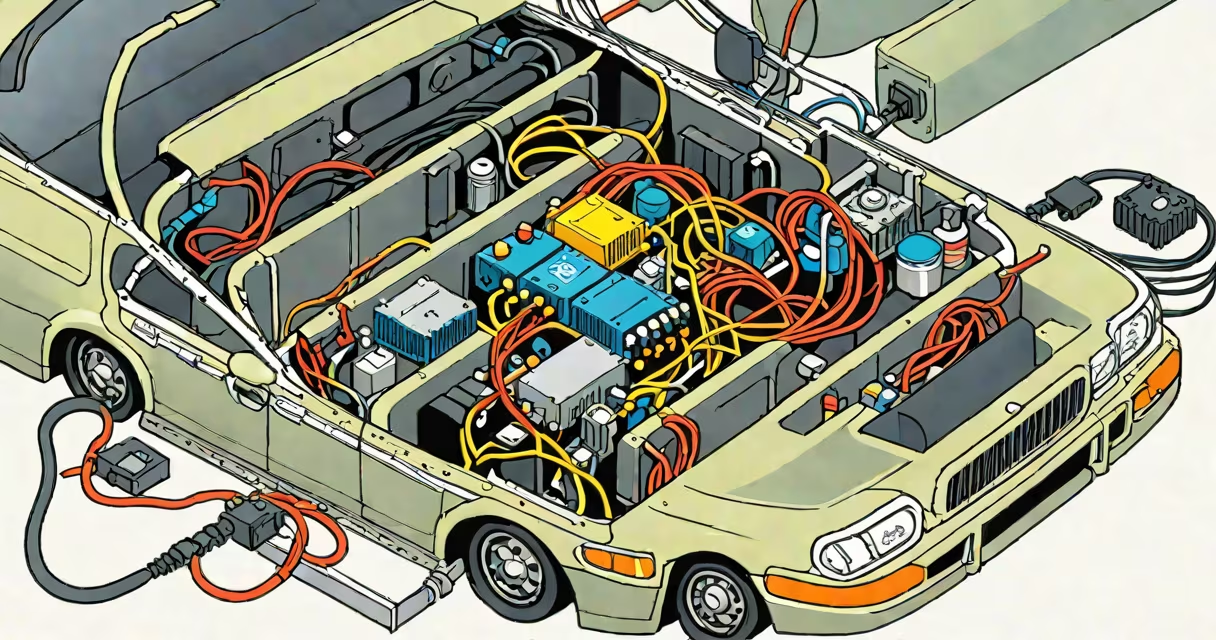
CAN bus stands for Controller Area Network, a serial communication protocol designed for real-time data exchange between microcontrollers in automotive and industrial systems. It enables multiple devices to share information efficiently over a single pair of wires, reducing wiring complexity and improving reliability.
Developed in the 1980s by Bosch, CAN bus was created to address the growing number of electronic control units (ECUs) in vehicles. Before CAN, each ECU required dedicated wiring, leading to bulky harnesses and integration challenges. CAN bus solved this by allowing all ECUs-such as engine control, braking systems, and infotainment-to communicate over a shared network using standardized messages.
The protocol operates at speeds up to 1 Mbps in automotive applications, with message prioritization based on identifier values. This ensures time-critical signals, like brake activation or airbag deployment, are transmitted first, even under high traffic. CAN bus is not limited to cars-it's widely used in industrial automation, medical devices, and aerospace systems.
CAN bus uses a differential signaling method over two wires: CAN High and CAN Low. These wires carry complementary signals, making the system resilient to electromagnetic interference. A voltage difference between the lines represents data bits-logic 0 (dominant) or logic 1 (recessive).
Each node on the network listens continuously. When a message is sent, all nodes receive it. Nodes then compare the message ID against their own filters. If a match occurs, the node processes the data. This broadcast model eliminates the need for a central master controller, enabling decentralized decision-making.
Messages are structured into frames: the start of frame, arbitration field (containing the message ID), control field (data length), data field (up to 8 bytes), CRC field (error detection), acknowledgment slot, and end of frame. The protocol includes automatic error checking and recovery, ensuring data integrity even in noisy environments.
Several CAN variants exist, tailored to different performance and application needs:
| Type | Data Rate | Use Case | Standard |
|---|---|---|---|
| CAN 2.0A/B | Up to 1 Mbps | Automotive ECUs, basic diagnostics | ISO 11898-2 |
| CAN FD (Flexible Data-Rate) | Up to 5 Mbps | High-speed sensor data, advanced driver assistance | ISO 15765-2 |
| CAN XL | Up to 10 Mbps | Future vehicle architectures, high-bandwidth systems | ISO 11898-7 |
CAN FD extends the original CAN 2.0 standard by increasing the data payload to 64 bytes and allowing higher bit rates during the data phase. This improvement supports modern features like adaptive cruise control and lane-keeping assist, which require rapid transmission of large data sets.
CAN XL, introduced in 2020, further increases bandwidth and supports longer message lengths. It's designed for upcoming vehicle platforms that integrate autonomous driving systems and extensive sensor arrays. Unlike earlier versions, CAN XL uses a single wire for data and a separate clock signal, enabling deterministic timing.
Many assume CAN bus is proprietary or exclusive to luxury vehicles. In reality, it's a standardized protocol governed by ISO and SAE. Over 30 million vehicles produced annually use CAN bus, including models from Toyota, Ford, and Hyundai. The protocol is open-source in implementation, meaning developers can build compatible hardware and software without licensing fees.
Another misconception is that CAN bus requires complex configuration. While setup varies by system, most automotive ECUs auto-negotiate parameters through a process called "bus initialization." Once connected, nodes synchronize automatically using predefined baud rates and message IDs.
A less obvious point: CAN bus does not support encryption or authentication natively. This makes it vulnerable to spoofing attacks if not secured at the application layer. Researchers have demonstrated that malicious actors can inject false messages into a CAN network, potentially disabling brakes or altering speed readings. Modern vehicles now incorporate CAN security extensions, such as authenticated CAN (CANsec), though adoption remains limited.
Consider a 2018 Honda Civic with a malfunctioning oxygen sensor. The engine control module (ECM) sends a diagnostic trouble code (DTC) via CAN bus to the dashboard. The DTC is assigned a unique ID-0x18FF001-and contains a 6-byte payload: status flags, fault code, and timestamp.
When the mechanic connects a scan tool, it sends a request frame with ID 0x18FF001. All nodes on the network receive it. The ECM responds with a data frame containing the actual fault code (e.g., P0135). The scan tool decodes the message, displays the result, and logs it for repair.
This entire exchange happens in under 10 milliseconds. Without CAN bus, diagnosing the issue would require physically tracing dozens of wires to locate the sensor's signal path-a process that could take hours.
CAN bus is often confused with similar protocols like LIN (Local Interconnect Network) and FlexRay. LIN is a low-cost alternative used for non-critical functions such as window controls and door locks. It operates at 20 kbps and uses a single-wire architecture, making it simpler but slower than CAN.
FlexRay, developed for safety-critical systems, offers deterministic timing and higher bandwidth than CAN. However, it's more expensive and complex. FlexRay is used in high-end vehicles for stability control and active suspension systems, while CAN remains dominant for general-purpose communication.
Understanding CAN bus is essential for anyone working with modern vehicle electronics, embedded systems, or industrial automation. Its role in enabling efficient, reliable communication across distributed systems makes it foundational to today's connected world.