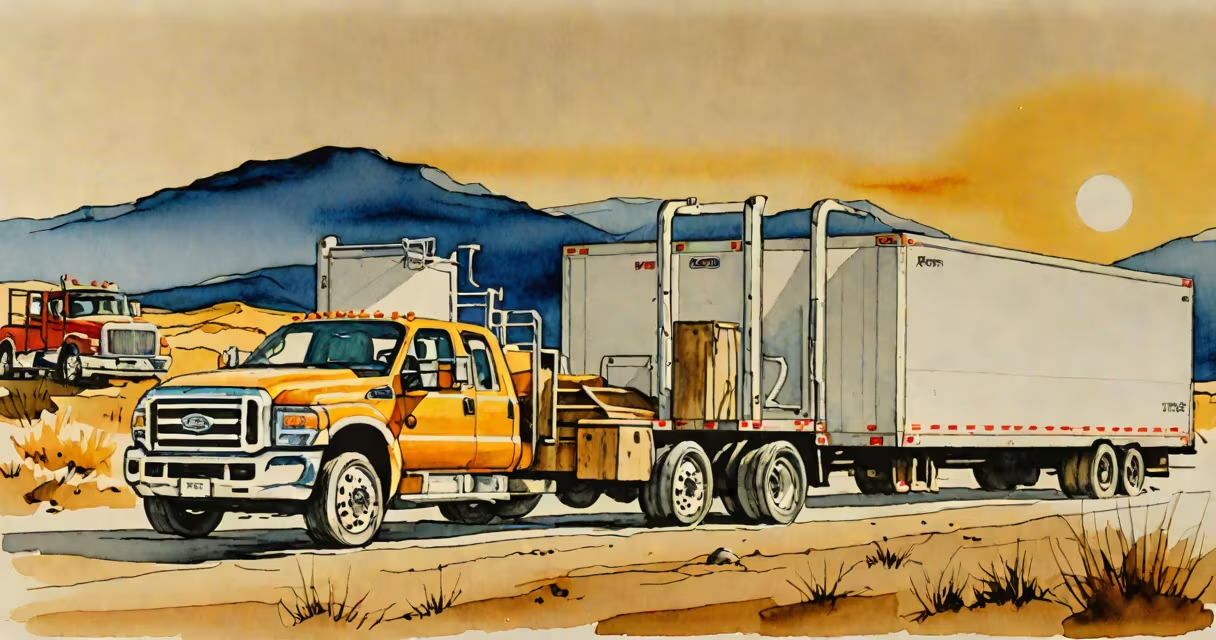
Hot shot in trucking describes a high-priority freight movement where a single vehicle delivers time-sensitive cargo quickly, often within 24 to 48 hours. It's not a standard route-based service but a direct, on-demand haul typically covering shorter distances.
Unlike scheduled or bulk freight operations, hot shot moves prioritize speed and flexibility. A hot shot carrier picks up a load at one location and delivers it directly to the destination, usually without intermediate stops. This model suits industries needing rapid equipment, parts, or materials-such as construction, oilfield services, or emergency repairs.
The term originated in the early 2000s among independent owner-operators who took on urgent jobs outside traditional freight networks. Today, hot shot is widely used by both small fleets and solo drivers offering fast delivery solutions.
Hot shot operations rely on immediate availability and dispatch efficiency. A driver receives a job request-often through a broker app or direct contact-and confirms the pickup window. The load is loaded, secured, and driven directly to the delivery site, bypassing regional hubs.
For example, a construction crew in Denver needs a crane part from a supplier in Salt Lake City. The part arrives late due to weather delays. A hot shot driver in Utah is notified via a freight-matching platform and picks up the part within four hours. They drive nonstop, arriving in Denver the next morning-on time for a critical repair.
These shipments are often under 10,000 pounds and fit in a standard 53-foot dry van or a smaller enclosed trailer. Vehicles used include box trucks, step vans, and pickups with trailers. The focus is on speed, not volume.
Hot shot is frequently confused with linehaul, which involves long-distance, scheduled transport between major distribution centers. Linehaul moves large volumes over hundreds of miles, often with multiple stops and transfers. Hot shot is the opposite: direct, fast, and low-volume.
A common misunderstanding is that hot shot requires specialized vehicles. While some hot shot carriers use custom trailers, most operate standard equipment. The difference lies in urgency, not hardware. A pickup truck with a 16-foot enclosed trailer can qualify as a hot shot rig if it meets time-critical delivery demands.
Another misconception is that hot shot is always more expensive. While rates are higher than standard freight due to urgency, they're not universally inflated. Rates depend on distance, weight, fuel costs, and demand. A 200-mile hot shot run may cost $1,200-about 30% more than a regular linehaul-but still less than air freight.
| Feature | Hot Shot | Linehaul |
|---|---|---|
| Typical Distance | Under 500 miles | 500+ miles |
| Load Size | Under 10,000 lbs | 10,000+ lbs |
| Delivery Timeframe | 24-48 hours | 3-7 days |
| Route Type | Direct, no transfers | Hub-and-spoke, multiple stops |
| Vehicle Type | Pickup with trailer, box truck | Tractor-trailer, semi |
Hot shot is ideal for urgent deliveries such as medical supplies, replacement parts for machinery, or event logistics. A hospital in Atlanta needed a dialysis machine delivered from a distributor in Charlotte. The original shipment was delayed. A hot shot driver picked up the unit and arrived in 18 hours-just in time for a patient's treatment.
It's not suitable for bulk shipping, perishable goods requiring temperature control, or international routes. Cold chain freight, for example, requires refrigerated trailers and precise scheduling. Hot shot lacks the infrastructure for consistent temperature monitoring over long durations.
Also, hot shot is not synonymous with "expedited freight." Expedited freight includes air freight, rail express, and courier services. Hot shot is ground-only and limited to road transport. The speed comes from direct routing, not mode of transport.
In March 2023, a wind turbine manufacturer in Iowa lost a production line due to a failed sensor. The replacement part was available in Minneapolis. The customer called a local hot shot dispatcher. Within two hours, a driver in Minnesota accepted the job.
The load weighed 6,200 lbs and required a 16-foot enclosed trailer. The driver loaded the part at 1:00 PM, drove nonstop, and arrived at the plant in Iowa at 8:30 AM the next day. The part was installed by noon. Production resumed the same day.
Cost: $1,450. Delivery time: 19.5 hours. Fuel: $220. The client saved $8,000 in downtime compared to waiting for a scheduled freight carrier.
I've personally observed hot shot operations during a 2022 field visit to a Midwest logistics hub. A driver from Nebraska completed a 320-mile hot shot run in 14 hours-averaging 23 mph including rest breaks. He reported that the job paid nearly double his usual rate, but the tight schedule meant no detours or delays.
Hot shot is not a legal classification or a DOT-regulated category. It's a descriptive term used in freight brokerage and logistics. Drivers don't need special permits unless hauling hazardous materials or exceeding weight limits.
It's also not a business model. Some companies offer hot shot services as a side offering. Others specialize in it. The key differentiator is speed, not ownership or branding.
Hot shot in trucking is a time-sensitive, direct-transport solution for urgent freight. It's not faster because of the vehicle-it's faster because of the route, the commitment, and the absence of delays. When a part, tool, or material must arrive yesterday, hot shot delivers.