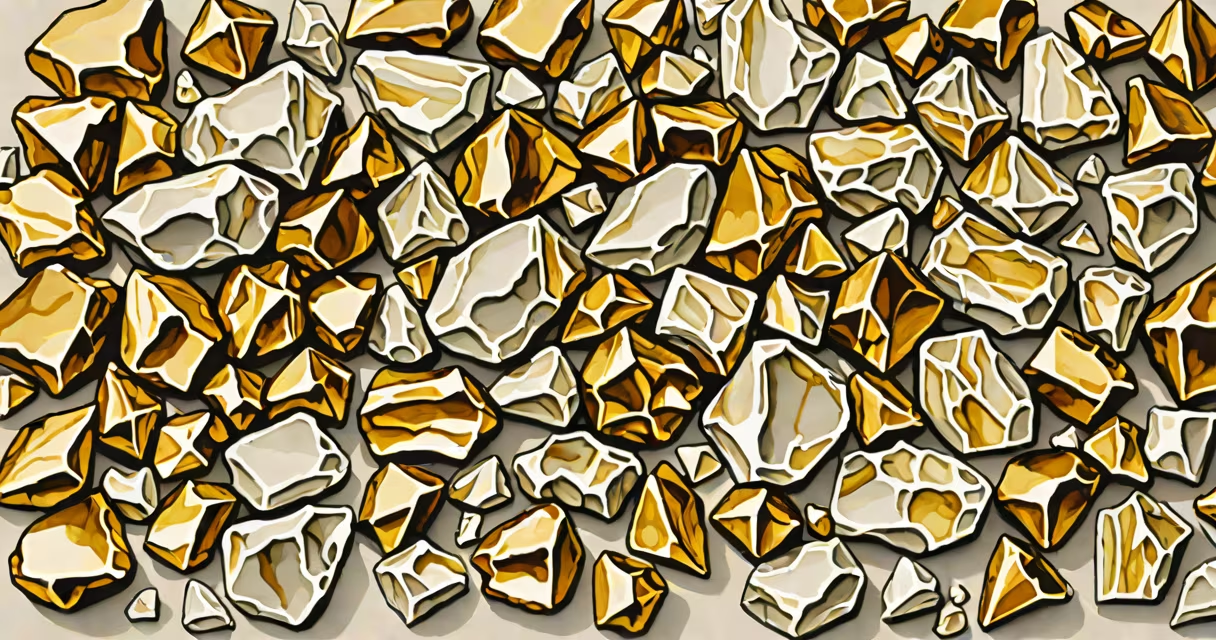
Mined gold typically appears as irregular, lumpy pieces ranging from tiny specks to fist-sized nuggets, often embedded in quartz or other rock. It's rarely shiny or pure when extracted-it's usually dull, earthy, or tarnished. The color ranges from pale yellow to deep gold, depending on purity and mineral content.
Gold occurs naturally in nature as a native element, meaning it exists in metallic form without chemical bonding. This allows it to appear in distinct shapes when freed from surrounding rock. Most mined gold comes from placer deposits-riverbeds or stream beds-or hardrock veins. The physical form depends on geologic history and the environment where it formed.
Raw gold doesn't resemble the polished bars or coins seen in banks or jewelry stores. Instead, it looks like heavy, malleable metal that's been shaped by water flow, pressure, or time. Its surface may be pitted, cracked, or layered with sediment. A single nugget can weigh less than a gram or exceed 100 grams, though larger specimens are rare.
Mined gold takes several recognizable forms based on origin and formation process. The most common types include:
| Type | Appearance | Typical Location | Size Range |
|---|---|---|---|
| Nuggets | Irregular, rounded masses; often pitted or folded; yellow to gold-orange | Placer deposits, river gravels | 0.1 g - 1 kg |
| Flakes | Thin, flat sheets; can be torn or crumpled; silvery-yellow | Streambeds, glacial till | 0.01 g - 5 g |
| Vein Gold | Crystalline, wire-like, or fine filaments; often brittle | Hardrock mines, quartz veins | Microscopic to 10 cm |
| Grains | Small, granular particles; sometimes visible under magnification | Sedimentary layers, alluvial soils | 0.001 g - 0.1 g |
A real-world example: in California's Sierra Nevada foothills, prospectors find gold flakes and small nuggets in gravel beds. These pieces are often coated in iron oxide or clay, giving them a dark, gritty surface. After washing and panning, the gold reveals a bright, buttery yellow hue-its true color.
One non-obvious fact: gold doesn't always look golden. Impurities like silver, copper, or tellurium can alter its color. High-silver gold (electrum) appears whitish or pale yellow. Copper-rich gold can look reddish. These variations affect value and identification.
Mined gold originates in hydrothermal veins formed deep underground. Hot, mineral-rich water flows through cracks in rock, depositing gold as temperatures drop. Over millions of years, erosion exposes these veins, and rivers carry gold downstream into gravel beds-placers.
Placer deposits are easier to mine with basic tools. Panning, sluicing, and dredging extract gold from sand and gravel. Hardrock mining requires drilling and crushing rock to access vein gold. The yield is lower, but the concentration can be higher.
For example, the Witwatersrand Basin in South Africa contains gold-bearing conglomerates formed 2.7 billion years ago. Miners extract gold from crushed rock using cyanide leaching-a process that dissolves gold from ore. The resulting material is still visibly rocky and uneven, not the clean metal we see in vaults.
Many assume mined gold is shiny and uniform. It's not. Pure gold is soft and malleable, so it deforms easily during transport. Water action rounds edges, creating smooth, oval shapes. But this doesn't make it look like jewelry.
Another mistake: confusing gold with pyrite ("fool's gold"). Pyrite is a brass-colored sulfide mineral that looks similar under low light. However, pyrite is harder (6-6.5 on Mohs scale) and fractures with sharp edges. Gold is softer (2.5-3) and dents under pressure. A scratch test with a steel nail confirms the difference-gold leaves a yellow mark, pyrite a gray one.
Even experienced prospectors misidentify materials. In 2019, a man in Alaska submitted a rock to a lab claiming it was a 100-gram gold nugget. Analysis revealed it was mostly iron oxides with trace gold. The sample had a high density but lacked the malleability and color consistency of real gold.
I once visited a small-scale gold mine in Nevada. Workers used hand screens and pans to separate gold from gravel. The raw material looked like dirty sand with flecks of yellow. After washing, the gold appeared as tiny, waxy flakes and small, bent nuggets. One piece, about the size of a dime, had a matte finish and felt heavier than expected. When held in sunlight, it showed a warm, honey-gold sheen-not the reflective shine of refined gold.
This experience confirmed that mined gold lacks the polish and symmetry of commercial products. It's functional, not decorative. Its value lies in weight and purity, not appearance.
The term "mined gold" describes the raw state of the metal before refining. It's not a specific shape or color-it's a condition. Its appearance varies widely based on geology, processing, and contamination. Recognizing this helps distinguish authentic samples from fakes or imitations.