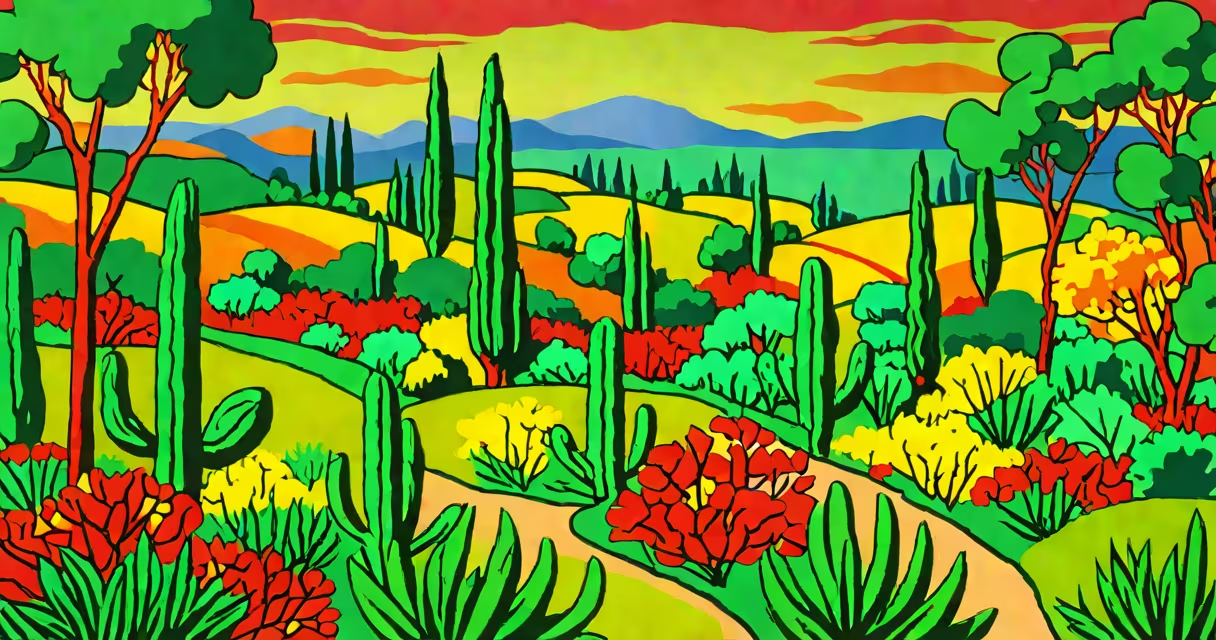
Fauvism was an early 20th-century art movement centered on expressive, non-representational color used to convey emotion rather than depict reality. It emerged in France around 1905 and lasted until about 1908, defined by radical color choices and loose brushwork.
The term "fauvism" comes from the French word *fauves*, meaning "wild beasts," a nickname given by critics to the group's shocking use of color. These artists rejected realistic representation in favor of emotional resonance through hue. They painted landscapes, portraits, and still lifes using intense reds, blues, greens, and yellows-not as they appeared in nature, but as they felt.
Henri Matisse and André Derain were the core figures. Matisse's *Woman with a Hat* (1905) shocked viewers with its jarring pink and green tones. Derain's *The Turning Road, L'Estaque* (1906) used clashing colors to distort space and form. Both men were influenced by Post-Impressionists like Van Gogh and Gauguin, who had already challenged naturalism.
Fauvism operates on the principle that color can carry psychological weight independent of form. Artists didn't aim to replicate visual appearances. Instead, they selected hues based on mood, energy, or symbolic meaning. A blue sky might become orange to suggest unease. A green tree could turn purple to evoke melancholy.
This approach broke from academic traditions where color served to model light and volume. Fauvists used flat areas of color, often applied thickly with visible brushstrokes. Shapes were simplified, contours blurred. The result was paintings that felt immediate and visceral, prioritizing sensation over accuracy.
For example, Matisse's *The Dance* (1909) shows five nude figures in a swirling circle, rendered in vivid red, blue, and green. The figures don't move realistically-they vibrate. The background is a flat, unmodulated blue. The composition feels rhythmic, almost musical. This wasn't a scene from life-it was an emotional state made visible.
Fauvism wasn't a unified style, but a shared impulse toward liberation from representational constraints. Its defining traits include:
While most fauvist works were oil paintings, some artists experimented with watercolor and printmaking. Matisse, for instance, created a series of cut-outs later in life that echoed fauvist principles-using pure color and simplified shapes to express feeling.
Although fauvism lasted only a few years, it marked a turning point. It proved that color could stand alone as a narrative force. This paved the way for Expressionism, Cubism, and Abstract Art. Without fauvism, movements like German Expressionism and even modern abstraction might have taken a different path.
Fauvism emerged in Paris during a period of artistic ferment. The Salon d'Automne of 1905 displayed works by Matisse, Derain, Maurice de Vlaminck, and others. Critics were horrified. Louis Vauxcelles called the group "les fauves"-a term that stuck.
These artists weren't reacting to politics or social change. They were responding to a desire to break free from academic training. Their goal wasn't to depict the world as seen, but to show how it felt. A forest wasn't green-it could be crimson if it stirred passion. A face wasn't neutral-it could flare with anger or joy.
They painted outdoors (*en plein air*) to capture light, but then distorted it. A hillside might be painted in turquoise because the artist wanted to convey coolness, not because it looked that way. This was not observation-it was interpretation.
One example: Derain's *L'Estaque* (1906). The village is rendered in jagged patches of yellow, magenta, and cobalt. The buildings tilt unnaturally. The sea is a violent blue-green. The painting doesn't look like L'Estaque-it feels like the artist's inner state during his visit.
Fauvism is often mistaken for Impressionism. Both use visible brushstrokes and focus on light, but their goals differ. Impressionists sought to capture fleeting moments-the way sunlight changed on water. Fauvists ignored time and place. They painted feeling, not phenomenon.
Another error: assuming fauvism was chaotic or random. In fact, the artists planned compositions carefully. Matisse studied color theory extensively. He believed certain combinations evoked specific emotions. He wrote in *Notes of a Painter* (1908): "I use color... to express my feelings."
A lesser-known fact: fauvism did not reject form entirely. While shapes were simplified, they were still recognizable. A figure remained a figure, a house a house. The distortion came from color, not from abandoning structure. This distinguishes fauvism from later abstraction, where form disappeared completely.
I once stood in front of Matisse's *The Red Room* (1908) at the Museum of Modern Art. The walls are a single, overwhelming red. The furniture is flattened, the floor tilted. I expected to feel disoriented-but instead, I felt calm. The color wasn't aggressive. It was enveloping. That's the power of fauvism: it doesn't show the world-it makes you feel it.
Fauvism ended by 1908, as artists moved toward new directions. Matisse turned to decorative harmony. Derain embraced classical themes. But the movement's legacy endured. It proved that art could prioritize emotion over likeness.
Modern artists continue to draw from fauvist principles. David Hockney uses bold color to convey atmosphere in his California landscapes. Kehinde Wiley paints Black subjects in rich, saturated palettes reminiscent of fauvist interiors. Even contemporary digital artists use high-contrast color fields to evoke mood-echoing fauvist intent.
According to the Metropolitan Museum of Art, "Fauvism opened the door to abstraction by freeing color from its descriptive role." The Tate Modern notes that "the movement's rejection of naturalism helped lay the foundation for 20th-century avant-garde art."
Understanding what is fauvism means recognizing that art doesn't have to copy reality to be truthful. Sometimes, the most accurate representation of a feeling is a patch of orange sky or a violet face. Fauvism taught us that color speaks louder than form.