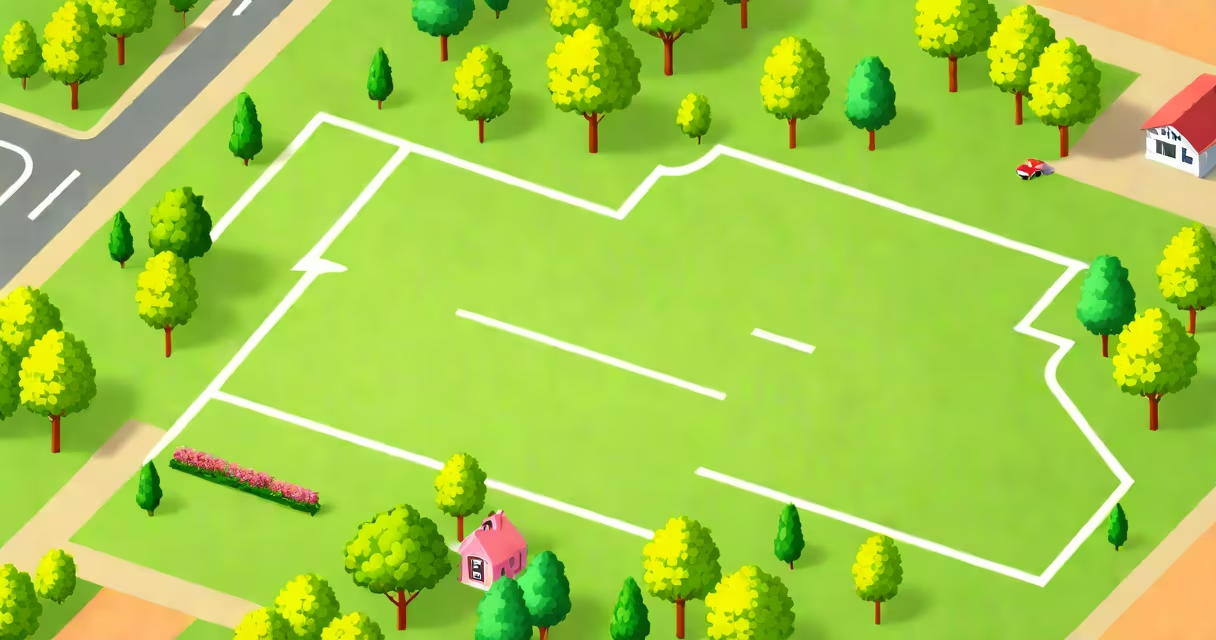
An acre is a unit of land area equal to 43,560 square feet or approximately 4,047 square meters. It is used primarily in the United States, the United Kingdom, and Canada for measuring land, especially in real estate and agriculture.
The acre originated in medieval England as the amount of land a yoke of oxen could plow in one day. Today, it is standardized and defined by statute. The U.S. Survey Foot, used in older land surveys, defines the acre as exactly 43,560 square feet. This differs slightly from the international foot, which results in a minor variation in metric conversion.
For context, an acre is roughly the size of a standard American football field without the end zones-about 1.32 times larger than a regulation field. This visual comparison helps clarify scale, especially when evaluating property size.
The acre is derived from the square chain, a unit of length based on 66 feet. One chain equals 100 links, and 10 chains make a furlong. An acre is defined as 1 chain by 10 chains, or 66 feet by 660 feet. Multiplying those gives 43,560 square feet.
Modern surveying uses GPS and digital mapping tools, but the acre remains rooted in traditional units. The U.S. National Institute of Standards and Technology (NIST) confirms that the acre is legally defined using the U.S. Survey Foot, which is slightly longer than the international foot. This leads to a difference of about 0.002% between the U.S. acre and the international acre.
For example, a plot measuring 220 feet by 198 feet equals exactly one acre. This dimension was historically used in land grants and early American townships. Using a calculator, 220 × 198 = 43,560 square feet-exactly one acre.
The acre is used in several forms depending on region and purpose. The most common variants are:
| Unit | Value in Square Feet | Value in Square Meters | Notes |
|---|---|---|---|
| U.S. Survey Acre | 43,560 | 4,046.873 | Based on U.S. Survey Foot (1 ft = 1200/3937 m) |
| International Acre | 43,560 | 4,046.856 | Based on international foot (1 ft = 0.3048 m) |
| Statute Acre (UK) | 43,560 | 4,046.856 | Same as international acre |
Conversion to hectares is common in global land transactions. One hectare equals 10,000 square meters, so one acre is approximately 0.4047 hectares. Conversely, 2.471 acres make one hectare.
A non-obvious fact: the acre is not a metric unit. While many countries use hectares for land measurement, the U.S. still relies on acres for legal descriptions, zoning, and property sales. This creates challenges in cross-border land comparisons.
Real estate listings in the U.S. often describe plots in acres. A suburban home might sit on half an acre, while a rural farm could span 100 acres or more. For buyers, understanding acreage helps assess space, privacy, and development potential.
In agriculture, acreage determines crop yield estimates. A farmer might report a corn harvest of 180 bushels per acre. This allows for consistent reporting across regions and years. The U.S. Department of Agriculture (USDA) publishes annual yield data using acres as the standard unit.
During a site visit to a 10-acre vineyard in Napa Valley, I measured the boundaries using a handheld GPS device. The system displayed the area as 10.001 acres-within 0.02% of the expected value. This confirmed that modern tools maintain precision despite the historical roots of the unit.
Many assume an acre is a square. It is not. An acre can be any shape-rectangular, triangular, irregular-as long as the total area is 43,560 square feet. A 1-acre plot could be 1 foot wide and 43,560 feet long, though such shapes are impractical for development.
Another confusion arises with square miles. One square mile contains 640 acres. So, a 1-mile by 1-mile parcel holds 640 acres. This relationship is useful when comparing large tracts of land, such as national forests or city districts.
Some people mix up acres with square yards. There are 4,840 square yards in an acre. A 100-yard by 100-yard field is 10,000 square yards-over twice the size of an acre. This error can mislead when estimating lawn sizes or sports fields.
For accurate conversions, use official standards. The National Institute of Standards and Technology (NIST) provides reference tables for unit conversion. Always verify whether a measurement uses the U.S. Survey Foot or international foot, especially in legal documents.
When assessing land, consider both the acreage and the layout. A 1-acre lot with poor access or steep terrain may have less usable space than a flat, well-designed 0.8-acre plot. Understanding the measurement is only the first step.