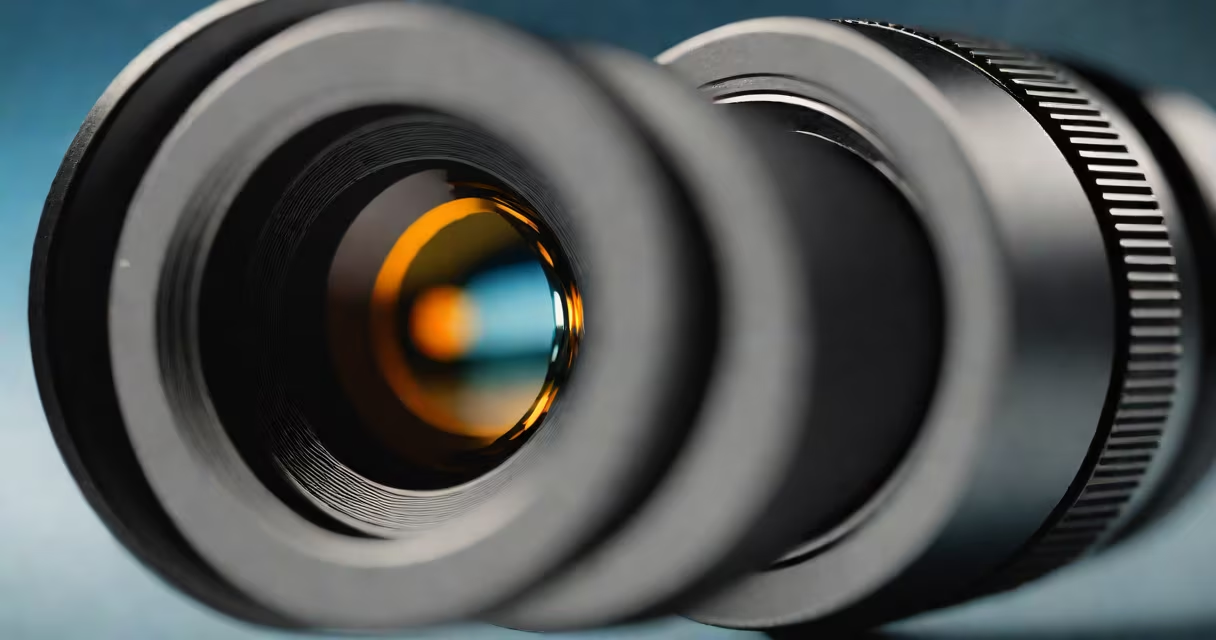
The function of the objective lens is to collect light from a specimen and create a magnified real image that is further enlarged by the eyepiece. It is the primary optical component responsible for resolution and magnification in compound microscopes.
Objective lenses are precision-ground glass elements mounted on a rotating turret or nosepiece. They work by bending incoming light rays through refraction, focusing them to form a clear, enlarged image of the sample. The quality of the image depends heavily on the lens's numerical aperture, focal length, and correction for optical aberrations.
Modern objectives are designed with multiple lens groups to correct chromatic and spherical distortions. A 40x objective with a numerical aperture of 0.65 can resolve features as small as 0.8 micrometers under standard illumination. This level of detail makes objective lenses essential in fields like pathology, microbiology, and semiconductor inspection.
When light passes through a transparent specimen, it carries encoded structural information. The objective lens captures this light and focuses it into a real image located within the microscope's body. This image is then magnified further by the ocular lens, typically to 10x or 15x, resulting in total magnifications ranging from 40x to 1000x.
Resolution-the ability to distinguish between two closely spaced points-is determined by the objective's numerical aperture (NA). NA is calculated as n × sin(θ), where n is the refractive index of the medium between the lens and specimen (air = 1.0, oil = 1.51), and θ is half the angular aperture of the lens. Higher NA means better resolution and greater light-gathering capacity.
For example, a 100x oil immersion objective with an NA of 1.4 requires immersion oil between the lens and slide to prevent light scattering. Without oil, the NA drops to ~0.9, reducing resolution by nearly 40%. This demonstrates why proper technique is critical for accurate imaging.
Objectives are categorized by magnification, working distance, and correction. The most common types include:
| Magnification | Numerical Aperture (NA) | Working Distance | Use Case |
|---|---|---|---|
| 4x | 0.10 | 20 mm | Scanning large samples, such as tissue sections or soil particles |
| 10x | 0.25 | 10 mm | General observation, classroom labs, and initial screening |
| 40x | 0.65 | 0.5 mm | Detail analysis of cells, bacteria, and fine structures |
| 100x | 1.40 (oil immersion) | 0.1 mm | High-resolution imaging of organelles, viruses, and nanomaterials |
Plan objectives provide flat-field images across the entire field of view, making them ideal for photography and digital imaging. Apochromatic objectives correct for chromatic aberration across multiple wavelengths, offering superior color fidelity-critical in fluorescence microscopy.
A non-obvious distinction: many users assume higher magnification always means better performance. But a 100x objective with poor correction may produce blurry or distorted images compared to a well-corrected 40x lens. Resolution depends on both magnification and optical quality.
Some confuse the objective lens with the condenser lens. While the objective gathers light from the specimen, the condenser focuses light onto the specimen from below. The condenser controls illumination intensity and contrast, especially in Köhler illumination setups.
Another error is assuming all objectives are interchangeable. Objectives are calibrated to specific tube lengths (e.g., 160mm or infinity). Using a finite-length objective on an infinite-focus system causes focus shifts and image degradation. Always match objectives to the microscope's optical design.
I once observed a student attempt to use a 40x dry objective on a slide covered in oil. The lens touched the oil layer, causing permanent damage to the front element. The repair cost exceeded $200. This illustrates why understanding working distance and proper handling is important.
In clinical laboratories, pathologists use 20x and 40x objectives to examine blood smears for malaria parasites. A single infected red blood cell measures ~5 micrometers-visible only at 400x magnification. Without high-quality objectives, false negatives occur.
In materials science, researchers use 100x oil immersion objectives to study grain boundaries in metals. These interfaces determine strength and fatigue resistance. A 100x objective reveals crystal lattice patterns as small as 0.3 micrometers, enabling failure analysis and alloy development.
Even in education, objective lenses enable hands-on learning. A high school biology class using a 10x objective can observe onion epidermal cells, identifying nuclei and cell walls. The clarity of the image directly reflects the lens's performance.
Understanding the function of the objective lens ensures accurate interpretation of microscopic data. Whether in research, medicine, or teaching, the objective lens remains the core component of visualizing the unseen.
For context on how precise terminology matters in technical systems, reviewing the role of punctuation can clarify how small details impact clarity.