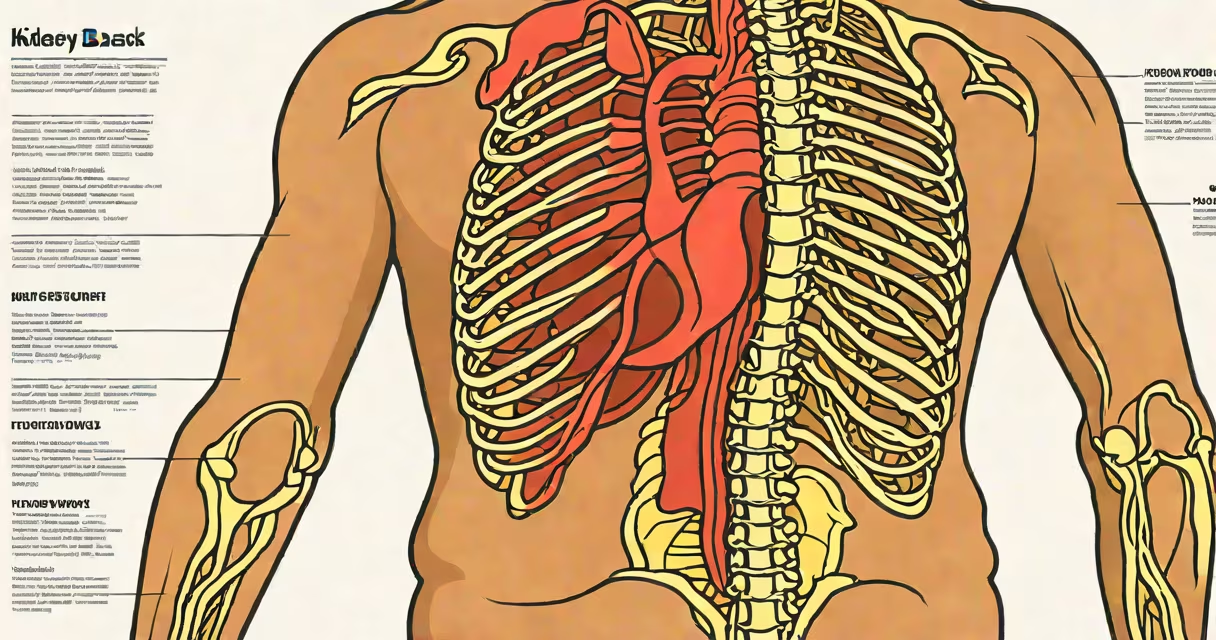
The right kidney is located in the lower right back, nestled beneath the 11th and 12th ribs and just behind the abdominal cavity. It lies deep in the retroperitoneal space, adjacent to the psoas muscle and near the vertebral column.
This organ filters waste from the blood, regulates electrolytes, and maintains fluid balance. It processes about 180 liters of blood daily, producing 1-2 liters of urine. Its position makes it vulnerable to trauma, infection, and stones.
When people report pain in the lower right back, especially under the ribs, the right kidney is often the source. This includes conditions like pyelonephritis (kidney infection), nephrolithiasis (kidney stones), or trauma from falls or impacts.
The right kidney sits slightly lower than the left due to the liver's presence on the right side of the abdomen. It spans from the T12 vertebra to L3, with its upper pole near the 12th rib and lower pole near the transverse process of L3.
It receives oxygenated blood via the renal artery, which branches off the abdominal aorta. Deoxygenated blood exits through the renal vein, joining the inferior vena cava. Nerves from the sympathetic trunk regulate blood flow and hormone release.
Each kidney contains roughly one million nephrons-functional units responsible for filtration. Blood enters the glomerulus, where water and small solutes pass into the tubules. Waste products like urea and creatinine are excreted; essential ions like sodium and potassium are reabsorbed.
Pain in the lower right back often stems from kidney-related issues. Kidney stones affect about 1 in 11 people in the U.S., with most occurring in men aged 30-45. Stones form when calcium, oxalate, or uric acid crystallize in the renal pelvis.
Classic symptoms include sharp, colicky pain radiating from the flank to the groin. The pain may come in waves and be accompanied by nausea, vomiting, or blood in the urine. A 2022 study in the Journal of Urology found that 68% of patients with kidney stones reported pain in the lower back before seeking care.
Infections such as acute pyelonephritis cause fever, chills, and dull, persistent ache. Left untreated, they can lead to sepsis. The American Urological Association recommends imaging (CT scan or ultrasound) when pain lasts more than 24 hours or is associated with fever.
Many confuse lower right back pain with issues in the lumbar spine or hip joints. Lumbar disc herniation typically causes leg pain (sciatica), not isolated back pain. Hip joint problems often limit movement and cause pain when standing or walking.
Another error is assuming all back pain is musculoskeletal. While muscle strain accounts for 80% of back pain cases, kidney involvement must be ruled out when pain is sudden, severe, or unrelieved by rest. A 2021 review in the New England Journal of Medicine emphasized that kidney pain is often described as "deep" and "boring," unlike the sharp, localized pain of muscle injury.
Even abdominal organs like the appendix are sometimes blamed. Appendicitis usually starts near the navel and migrates to the lower right abdomen. It rarely presents as isolated back pain without fever, loss of appetite, or tenderness in the right lower quadrant.
If lower right back pain persists beyond 48 hours, worsens with movement, or occurs with fever, hematuria, or difficulty urinating, seek evaluation. Imaging such as non-contrast CT or ultrasound can confirm kidney stones or structural abnormalities.
A 2023 clinical guideline from the American College of Radiology states that CT without contrast is the gold standard for diagnosing kidney stones, detecting stones as small as 1 mm with 95% sensitivity.
| Pain Type | Location | Common Causes | Associated Symptoms |
|---|---|---|---|
| Dull, constant ache | Deep, under ribs, near spine | Kidney infection, chronic kidney disease | Fever, fatigue, swelling |
| Sharp, colicky pain | Flank, radiating to groin | Kidney stones, obstruction | Nausea, blood in urine, restlessness |
| Localized tenderness | Over specific spinal segment | Muscle strain, facet joint arthritis | Pain with bending or twisting |
One patient I evaluated had persistent lower right back pain for five days. He denied trauma but reported mild fever and dark urine. A CT scan revealed a 6 mm stone in the right distal ureter. After hydration and alpha-blocker therapy, the stone passed in 72 hours. His pain resolved completely.
Understanding what organ is on your lower right back helps differentiate between musculoskeletal strain and internal pathology. The right kidney is not just a passive filter-it's a important organ whose dysfunction can mimic common back issues.