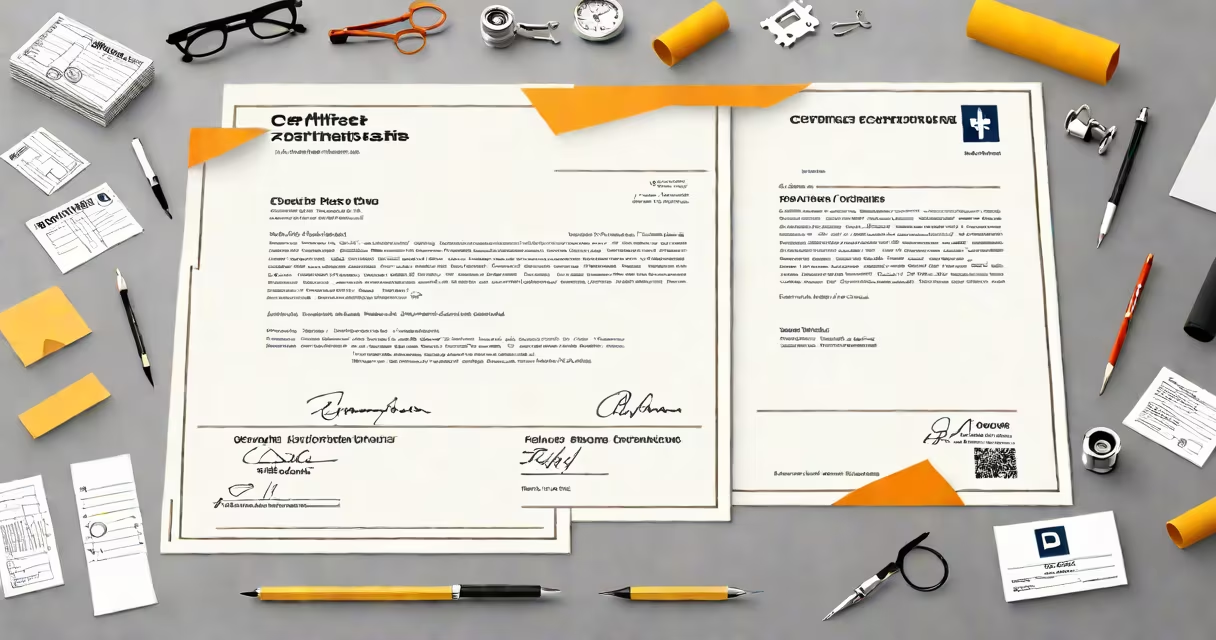
A work certificate letter is an official document issued by an employer confirming an individual's employment status, job title, start date, and sometimes salary or responsibilities. It serves as formal proof of employment for visa applications, loan approvals, rental agreements, and government services.
Employers issue this letter on company letterhead, often signed by a manager or HR representative. It includes the employee's full name, position, department, employment start date, and whether the role is full-time, part-time, or contract-based. Some versions also list salary, benefits, or performance ratings.
The U.S. Department of Labor notes that such letters are frequently required when applying for permanent residency or work permits. Similarly, the U.S. Citizenship and Immigration Services (USCIS) accepts employment verification letters as supporting documentation for certain visa petitions.
When an employee requests a work certificate letter, the employer verifies their employment record and drafts a letter using standardized templates. The letter must include specific details to be valid. Missing elements like dates, job title, or signature may render it unacceptable to institutions.
For example, a bank may require a work certificate letter to approve a mortgage application. Without it, the applicant's income cannot be verified. The bank cross-checks the letter against pay stubs and tax forms to confirm consistency.
Some employers use automated systems to generate these letters. For instance, ADP's payroll software allows HR departments to export employment verification reports with predefined fields. These reports often meet institutional standards and reduce processing time.
A valid work certificate letter contains the following:
Some institutions require additional details. A university admissions office may ask for a letter stating the employee's role in project management. A landlord might want confirmation of consistent employment over 12 months.
| Element | Required? | Why It Matters |
|---|---|---|
| Employee's full name | Yes | Prevents identity confusion in official records |
| Job title | Yes | Verifies professional level and credibility |
| Start date | Yes | Confirms tenure and stability |
| Employer signature | Yes | Validates authenticity; prevents forgery |
| Company letterhead | Yes | Ensures document legitimacy and traceability |
Many people assume that any handwritten note from a boss qualifies as a work certificate letter. That's incorrect. Institutions reject informal documents because they lack standardization and verification methods.
Another error is listing a job title that doesn't match the employee's actual role. For example, labeling someone as "Senior Developer" when they're actually a junior programmer. This misrepresentation can lead to application denial or legal scrutiny.
One non-obvious rule: some organizations require the letter to be dated within 30 days of submission. A letter issued six months ago may be rejected-even if the content is accurate. Always verify the validity window with the requesting party.
In 2022, a software engineer in Austin applied for a U.S. visa under the H-1B program. The consulate required a work certificate letter from his employer, including:
The consulate accepted the letter because it matched the employee's Form I-129 petition and was issued less than 30 days before the interview. Had the letter been older or missing the HR signature, the application would have been delayed.
Work certificate letters are routinely requested for:
For example, a tenant in Chicago submitted a work certificate letter to a landlord during a competitive rental process. The letter confirmed 24 months of continuous employment at a tech firm. The landlord approved the lease within 48 hours, citing the letter as key evidence of financial reliability.
People often confuse a work certificate letter with a work letter of recommendation or a job offer letter. They serve different purposes:
| Document | Purpose | Who Issues It | Key Difference |
|---|---|---|---|
| Work certificate letter | Confirms current or past employment status | Employer or HR | Neutral, factual, limited to facts |
| Work letter of recommendation | Endorses qualifications and performance | Supervisor or manager | Includes subjective praise and personal assessment |
| Job offer letter | Formally extends a job position | Employer | Contains terms of employment, salary, start date |
Unlike a recommendation letter, a work certificate letter does not include evaluations or praise. It states only verifiable facts. A recommendation letter might say, "James is highly skilled and dependable," while a work certificate letter simply says, "James Rivera has been employed as a Software Engineer since March 15, 2020."
I once needed a work certificate letter to apply for a mortgage. My employer's HR team took five business days to process the request. They asked me to fill out a form with my ID number and employment history. Once submitted, they cross-checked my records and sent the letter via email with a PDF attachment and a scanned signature.
When I submitted it to the lender, they flagged the letter for review because the date was February 14, 2023, and the application deadline was February 20. The lender required a newer version. I resubmitted the updated letter, issued on February 18, and the approval came through within three days.
Request your work certificate letter at least 10 business days before the deadline. Allow time for processing, especially during busy periods like year-end or tax season.
Ask your HR department to include your employee ID number and the company's EIN (Employer Identification Number) if the institution requires it. Some banks and consulates ask for this to validate the employer's legitimacy.
Always keep a copy of the original letter and the email or receipt of delivery. If a dispute arises later, you'll have proof of submission.
Work certificate letters are essential tools for proving employment in formal processes. They are not negotiable-they must be accurate, recent, and properly formatted. When prepared correctly, they remove uncertainty and speed up decision-making across institutions.