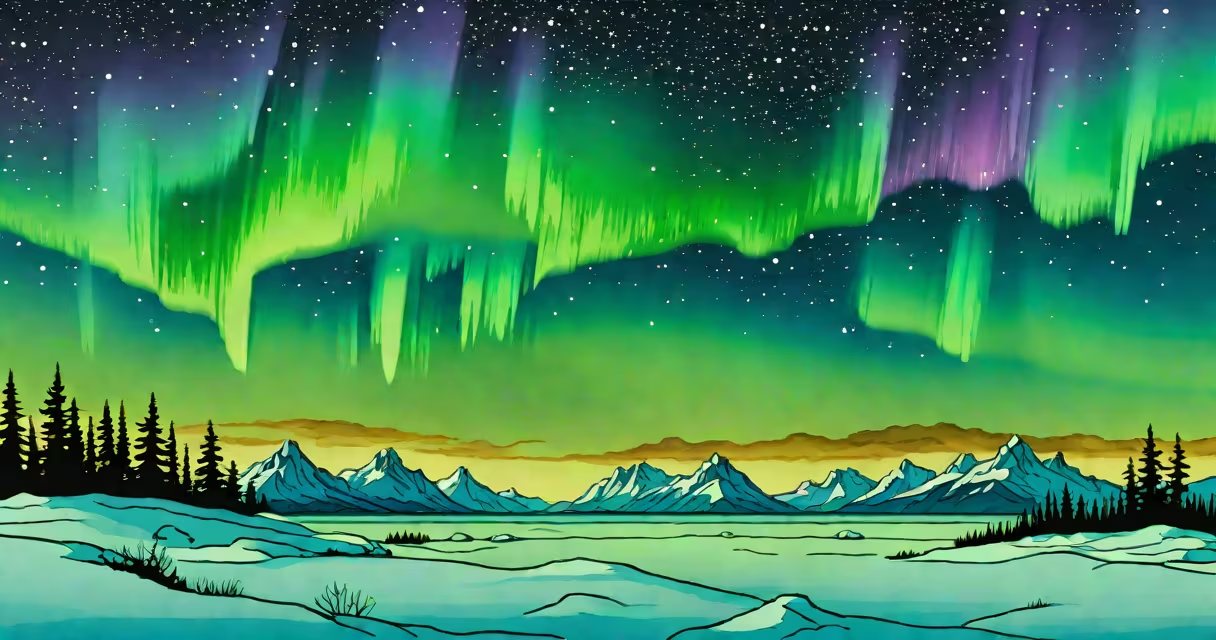
The aurora borealis, or northern lights, is a natural light display caused by charged particles from the sun colliding with Earth's upper atmosphere near the magnetic poles. These collisions excite oxygen and nitrogen atoms, which then emit light in colors ranging from green to purple.
Solar wind-streams of charged particles ejected from the sun's corona-drives auroral activity. When these particles interact with Earth's magnetosphere, they follow magnetic field lines toward the poles. There, they collide with atmospheric gases, producing the luminous displays seen in high-latitude regions.
Scientific observations confirm that auroras occur most frequently during periods of heightened solar activity, such as solar maximums, which happen roughly every 11 years. The current solar cycle (Cycle 25) began in December 2019 and reached peak activity in 2024, increasing the likelihood of intense auroral displays.
Auroras begin with coronal mass ejections (CMEs)-large bursts of plasma and magnetic fields from the sun's surface. When a CME reaches Earth, it compresses the magnetosphere and triggers geomagnetic storms. These storms accelerate electrons along magnetic field lines into the ionosphere, where they collide with atmospheric molecules.
Oxygen atoms at altitudes between 100 and 300 km emit green light (557.7 nm wavelength) when excited. At higher altitudes, around 200 km, oxygen emits red light. Nitrogen molecules produce blue and purple hues upon ionization. The combination creates the shifting ribbons and curtains seen in auroral displays.
Visual patterns depend on magnetic field alignment and particle energy. Low-energy particles create steady glows; high-energy particles generate rapid flickering and dancing shapes. The most changing displays often occur during sudden impulses in the solar wind.
Auroras are visible within an oval-shaped region centered on each magnetic pole, known as the auroral oval. This zone typically spans latitudes between 60° and 75° north and south. In the Northern Hemisphere, prime viewing locations include northern Scandinavia, Iceland, northern Canada, Alaska, and parts of Siberia.
During strong geomagnetic storms, the auroral oval expands equatorward. In rare cases, auroras have been seen as far south as Texas, Florida, and southern Europe. Historical records show major events in 1859 (the Carrington Event) and 1989, both linked to extreme solar storms that disrupted power grids and produced visible auroras at low latitudes.
For accurate prediction, scientists use models based on solar wind speed, density, and interplanetary magnetic field orientation. Real-time monitoring systems like NASA's ACE satellite provide data with a 15-60 minute lead time before solar wind impacts Earth.
| Color | Altitude | Gas Involved | Energy Level |
|---|---|---|---|
| Green | 100-300 km | Oxygen | Medium |
| Red | 200-400 km | Oxygen | Low |
| Blue/Purple | 100 km and below | Nitrogen | High |
Green is the most common auroral color due to the abundance of oxygen at mid-altitudes. Red emissions are rarer because they require longer relaxation times and occur at lower densities. Blue and purple hues appear during intense particle bombardment and are often seen at the edges of active auroras.
Some auroras exhibit structured forms like rays, arcs, and coronas. Rays form when magnetic field lines align vertically, creating vertical streaks. Arcs appear as broad bands across the sky. Coronal displays happen when rays converge overhead, making the aurora seem to radiate from a central point.
Many assume auroras are caused by atmospheric refraction or temperature changes. This is incorrect. The phenomenon results entirely from solar-driven particle interactions with Earth's magnetic field and upper atmosphere.
Another myth is that auroras are visible everywhere in the Arctic. In reality, they require dark skies, clear conditions, and sufficient solar activity. Light pollution, cloud cover, and moonlight can obscure visibility even in ideal geographic zones.
A lesser-known fact: auroras are not limited to Earth. Jupiter, Saturn, Uranus, and Neptune all exhibit auroral activity. Jupiter's auroras are powered by its strong magnetic field and volcanic moon Io, which injects plasma into the planet's magnetosphere. These auroras are much brighter and larger than Earth's.
I once observed a moderate aurora near Tromsø, Norway, during a late October trip. The KP index was 5, indicating a moderate storm. The sky showed rippling green curtains moving east to west. A local guide confirmed that such displays were expected due to a recent CME impact recorded by the DSCOVR satellite.
For optimal viewing, wait until local midnight when the sky is darkest. Avoid city lights and check forecasts for cloud cover. Apps like My Aurora Forecast and the NOAA Space Weather Prediction Center offer alerts based on solar wind data.
Understanding the aurora borealis reveals how Earth interacts with space weather. Solar activity influences satellite operations, radio communications, and power grid stability. Monitoring these events helps protect infrastructure and enhances scientific insight into planetary magnetospheres.
Each aurora borealis display is a direct result of solar dynamics and Earth's magnetic environment. With accurate forecasting tools and global observation networks, people can now witness this celestial event with greater precision and safety.