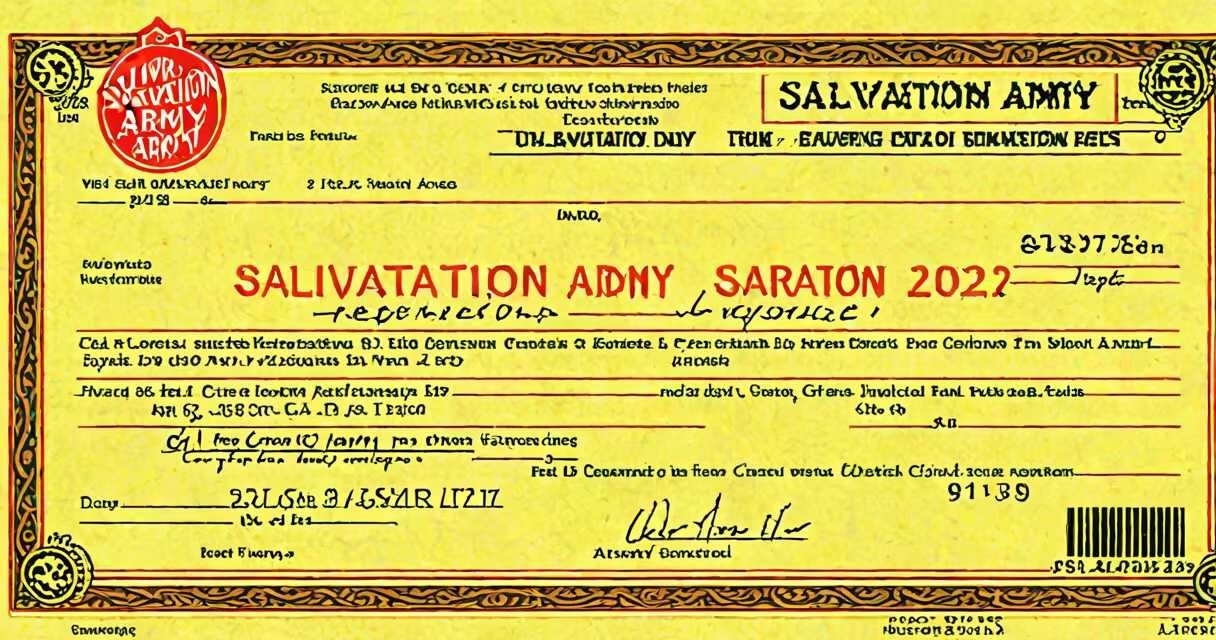
A salvation army receipt for taxes is a document issued by The Salvation Army that confirms a charitable donation was made and includes the necessary details for claiming a tax deduction. To meet IRS requirements, the receipt must list the donor's name, the date of the contribution, the amount donated, and the organization's legal name and tax ID number.
The IRS allows individuals to deduct cash donations to qualified nonprofits like The Salvation Army, but only if they have proper documentation. Without a receipt, donors risk losing the deduction during an audit. The Salvation Army provides receipts upon request for donations made in person, online, or via text. These receipts are essential for filing accurate federal tax returns.
Donations of $250 or more require a written acknowledgment from the charity. This acknowledgment must state whether the donor received goods or services in exchange for the gift. If so, the value of those benefits must be disclosed. For example, if a donor gives $300 and receives a $50 holiday ornament, the receipt must reflect that $250 was a deductible contribution.
Not all paper slips or email confirmations qualify as official tax documents. A valid salvation army receipt for taxes must contain four core elements: the donor's full name, the date of the donation, the exact amount contributed, and the organization's full legal name and Employer Identification Number (EIN).
The Salvation Army's EIN is 23-7222677. This number must appear on the receipt. If it doesn't, the IRS may reject the deduction. Many donors assume that a printed receipt from a red kettle or a mobile app confirmation is sufficient. But unless it includes the EIN and a clear statement of the donation amount, it lacks legal standing.
For online donations, the Salvation Army sends a confirmation email with a downloadable PDF receipt. These emails often include a unique transaction ID and a timestamp. While useful for recordkeeping, they are not automatically accepted by the IRS unless they contain the required details. Always verify that the document includes the EIN and a clear breakdown of the contribution.
When donating goods such as clothing, furniture, or household items, the value of the contribution depends on the condition and market demand. The Salvation Army does not assign a fixed value to donated items. Instead, donors must estimate fair market value based on current retail prices for similar used goods.
For example, a donor who gives a used leather jacket valued at $100 must report $100 as the donation amount. If the jacket is sold by The Salvation Army for $60, the donor cannot claim more than the actual fair market value. Overstating the value increases audit risk. The IRS requires donors to maintain records of the item's description, date of donation, and estimated value.
Donors who give items worth more than $500 must complete Form 8283 and attach it to their tax return. The form requires a detailed list of all non-cash donations exceeding $500. If the total exceeds $500 in any single year, the IRS may require a qualified appraisal for items valued above $500. This rule applies regardless of whether the donor received a receipt.
Many people believe that any paper with "Salvation Army" on it qualifies as a tax receipt. That's incorrect. A handwritten note on a napkin, a social media post, or a verbal promise does not count. Only a formal acknowledgment from the organization meets IRS standards.
Another misconception is that the Salvation Army issues a receipt for every donation, even small ones. In reality, the organization only mails a receipt upon request. If a donor donates $10 through a mobile app and doesn't ask for a receipt, they may lack documentation. The IRS does not accept bank statements alone as proof of donation unless they include the charity's name, date, and amount.
Here's a real-world example: Jane donated $200 to The Salvation Army via PayPal in December. She received a confirmation email stating "Thank you for your $200 donation." The email did not include the EIN or a donor name field. Jane filed her taxes using only the email. The IRS rejected her deduction because the document lacked required details. She later requested a corrected receipt from The Salvation Army and resubmitted her return with the proper form.
| Type of Contribution | Receipt Required? | Minimum Value Requiring Written Acknowledgment | Additional IRS Forms Needed |
|---|---|---|---|
| Cash donation (in person, online, text) | Yes | $250 | Form 8283 if total non-cash donations exceed $500 |
| Non-cash goods (clothing, furniture) | Yes | Not applicable - written acknowledgment required for all non-cash gifts | Form 8283 for items over $500 |
| Stock or securities | Yes | $250 | Form 8283 and potentially a qualified appraisal |
I once attended a Salvation Army fundraising event where a volunteer handed out printed receipts for donations under $250. They were missing the EIN and donor name fields. I asked for a corrected version. The volunteer confirmed that only donations over $250 required the full form. That moment highlighted how easily donors can overlook critical details.
The Internal Revenue Service provides official guidance on charitable contributions in Publication 526, "Charitable Contributions." This document outlines the rules for deducting donations, including the requirement for written acknowledgment. According to the IRS, "A written acknowledgment must be obtained from the charity for each contribution of $250 or more."
Donors should also consult a tax professional when reporting large or complex donations. The IRS treats contributions of $500 or more differently than smaller ones. For example, if a donor gives $1,000 in cash and receives a $100 gift card, the deductible amount is $900. The receipt must state the value of the benefit received.
Understanding what constitutes a valid salvation army receipt for taxes prevents errors and reduces audit risk. Always request a receipt with the EIN, donor name, date, and amount. Keep copies of all communications and transaction records. When in doubt, contact The Salvation Army directly to confirm the validity of your receipt.