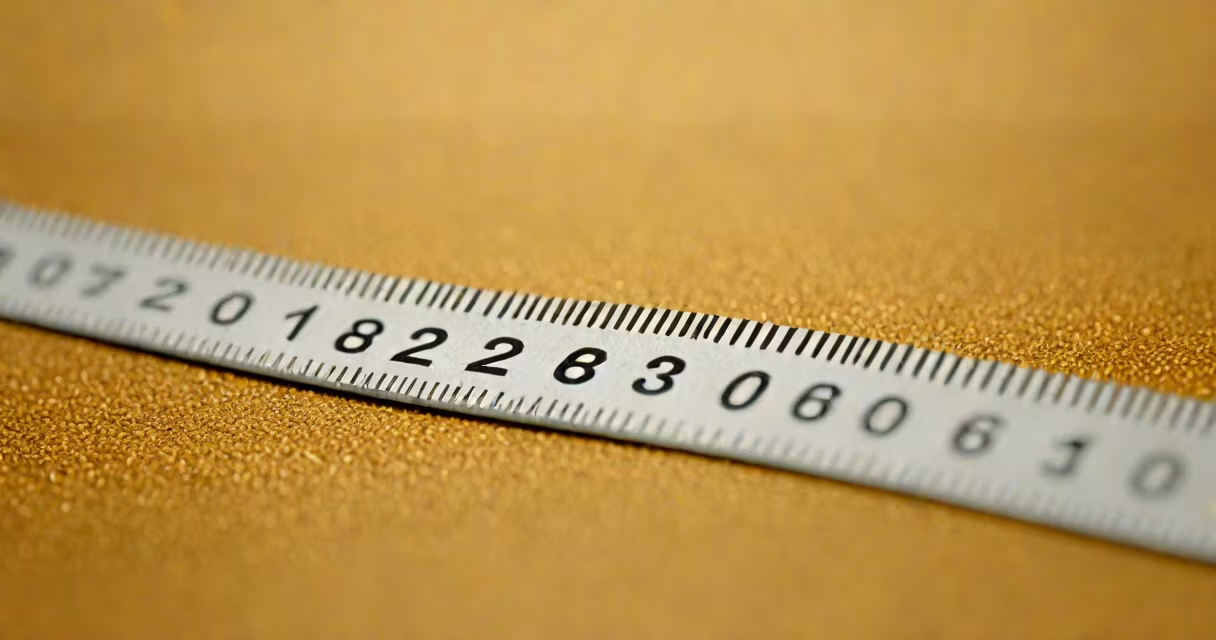
Two centimeters on a ruler is a distance equal to 20 millimeters, measured from the zero mark to the second full centimeter line. It appears as the second long tick after the zero point on a standard metric ruler.
On a metric ruler, each centimeter is divided into 10 equal parts, each representing 1 millimeter. The longest ticks mark whole centimeters, while shorter ticks represent millimeters. Two centimeters spans exactly two of these full centimeter segments, beginning at the zero line and ending at the second long tick.
This measurement is consistent across all standard metric rulers used in science, education, and everyday tasks. small objects, 2 cm provides a precise reference point for accuracy.
Each centimeter on a metric ruler is subdivided into 10 smaller divisions, each labeled with a number. The zero point marks the start. The first long tick after zero is 1 cm. The second long tick is 2 cm. Between these, you'll find nine shorter ticks-each representing 1 mm.
For example, if you place a ruler against a pencil and align the tip with the zero mark, the point where the pencil's eraser ends at the second long tick is exactly 2 cm long. This applies whether the ruler is 15 cm, 30 cm, or 1 meter in length.
The spacing between ticks is uniform. A 2 cm segment covers 20 mm, which is equivalent to 0.02 meters. This consistency ensures reliable measurements across tools and users.
Standard plastic or metal rulers typically display centimeters and millimeters. Some include inches on the opposite side for dual-unit measurement. The metric side uses a continuous scale from 0 to 30 cm or more.
Table: Common Ruler Types and Their 2 cm Mark Features
| Ruler Type | Scale Format | 2 cm Mark Appearance |
|---|---|---|
| Plastic School Ruler | 0-30 cm, 1 mm divisions | Second long tick after zero; labeled "2" |
| Metal Tape Measure | 0-150 cm, 1 mm divisions | Second long tick after zero; may have color-coded bands |
| Wooden Drafting Ruler | 0-30 cm, 0.5 mm precision | Second long tick; sometimes marked with a dot or line |
Some rulers use color coding to distinguish intervals. For example, every fifth millimeter may be a different color, helping users count faster. On such rulers, the 2 cm mark still lies at the second long tick, but the visual cues reduce errors during reading.
People often mistake 2 cm for 2 mm. The difference is tenfold: 2 mm is just two of the smallest ticks after zero, while 2 cm is the second full centimeter line. Misreading these leads to significant errors in projects requiring precision.
Another common error is confusing the metric scale with the imperial scale. On dual-sided rulers, the inch side shows fractions like 1/4 inch or 1/2 inch. One inch equals 2.54 cm, so 2 cm is slightly less than 4/5 of an inch. Users who mix units risk miscalculations, especially in crafting or engineering.
A non-obvious fact: the spacing between centimeter marks is standardized globally. According to the International Bureau of Weights and Measures (BIPM), metric units are defined by physical constants, ensuring that a 2 cm measurement on a ruler in Tokyo matches one in New York to within micrometers.
In a classroom setting, students use 2 cm as a benchmark for drawing shapes. For instance, when constructing a square with sides of 2 cm, they align the ruler from 0 to 2 and draw a line along the edge. This creates a square that fits precisely on a standard notebook page.
In sewing, patterns often specify 2 cm for seam allowances. A tailor measuring a hem must ensure the fold is exactly 2 cm wide. Using a ruler with clear markings avoids uneven edges and wasted fabric.
Here's a fully worked example: You're building a model airplane and need to cut a wing piece that is 2 cm wide. Place the ruler flat on the material. Align the zero mark with one edge. Slide the ruler until the second long tick lines up with the opposite edge. Cut along the edge of the ruler. The resulting piece is exactly 2 cm wide.
Understanding 2 centimeters on a ruler requires recognizing the structure of metric divisions. It is not a single tick but a span from 0 to the second long tick. Accuracy depends on identifying the correct tick lengths and avoiding confusion with millimeter or inch scales.