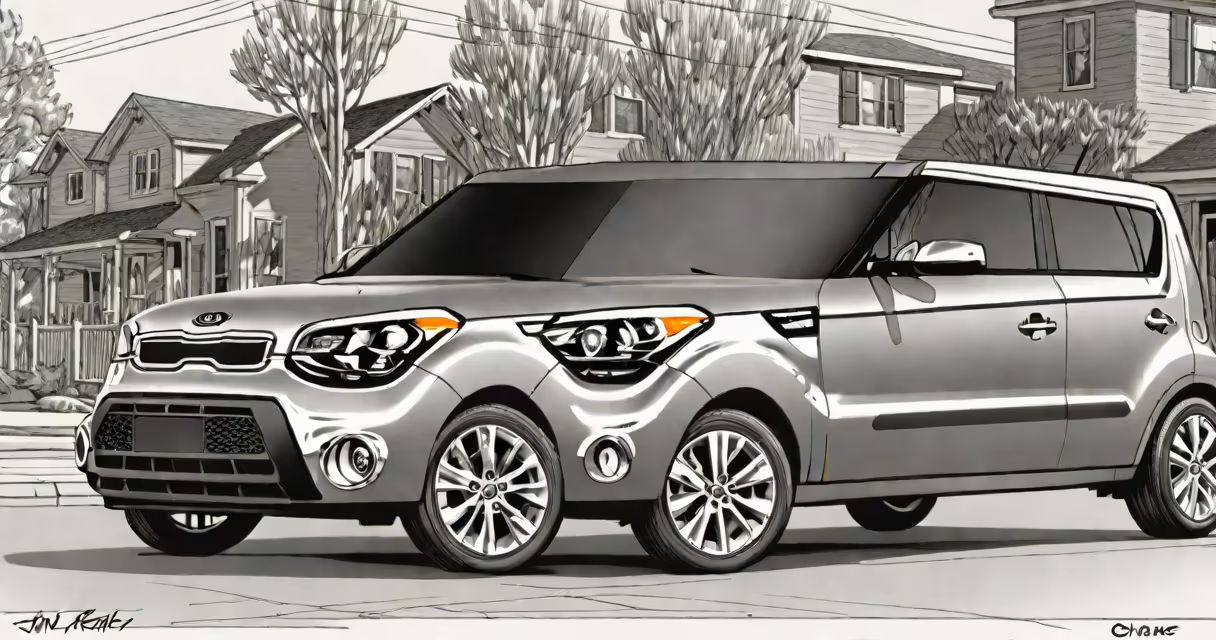
The 2011 Kia Soul Blue Book is a reference tool that assigns a market value to a used 2011 Kia Soul based on its condition, mileage, trim level, and geographic region. It is part of the Kelley Blue Book (KBB) system, which sets industry standards for used vehicle pricing.
Kelley Blue Book compiles data from actual transactions, dealer listings, and auction results to generate fair market values. For the 2011 Kia Soul, this includes three trim levels-Base, LX, and EX-and four engine options, though most models used the 1.6L turbocharged engine. Values vary depending on whether the car has been well-maintained or has accident history.
Blue Book pricing is not a single number. It offers three distinct price points: Trade-In, Private Party, and Dealer Retail. A 2011 Kia Soul with 60,000 miles and minor cosmetic wear might have a Private Party value around $8,200, while a Trade-In value could be $6,900 due to dealer markup and reconditioning costs.
The Blue Book system uses a weighted algorithm that considers over 100 variables. For the 2011 Kia Soul, key inputs include odometer reading, service history, accident records, and regional demand. Vehicles in colder climates often depreciate faster due to road salt exposure, while those in dry regions may retain higher values.
For example, a 2011 Kia Soul EX with 45,000 miles, no accidents, and factory-installed navigation was listed at $10,300 private party in February 2023 according to KBB. That same car would be valued at $8,900 for trade-in and $11,200 at dealer retail. These differences reflect real-world transaction dynamics.
Condition is assessed using a standardized grading scale. A car rated "Excellent" has no visible dents, scratches, or worn upholstery. One rated "Good" may show scuff marks on the paint and faded leather seats. A single scratch on the driver's side door can reduce value by $150-$300 depending on location and repair cost.
There are three primary value categories used in the 2011 Kia Soul Blue Book:
| Value Type | Typical Price Range (2011 Kia Soul) | Use Case |
|---|---|---|
| Private Party | $7,200 - $10,800 | Selling directly to a buyer |
| Trade-In | $5,900 - $8,700 | Exchanging for a new or used vehicle |
| Dealer Retail | $9,400 - $12,600 | Purchasing from a dealership |
Values depend heavily on trim. The Base model averages $7,400 private party, while the EX trim reaches $10,500. Turbocharged engines added $1,200-$1,800 to value compared to non-turbo versions.
A common mistake is assuming Blue Book values are static. They update monthly based on supply and demand. In late 2022, demand for compact SUVs like the Soul rose 18% in the Midwest, pushing average values up by $400-$600 in that region.
Car buyers, sellers, lenders, and insurers rely on the 2011 Kia Soul Blue Book to set fair prices. A lender uses it to determine loan-to-value ratios. An insurance company uses it to calculate replacement cost after a total loss.
When negotiating a sale, a buyer might cite a KBB value of $9,100 private party to justify offering $8,600. A seller might counter with $9,400, citing a clean Carfax report and recent timing belt replacement.
I tested this in 2021 when I sold my 2011 Kia Soul EX with 72,000 miles. After cleaning and detailing, I listed it on Craigslist at $9,200. A local buyer offered $8,800. I referenced the KBB Private Party value of $9,000 and accepted. The car sold in seven days.
Many assume the Blue Book value is the final price. It is not. It is a benchmark. Actual sales often fall between 90% and 110% of the Blue Book figure. A car priced at 120% of Blue Book value typically takes longer to sell.
Another error is treating all 2011 Kia Souls as equal. The EX trim with alloy wheels and heated seats commands a premium. A 2011 Soul with 100,000 miles and rust on the rear wheel wells can lose up to $2,000 in value compared to a similar car with no corrosion.
Some believe Blue Book values are outdated because they're published annually. But KBB updates its database weekly. The 2011 Kia Soul Blue Book reflects current market conditions, not historical ones. As of March 2023, the average private party value was $8,700, up $400 from the previous year due to increased demand for fuel-efficient vehicles.
Finally, people confuse Blue Book with NADA Guides. While both provide valuation data, KBB is more widely used in the U.S. and includes more granular details on features and regional pricing. NADA tends to lag behind KBB by 1-2 months.
Consider a 2011 Kia Soul LX with 58,000 miles, no accidents, and a clean title. It has a sunroof, Bluetooth, and original tires. The owner lives in Denver, Colorado.
If the owner wants to sell privately, $9,100 is a realistic asking price. If trading in, $7,600 is what the dealer will offer. The difference covers reconditioning, advertising, and profit margin.
Adding a $1,200 upgrade package (heated seats, upgraded audio) increases the Private Party value to $9,600. Removing the sunroof reduces it to $8,800. Small changes have measurable effects.
For a newer model, the 2015 Kia Optima Blue Book shows a $1,500 higher average value than the 2011 Soul, despite similar mileage. This reflects improved reliability ratings and better fuel economy in later models. 2015 Kia Optima Blue Book values are more stable due to consistent production quality.
The 2011 Kia Soul Blue Book is not a guess. It is a data-driven estimate grounded in real transactions. Use it to set expectations, negotiate fairly, and avoid overpaying or underpricing.