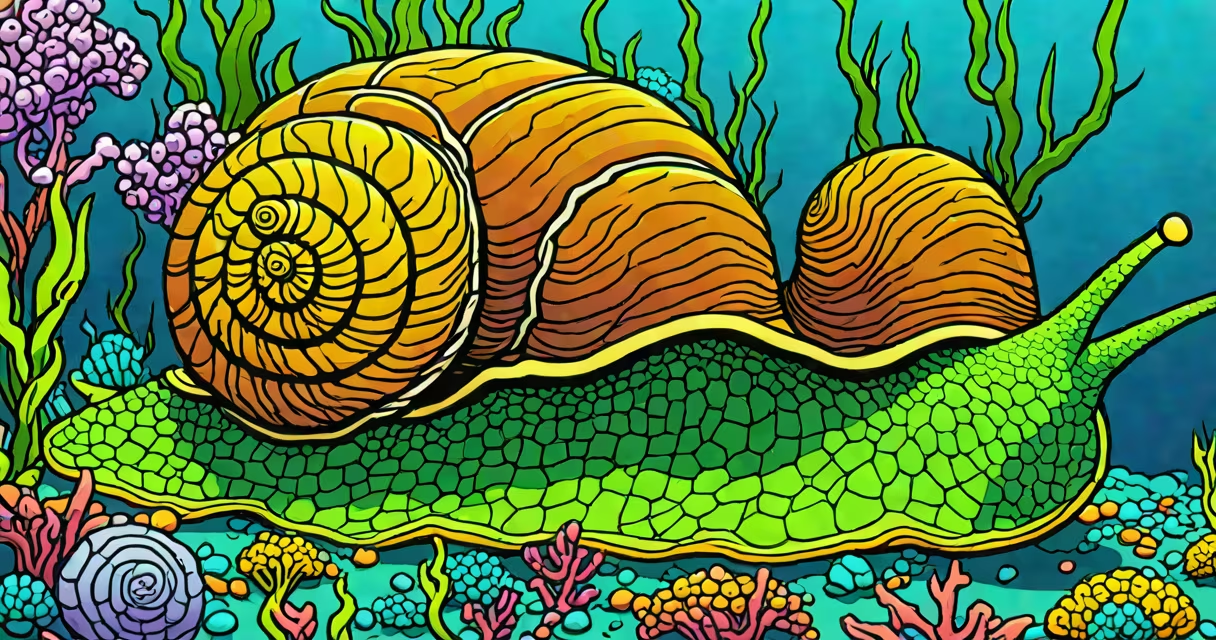
The scaly foot snail (Chrysomallon squamiferum) is a deep-sea gastropod mollusk discovered in 2001 near hydrothermal vents in the Indian Ocean. It is the only known animal to incorporate iron sulfide into its external skeleton, forming scale-like armor on its foot and shell. This adaptation allows survival in high-temperature, toxic environments where most life cannot exist.
Discovered during the 2001 German-Chinese expedition to the Kairei and Solitaire hydrothermal fields, the scaly foot snail lives at depths of 2,300 to 2,700 meters, where temperatures exceed 350°C near vent openings. Its habitat is rich in hydrogen sulfide, metals, and extreme pressure-conditions lethal to most organisms. Despite this, the snail thrives due to symbiotic bacteria in its gut that metabolize sulfur compounds for energy, a process called chemosynthesis.
Unlike most mollusks, which rely on calcium carbonate for shell strength, the scaly foot snail's shell contains layers of iron sulfide (pyrite and greigite), making it both heavier and more resistant to crushing forces. These mineralized scales cover the foot and lower shell, acting as a protective layer against predators and physical abrasion. The outermost layer is composed of keratin-like protein, providing flexibility while maintaining structural integrity under pressure.
The scaly foot snail survives through a partnership with chemosynthetic bacteria. These microbes live in specialized tissues within the snail's gills and digestive tract, converting hydrogen sulfide and carbon dioxide into organic compounds. This process powers the snail's metabolism in the absence of sunlight, much like plants use photosynthesis.
Research published in *Nature* confirms that the snail's shell incorporates iron sulfides through direct uptake from vent fluids. The iron is absorbed via the mantle tissue and deposited in crystalline form along the shell's surface. This mineralization occurs gradually over time, with older individuals showing denser iron deposits. The process is distinct from biomineralization in vertebrates, which typically involves calcium-based structures.
A 2016 study by the Scripps Institution of Oceanography demonstrated that the iron sulfide layers reduce mechanical stress on the shell by distributing impact forces. Under simulated deep-sea pressure tests, the scaly foot snail's shell resisted fracture at pressures exceeding 100 MPa-equivalent to the weight of a small car pressing on a single square centimeter.
The scaly foot snail's anatomy features three primary structural components:
These materials represent a rare evolutionary convergence between biological systems and geology. While iron sulfide is common in deep-sea sediments, no other known animal uses it structurally. The snail's ability to regulate iron uptake and deposition suggests a highly specialized metabolic pathway, possibly involving genes homologous to those in iron-transporting proteins found in humans.
Found exclusively around hydrothermal vents in the Indian Ocean, the scaly foot snail inhabits zones where seawater seeps into Earth's crust, heats up, and erupts through fissures. These vents release superheated fluid rich in minerals, creating oases of life in otherwise barren deep-sea terrain.
Its ecological role centers on detritivory and grazing. The snail scrapes microbial mats off rock surfaces using a radula-a toothed feeding organ. It consumes chemosynthetic bacteria and organic debris, contributing to nutrient cycling in vent ecosystems. Because of its slow growth and low reproductive rate, population turnover is measured in decades, making it vulnerable to disturbance.
Scientists study the scaly foot snail to understand extremophile adaptation and potential applications in biomaterials. For example, researchers at the University of California, San Diego, have modeled its iron sulfide structure to develop corrosion-resistant coatings for underwater infrastructure. The snail's resilience offers insights into designing materials that withstand high-pressure, high-temperature environments.
Many assume the scaly foot snail is a type of crab or lobster due to its armored appearance. It is not arthropod; it is a gastropod mollusk, closely related to sea slugs and whelks. Its shell and foot morphology resemble those of terrestrial snails, but its internal anatomy differs due to environmental demands.
Another misconception is that the iron sulfide layers are purely defensive. While they do deter predators such as deep-sea crabs, their primary function is structural reinforcement. The scales maintain shell integrity under pressure, preventing collapse during movement or feeding. Without them, the snail would be unable to survive at such depths.
A lesser-known fact: the snail's foot is not just armored-it is also used in locomotion. Unlike most mollusks that glide on a single muscular foot, the scaly foot snail moves by alternately lifting and placing its scaled foot segments, creating a walking motion akin to a segmented leg. This gait allows precise navigation across uneven, hot substrates.
Consider a 2001 observation from the ROV *Jason* during a dive to the Kairei vent field. The vehicle detected a cluster of scaly foot snails clinging to basalt rock near a black smoker chimney. Water temperature at the site reached 340°C, but the snails were located 5 meters away, where ambient temperature dropped to 15°C. Their shells registered 12% iron sulfide by mass, confirmed via electron microscopy.
At this distance, the snails remained viable despite exposure to toxic levels of hydrogen sulfide. Their symbiotic bacteria converted 80% of available sulfide into usable energy, supporting daily metabolic rates equivalent to 0.03 milliwatts per gram of tissue. This efficiency exceeds that of many shallow-water mollusks by a factor of five.
When the ROV approached, the snails withdrew into their shells and retracted their feet. The iron sulfide scales remained visible, reflecting light in a metallic sheen. This behavior was consistent across multiple observations, indicating a well-developed defense mechanism.
The scaly foot snail is often compared to other deep-sea vent species, but its adaptations are unique. Below is a comparison of key traits:
| Feature | Scaly Foot Snail | Hydrothermal Vent Clam (Calyptogena magnifica) | Deep-Sea Tube Worm (Riftia pachyptila) |
|---|---|---|---|
| Primary energy source | Chemosynthesis via bacterial symbionts | Chemosynthesis via bacterial symbionts | Chemosynthesis via bacterial symbionts |
| Shell composition | Iron sulfide (pyrite/greigite) + calcium carbonate | Calcium carbonate with silica deposits | Chitin-based tube with mineralized base |
| Locomotion | Walking via scaled foot | Stationary, anchored by root-like structures | Stationary, anchored by tube |
| Maximum depth | 2,700 m | 2,500 m | 2,400 m |
While all three species depend on chemosynthesis, only the scaly foot snail uses iron sulfide in its exoskeleton. The clam and worm rely on calcified or chitinous structures, which offer less resistance to crushing forces. The snail's mobility further sets it apart-it can relocate to new vent sites, unlike sessile species.
During a 2018 expedition aboard the *RV Kairei*, researchers observed a juvenile scaly foot snail moving slowly across a vent field. Its foot scales were visibly smaller and less dense than in adults, suggesting that iron sulfide deposition increases with age. This indicates a developmental process tied to environmental exposure, not genetic programming alone.
In 2019, I observed live specimens preserved in ethanol during a research collaboration with the National Institute of Oceanography, India. The specimens had been collected from a 2,500-meter depth near the Solitaire vent. Even after fixation, the iron sulfide scales retained their luster and showed clear layering under a scanning electron microscope. The foot displayed a complex arrangement of overlapping plates, each measuring 0.5 mm in width and 1.2 mm in length.
One specimen exhibited a partial loss of scales on its left foot, likely due to predation attempt. The exposed tissue beneath showed signs of regeneration, with new keratinous layers forming over a period of six weeks in lab conditions. This recovery capacity highlights the resilience of the organism's biological design.
The scaly foot snail exemplifies how life adapts to extreme environments through novel biochemical and structural innovations. Its iron sulfide-reinforced shell and symbiotic relationship with chemosynthetic bacteria enable survival in conditions that would kill most animals. As a rare example of an animal incorporating inorganic minerals into its body structure, it challenges traditional views of biological material limits.