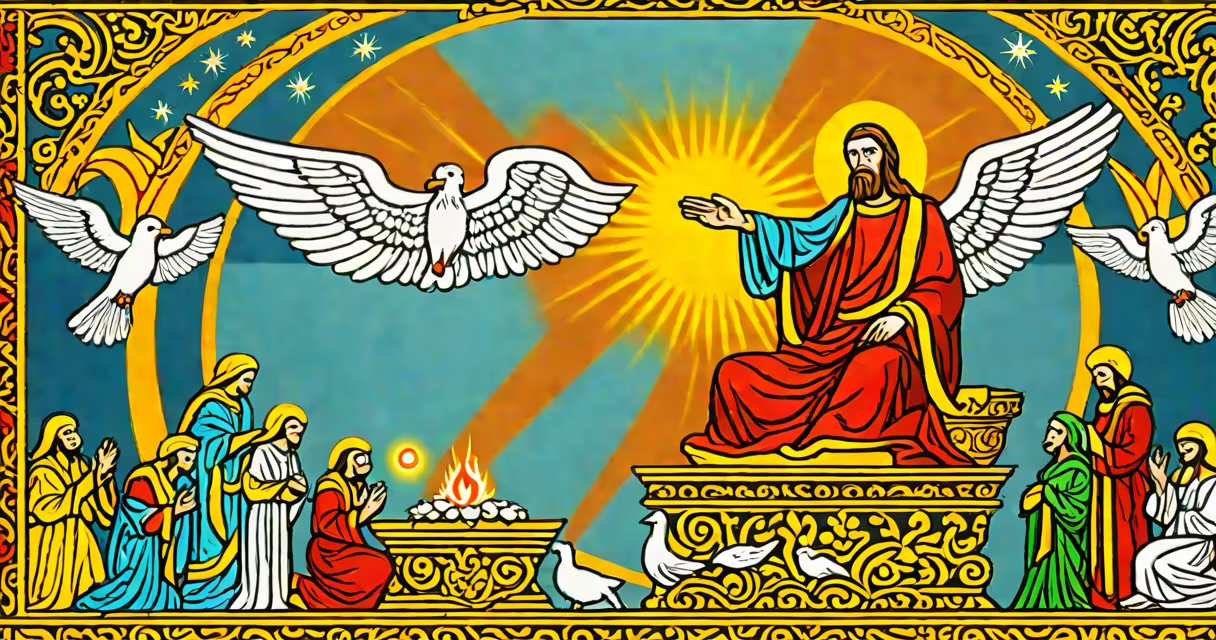
The 7 gifts of the holy spirit meaning refer to divine graces bestowed upon believers to guide moral decisions, deepen faith, and strengthen spiritual life. They are drawn from Isaiah 11:2-3 and formally defined in Catholic teaching as wisdom, understanding, counsel, fortitude, knowledge, piety, and fear of the Lord.
These gifts are not abilities earned through effort but supernatural endowments received through baptism and confirmation. They operate within the soul to align thoughts and actions with God's will. Unlike spiritual fruits such as love or joy, which are outcomes of grace, the gifts are active dispositions that enable discernment and virtuous action.
St. Thomas Aquinas identified these gifts in his *Summa Theologica* as infused virtues that perfect human reason. He wrote that they "dispose man to act according to the inspiration of the Holy Spirit" (ST II-II, Q. 8, Art. 1). This theological structure shapes Catholic catechesis and sacramental preparation.
Each gift operates in a distinct way, enabling believers to respond to challenges with divine insight. Wisdom allows judgment beyond immediate circumstances-choosing what truly matters. Understanding reveals the deeper meaning behind Scripture and suffering. Counsel provides practical guidance in difficult choices.
Fortitude grants courage to endure persecution or personal hardship. Knowledge enables accurate grasp of truths, especially those related to faith and ethics. Piety fosters reverence and devotion toward God and others. Fear of the Lord is not terror but profound awe-recognizing God's majesty and holiness.
For example, a parent facing a child's serious illness may feel overwhelmed. The gift of understanding helps them see the situation not as random tragedy but as part of a larger divine plan. Fortitude supports endurance through medical treatments. Counsel may lead them to seek pastoral care. Piety strengthens their prayer life. These are not emotional responses but major dispositions shaped by grace.
The foundation of the 7 gifts lies in Isaiah 11:2-3: "The spirit of the Lord shall rest upon him: a spirit of wisdom and understanding, a spirit of counsel and fortitude, a spirit of knowledge and piety, and a spirit of fear of the Lord." This passage describes the Messiah, but Christian tradition applies it to all who receive the Holy Spirit.
Early Church Fathers like St. Augustine and St. Gregory the Great expanded on this. Augustine stated in *On the Trinity* that "the gifts of the Spirit are not for show, but for sanctification." He emphasized that their purpose is not display but inner transformation.
Modern Catholic doctrine confirms this in the *Catechism of the Catholic Church* (CCC 1830): "The Holy Spirit gives the Church the power to proclaim the Gospel and to live in holiness. Among these gifts are wisdom, understanding, counsel, fortitude, knowledge, piety, and fear of the Lord."
Many confuse the 7 gifts with spiritual charisms listed in 1 Corinthians 12-such as healing, prophecy, or speaking in tongues. These are different categories. Charisms are extraordinary manifestations for the common good; the gifts are interior dispositions for personal sanctity.
A frequent error is assuming the gifts are optional or reserved for saints. But the Catechism teaches that all baptized Christians are called to grow in these gifts. They are not limited to clergy or religious. A teacher, nurse, or engineer can receive and live by them.
Another misconception is equating "fear of the Lord" with dread. In Hebrew, the term *yir'ah* means reverential awe-not terror. It is the attitude of a child before a loving father. As Psalm 111:10 says: "The fear of the Lord is the beginning of wisdom."
While the 7 gifts are most fully developed in Roman Catholic theology, Eastern Orthodox and some Protestant traditions recognize similar concepts under different names. For example, the Eastern Church speaks of the "sevenfold grace" of the Spirit, though it does not categorize them identically.
The table below compares the gifts across traditions:
| Gift | Catholic Teaching | Eastern Orthodox View | Protestant Interpretation |
|---|---|---|---|
| Wisdom | Divine insight into eternal truths | Seen in liturgical worship and ascetic practice | Often linked to discernment in life decisions |
| Understanding | Grasp of spiritual realities beyond logic | Emphasized in mystical theology | Viewed as deeper Bible study insight |
| Counsel | Practical guidance in moral choices | Part of spiritual direction and repentance | Associated with wise advice from Scripture |
| Fortitude | Courage to face trials and martyrdom | Exemplified in monastic endurance | Linked to perseverance in faith |
| Knowledge | Truth about God and creation | Part of theological education | Understood as biblical literacy |
| Piety | Devotion to God and neighbor | Expressed in daily prayers and fasting | Connected to worship and service |
| Fear of the Lord | Reverence for God's holiness | Central to repentance and humility | Interpreted as respect for divine authority |
One non-obvious distinction: the Catholic Church teaches that the gifts are infused at baptism and grow through prayer and virtue. They are not activated by performance but cultivated through consistent openness to grace. This counters the idea that spiritual growth depends on effort alone.
I once worked with a volunteer at a homeless shelter who described how the gifts helped her through a crisis. After a client died unexpectedly, she felt numb. But during a quiet moment at the chapel, she recalled the gift of understanding. She realized the man had lived in constant pain and was finally free. That insight brought peace.
Later, when deciding whether to stay or leave the program, counsel guided her choice. She chose to remain, trusting that God's plan included her presence. Her fortitude carried her through months of grief. This wasn't dramatic revelation-it was quiet, daily grace.
This mirrors the testimony of St. Teresa of Calcutta, who wrote in *The Joy of Loving* that "the gifts of the Holy Spirit are not for great moments-they are for ordinary days."
The 7 gifts of the holy spirit meaning are not abstract ideas but living realities in Christian life. Rooted in Isaiah and affirmed by centuries of teaching, they equip believers to live with integrity, courage, and love. They are not tools for success but instruments of holiness.