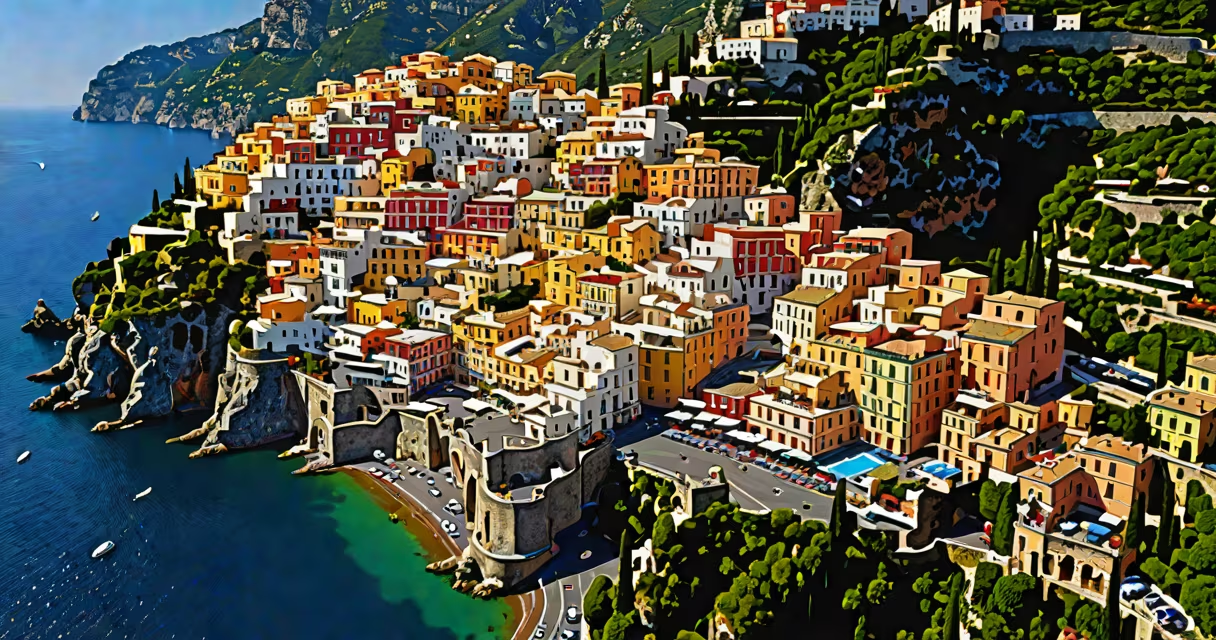
Amalfi Coast towns are a string of hillside villages along Italy's southern Tyrrhenian Sea coastline, known for dramatic cliffside architecture, citrus orchards, and centuries-old maritime heritage. These communities, clustered between Sorrento and Salerno, blend ancient roots with modern tourism, drawing visitors with narrow alleys, sea views, and regional cuisine.
The region's towns emerged from Roman and medieval trade networks. By the 9th century, Amalfi itself was a major maritime republic, rivaling Venice and Genoa. Today, its legacy lives in the 11th-century cathedral, the Duomo di Sant'Andrea, which features a mix of Arab-Norman and Byzantine design. The town's location on a natural harbor gave it early economic power, and its influence extended into the Adriatic and North Africa.
Modern travel focuses on accessibility via the SS163 coastal road, which winds through tunnels and hairpin bends. This route connects towns like Positano, Praiano, and Atrani. Public buses run seasonally from Naples and Salerno, but private transport or guided tours are often needed for full access. The area's popularity has led to congestion and rising prices, especially between June and September.
Each town operates under a mix of local governance and regional tourism coordination. Municipalities manage waste, water, and street maintenance, while the Campania regional government oversees infrastructure and cultural preservation. The Italian Ministry of Culture maintains heritage sites, including the 13th-century Abbey of Cava de' Tirreni and the ruins of Pompeii, though these lie slightly inland.
Tourism drives the economy. Most residents work in hospitality, food service, or artisan crafts. Shops sell handmade ceramics, limoncello, and woolen scarves. In summer, many families close their homes to rent rooms or host guests. This seasonal shift affects public services-schools close, pharmacies reduce hours, and emergency response times increase during peak months.
Transportation relies on footpaths, funiculars, and boats. In Positano, the main road ends at the beach; visitors must climb 300 steps to reach the upper town. Funiculars connect the port to the hilltop areas in Amalfi and Ravello. Boats from Marina Grande offer access to hidden coves like Furore's fjord-like inlet. The lack of car parking in most centers forces tourists to park outside and walk.
Amalfi Coast towns fall into three categories based on size, function, and visitor volume:
| Type | Examples | Key Features | Visitor Focus |
|---|---|---|---|
| Major tourist hubs | Positano, Amalfi, Praiano | High-density accommodation, multiple restaurants, daily boat tours, limited parking | Short stays, photo stops, guided excursions |
| Residential enclaves | Atrani, Conca dei Marini, Furore | Small populations (under 1,000), quiet streets, local markets, minimal signage in English | Long-term stays, cultural immersion, off-season visits |
| Scenic overlooks | Ravello, Scala, Minori | Elevated positions, gardens, concert venues, fewer direct sea views | Day trips, art events, hiking, photography |
Positano stands out as the most photographed town. Its steep streets, red-tiled roofs, and boutique shops attract over 1 million visitors annually. The town's central square, Piazza del Duomo, hosts festivals in July and August. In contrast, Atrani-a village smaller than a city block-has fewer than 1,000 residents and no hotel chains. Locals still gather at the 12th-century church of San Salvatore for Sunday mass.
One lesser-known fact: several towns were rebuilt after the 1980s floods that damaged the entire coastline. The 1980s storm surge destroyed parts of Praiano and raised the risk of landslides. Since then, building codes require reinforced foundations and drainage systems. Towns now use sensors to monitor soil movement, especially in areas like Bomerano, where rockfall incidents have occurred.
Amalfi Coast towns serve as vacation destinations, filming locations, and cultural landmarks. They appear in movies such as *Under the Tuscan Sun* (2003), *The Talented Mr. Ripley* (1999), and *Call Me by Your Name* (2017), though the latter was filmed in Lombardy. The region's aesthetic-pastel facades, arched doorways, and terraced vineyards-makes it ideal for visual storytelling.
Locals use the towns for community life. Events include the Festa della Madonna della Libera in Amalfi (first week of August), where residents carry a statue through the streets. In Ravello, the annual Festival of Music draws classical performers from Europe and Japan. These events are free to attend and draw locals more than tourists.
For travelers, the towns offer access to outdoor activities. Hiking trails like the Path of the Gods (Sentiero degli Dei) stretch from Bomerano to Nocelle, covering 11 kilometers with panoramic views. The trail takes 3-4 hours and requires sturdy footwear. Water-based options include kayak tours from Praiano, which explore sea caves and hidden beaches.
Many assume all Amalfi Coast towns are equally accessible. In reality, only Positano and Amalfi have regular public transit. Smaller towns like Castiglione di Santa Maria and Mergellina rely on private shuttles or walking. Visitors who plan to move between towns without a car may face delays or missed connections.
Another misconception: the entire coast is safe from natural hazards. Landslides remain a threat, especially after heavy rain. In 2021, a landslide near Praiano blocked the coastal road for two days. Authorities now issue alerts via the Civil Protection Department's app. The region's geology-volcanic rock layered with clay-makes it prone to slippage during wet seasons.
Some believe the towns are unchanged since the 1950s. While their appearance remains largely intact, modernization has altered daily life. Solar panels now cover rooftops in Minori. Wi-Fi is available in public squares. Even Atrani has a small espresso bar with digital payment terminals. These changes reflect adaptation, not loss of authenticity.
During a visit in October 2022, I walked the path from Praiano to Furore. The weather was clear, and the sea glowed turquoise. I stopped at a family-run olive oil shop where the owner offered samples with homemade bread. He spoke in rapid Italian, but his gestures-pointing to the label, nodding at the taste-conveyed everything. That moment, in a place where time feels suspended, showed me how deeply rooted identity remains in these towns.
While the Amalfi Coast towns are famous for their beauty, their value lies in resilience. They've survived wars, storms, and overcrowding. Their enduring charm comes not from perfection, but from continuity-where tradition meets adaptation, and where every stone tells a story.