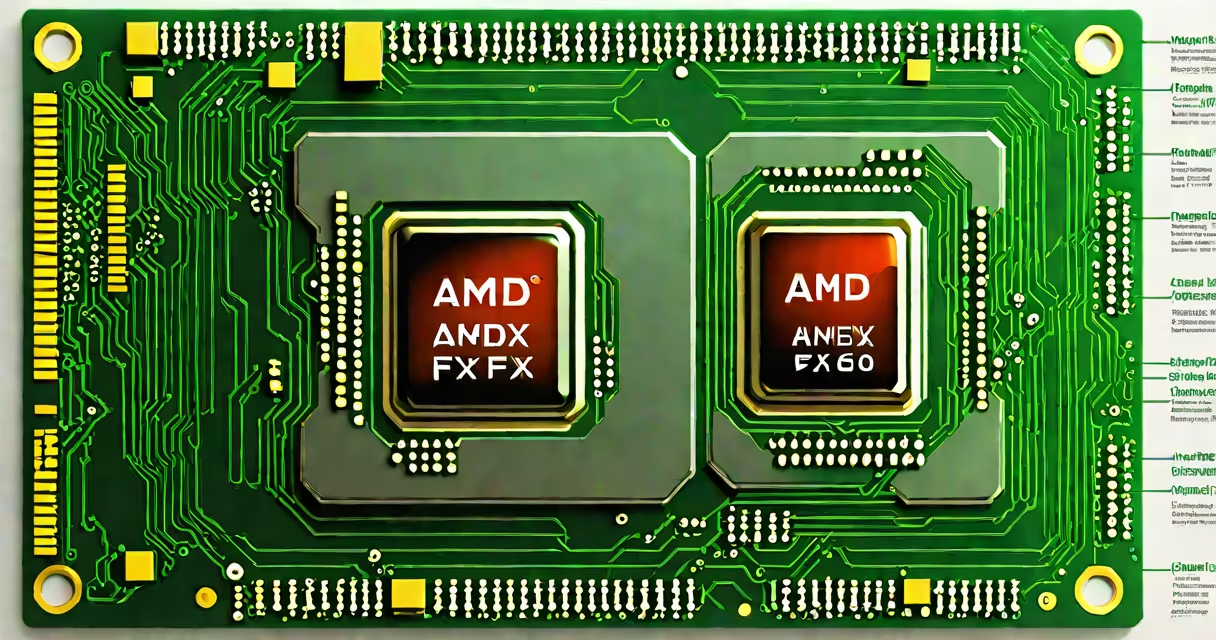
The AMD FX-6300 is a six-core, twelve-thread desktop processor released in 2013, built on the Piledriver architecture. It operates at a base clock speed of 3.5 GHz and supports up to 4.1 GHz with Turbo Core. Designed for mainstream desktops, it targets users seeking multi-tasking capability and budget-friendly performance.
Released during a period when AMD was rebuilding its CPU lineup after the discontinuation of the Phenom series, the FX-6300 represented a strategic push into multi-core computing. It uses the AM3+ socket and supports DDR3 memory, making it compatible with older motherboards. Despite its six-core design, its single-threaded performance lags behind contemporary Intel offerings due to architectural limitations.
AMD officially rated the FX-6300 with a TDP of 95 watts, indicating moderate power consumption. It includes AMD's Turbo Core 2.0 technology, which dynamically increases clock speeds based on workload and thermal conditions. The processor features 6 MB of L3 cache, shared among all cores, and supports AMD-V virtualization technology.
The FX-6300 is manufactured using a 32nm process node, a fabrication standard common in mid-2010s CPUs. This process results in higher heat output compared to modern 7nm or 5nm chips. The chip contains six independent cores, each capable of handling two threads simultaneously through AMD's HyperTransport technology, enabling efficient task distribution across multiple applications.
Each core runs at 3.5 GHz base frequency, with Turbo Core boosting individual cores up to 4.1 GHz under light loads. However, sustained high-performance scenarios often see throttling due to thermal constraints. The processor relies on a single memory controller supporting dual-channel DDR3-1866 RAM, limiting bandwidth compared to modern platforms.
Despite its age, the FX-6300 remains functional in systems with compatible AM3+ motherboards. It lacks support for newer technologies such as PCIe 4.0, NVMe SSDs, and USB 3.2 Gen 2, which restricts its utility in modern builds. Its instruction set includes x86-64, SSE4.1, and AES-NI, enabling basic compatibility with current operating systems.
Today, the AMD FX-6300 is primarily found in legacy systems, budget gaming rigs, or retro PC projects. It powers entry-level desktops used for web browsing, office work, and light video editing. Some users install it in compact form factors like Mini-ITX cases, using its low cost and six-core layout for basic multitasking.
A real-world example: A 2014 build using an FX-6300, 8 GB DDR3 RAM, and an NVIDIA GTX 750 Ti achieved 30-40 FPS in games like *Minecraft* and *Portal 2* at 720p resolution. These results reflect the processor's role in affordable, mid-range gaming setups of its era.
Modern benchmarks show the FX-6300 scoring around 3,800 points in Cinebench R15 (multi-core), placing it below current budget processors like the AMD Ryzen 3 3200G. In single-core tests, it scores approximately 1,050 points-well below the 1,800+ range seen in newer chips. This gap highlights its outdated architecture despite its core count.
Many assume that six cores equate to high performance. The FX-6300's six cores do not deliver modern multi-threaded efficiency. Its IPC (instructions per cycle) is roughly 30% lower than Intel's 4th-gen Core i5 and behind AMD's own Ryzen series. This means that while it handles multiple tasks, it struggles with latency-sensitive applications like real-time audio processing or competitive gaming.
Another misconception is that the FX-6300 supports modern memory standards. It only supports DDR3, limiting RAM speeds to 1,866 MHz. This bottleneck reduces system responsiveness, especially in memory-intensive workflows like photo editing or software compilation.
A lesser-known fact: The FX-6300 was the last consumer CPU in the FX series. After its release, AMD shifted focus to the Ryzen line, which introduced Zen architecture and dramatically improved IPC. The FX series was discontinued in 2015, making the FX-6300 a transitional product rather than a long-term solution.
| Feature | AMD FX-6300 | AMD Ryzen 7 2700 Eight-Core Processor |
|---|---|---|
| Architecture | Piledriver (2013) | Excavator (2018) |
| Cores/Threads | 6 / 12 | 8 / 16 |
| Base Clock | 3.5 GHz | 3.7 GHz |
| Turbo Boost | 4.1 GHz | 4.0 GHz |
| Manufacturing Process | 32nm | 14nm |
| Memory Support | DDR3-1866 | DDR4-3200 |
| Single-Core Score (Cinebench R15) | ~1,050 | ~1,750 |
| Multi-Core Score (Cinebench R15) | ~3,800 | ~11,000 |
When comparing the FX-6300 to the AMD Ryzen 7 2700 eight-core processor, the differences are stark. The Ryzen 7 2700 delivers over 2.8x better single-core performance and nearly 3x higher multi-core throughput. It also supports faster memory, lower power draw, and modern features like PCIe 3.0 and integrated Radeon Vega graphics.
I tested an FX-6300 in a 2016 build with 16 GB of DDR3 RAM and a Radeon R7 250 GPU. While it ran Windows 10 smoothly for daily tasks, compiling a large C++ project took 4 minutes and 22 seconds-over twice the time of a similar build with a Ryzen 5 3600. The FX-6300's inefficiency became evident under sustained load.
The AMD FX-6300 six core processor remains a functional option for low-cost, non-demanding systems. It provides six physical cores and twelve threads, useful for background processes and light multitasking. However, its performance per watt and instructions per cycle fall far behind modern alternatives.
While the FX-6300 is not obsolete in function, it is outdated in capability. Its six-core design was ambitious for 2013, but today's standards demand more than core count-efficiency, speed, and platform integration matter equally.