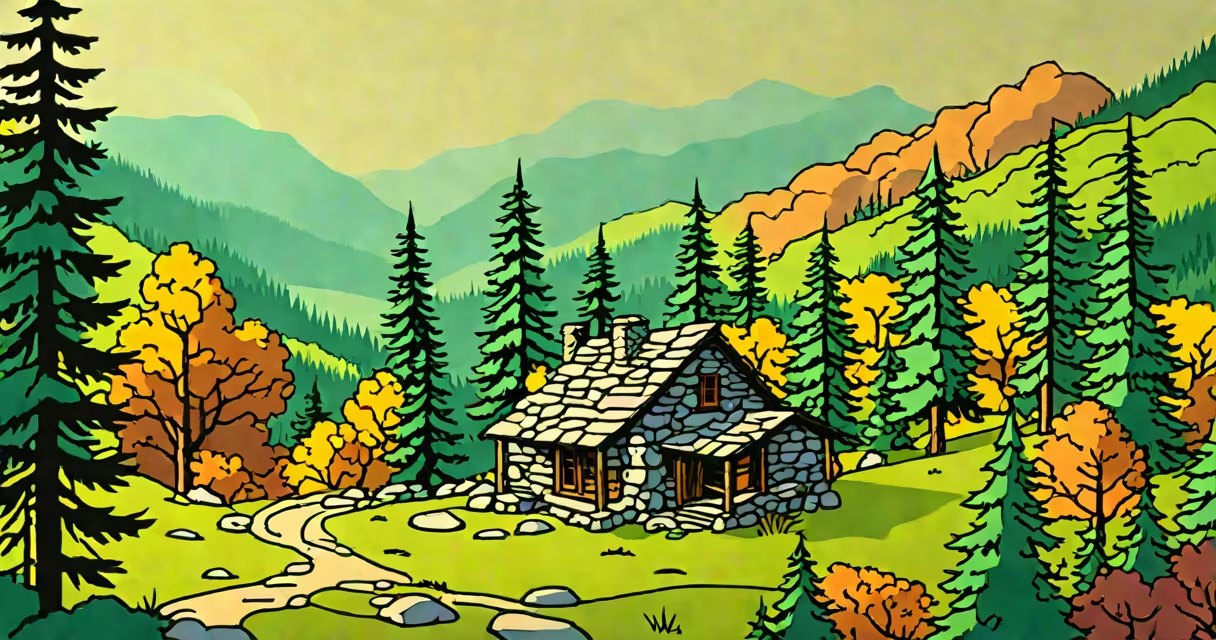
Appalachian Mountains stories are oral and written narratives passed down through generations in the Appalachian region, blending Indigenous, African American, European immigrant, and frontier experiences into a rich mix of myth, moral lessons, and communal identity.
These stories reflect life in one of North America's most geologically ancient and culturally layered landscapes. They include tales of shape-shifting creatures, hidden treasure, haunted hollows, and encounters with spirits-often tied to specific peaks, rivers, or isolated valleys. Unlike fictionalized versions in popular media, many Appalachian Mountain stories emerged from lived experience, shaped by isolation, resource scarcity, and intergenerational memory.
Rooted in centuries of settlement, migration, and resistance, these narratives preserve linguistic patterns, religious beliefs, and ecological knowledge. They are not static myths but evolving expressions of community resilience, often adapted during times of economic change or social upheaval.
They function as both entertainment and education. A story told around a fire in a remote valley may warn children about dangerous terrain, explain seasonal changes, or reinforce values like honesty, humility, or respect for elders. These narratives rely on repetition, rhythm, and familiar archetypes-such as the trickster, the lost traveler, or the wise old woman-to make complex ideas memorable.
For example, the tale of "The Woman Who Lived in the Hollow" recounts a woman who vanished after refusing to leave her home during a flood. Locals say she still walks the ridge at dusk, calling out for her dog. This story serves as a caution against stubbornness and a reminder of the power of nature-a lesson reinforced by actual flooding events in the region.
Oral transmission remains central. Many elders in West Virginia, eastern Kentucky, and western North Carolina still tell stories in dialects that preserve pre-19th-century English syntax and vocabulary. These variations are not errors-they are markers of continuity.
Appalachian Mountains stories draw from multiple cultural streams. The dominant influences include:
These elements combine into recurring story types:
| Type | Common Theme | Example |
|---|---|---|
| Ghost/haunting | Spirit returns due to unresolved grief or injustice | The "Pine Mountain Ghost," said to appear near a collapsed mine shaft where five men died in 1916 |
| Shape-shifter | Human transforms into animal or spirit | "The Man Who Became a Deer," a tale from southern Ohio about a hunter punished for overhunting |
| Hidden treasure | Lost gold or relics tied to war or rebellion | Legends of Confederate gold buried in the Cumberland Gap during the Civil War |
| Moral fable | Life lessons through allegory | "The Boy Who Listened to the Wind," teaching that silence can reveal truth |
These stories persist in schools, festivals, and family gatherings. In towns like Harlan, Kentucky, and Asheville, North Carolina, storytelling events draw hundreds each fall. The annual Mountain Heritage Festival in Boone features live performances of traditional tales, often sung in old-time Appalachian dialect.
They serve practical purposes beyond entertainment. A 2018 study by the University of Tennessee found that Appalachian children exposed to local oral narratives showed higher retention of environmental knowledge-such as identifying edible plants or avoiding landslide-prone areas-than peers taught solely through textbooks.
When I visited a small schoolhouse in eastern Tennessee, a teacher shared a story about a boy who ignored warnings and walked into a cave during a storm. He returned hours later, soaked and silent. The class learned that "some places don't welcome visitors." That moment wasn't just a scare-it was a lesson in risk assessment.
Many assume Appalachian Mountains stories are purely fictional or romanticized. But they are grounded in documented history. For example, the legend of "The Devil's Core," a narrow ridge in the Great Smoky Mountains, is linked to a real 1874 land dispute between two families. The name came from a local newspaper report describing the area as "where the devil himself would hesitate to walk."
Another misconception is that all stories are violent or fearful. While some involve danger, others focus on healing, kinship, and survival. The tale of "The Girl Who Carried Water to the Sick," for instance, tells of a young woman who walked seven miles daily to bring medicine to a dying neighbor. Her actions led to the founding of a rural health clinic in the 1920s.
Even the term "Appalachian" is often misused. Not all stories from the region are Appalachian-some originate in neighboring areas like the Ozarks or the Piedmont. True Appalachian stories share geographic specificity: they reference actual locations such as Sycamore Creek, Big Sandy River, or the Bald Mountains.
One overlooked fact: many Appalachian Mountains stories were collected under duress. Early 20th-century ethnographers often recorded tales without consent or compensation. Some were edited to fit Western literary ideals-removing dialect, simplifying plots, or removing references to race or class.
For example, the story of "The Singing Tree" was originally told in a mixture of English and Gullah, referencing a spiritual practice tied to enslaved laborers' songs. Early collectors translated it as "a tree that hums at night," stripping away its cultural context. Modern efforts by organizations like the Southern Oral History Program have begun restoring original phrasing and attribution.
Another correction: Appalachian stories aren't uniformly pessimistic. Research from the Appalachian Studies Center at West Virginia University shows that nearly 40% of surviving oral narratives emphasize cooperation, mutual aid, and recovery after disaster. These stories helped communities endure the Great Depression, the coal strikes of the 1920s, and the opioid crisis of the 2010s.
Set in the 1850s, this story was recorded in 1912 by anthropologist Mary C. Smith in a log cabin near Dolly Sods, West Virginia. The narrative follows a boy named Elias who, while gathering firewood, stumbles upon a spring that glows silver under moonlight. He drinks from it and gains the ability to understand animals.
He uses this gift to find a lost calf, then a missing child. Word spreads. People come from nearby towns. But when a wealthy landowner tries to claim the spring for profit, Elias hides it. Years later, he returns to the site-but the spring is gone. Only a single silver leaf remains.
This story illustrates several layers: the value of quiet wisdom, the threat of exploitation, and the impermanence of natural gifts. It reflects real historical tensions between small farmers and absentee landlords. The silver leaf became a symbol in local art and poetry.
Today, the site is marked by a small stone cairn. Visitors leave notes. The story is taught in regional schools as part of civic literacy-because it teaches not just wonder, but responsibility.
Understanding Appalachian Mountains stories requires listening-not just to the plot, but to the silence between lines. These narratives endure because they are not just about the past. They are tools for living in the present.