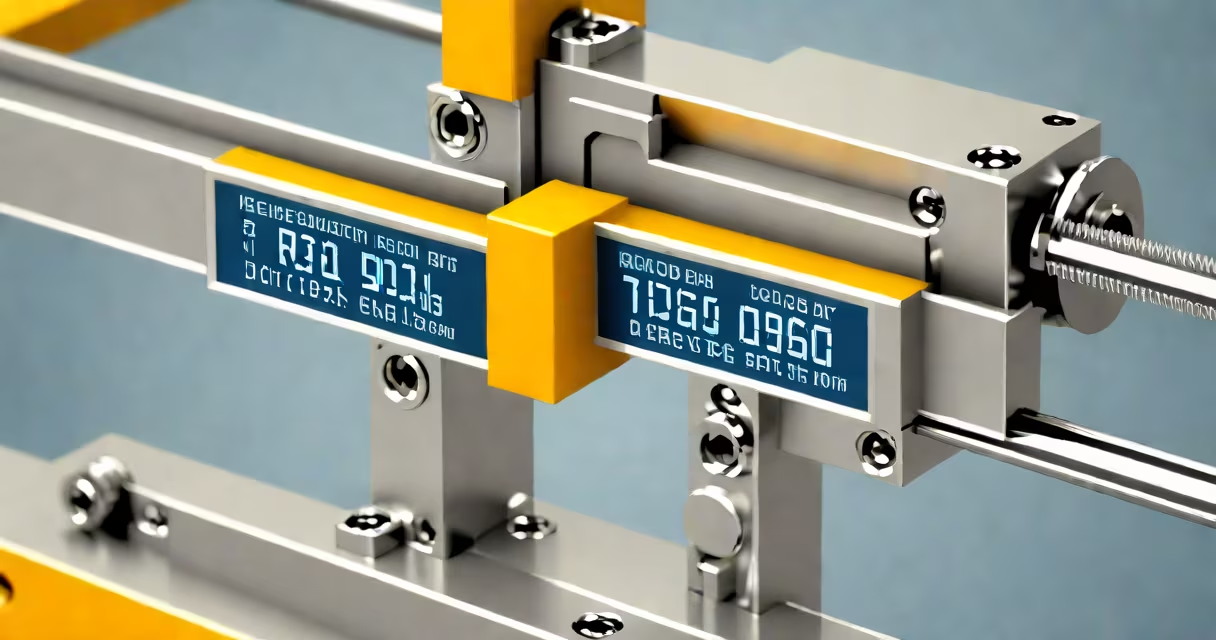
Strain gauges measure minute changes in physical dimensions-specifically, deformation caused by applied force or stress-on a material's surface. They convert mechanical strain into an electrical signal proportional to the amount of stretch or compression.
These sensors detect how much a material stretches or compresses under load, typically reporting results in microstrain (με), where 1 με equals 1 part per million of original length. This level of precision makes them essential in structural testing, industrial monitoring, and product development.
For example, a strain gauge mounted on a bridge support can detect how much the structure bends under traffic loads. A reading of 1,200 με indicates the material stretched by 0.00012% of its original length-a change too small to see with the naked eye but critical for safety assessments.
Strain gauges operate based on the piezoresistive effect: when a conductive material deforms, its electrical resistance changes. Most gauges use a thin metallic foil or semiconductor grid pattern bonded to a flexible backing.
When the base material stretches, the foil grid elongates and becomes thinner. This increases resistance. Conversely, compression reduces resistance. The change is measured using a Wheatstone bridge circuit, which outputs a voltage proportional to the strain.
A typical setup uses four strain gauges arranged in a bridge configuration. Two measure tensile strain (stretching), two measure compressive strain (squeezing). This arrangement cancels out temperature drift and improves accuracy. Modern systems use digital signal conditioning to filter noise and calibrate readings automatically.
There are three primary types, each suited to different applications:
| Type | Material | Best For | Typical Sensitivity |
|---|---|---|---|
| Metal Foil | Copper-nickel alloy | General-purpose testing, static loads | 2.0-2.5 |
| Semiconductor | Silicon | High-sensitivity applications, changing loads | 50-100 |
| Wire | Constantan or platinum-tungsten | High-temperature environments | 2.0-2.2 |
Metal foil gauges are the most common due to their durability and stability. Semiconductor gauges offer higher sensitivity but are more sensitive to temperature changes. Wire gauges are used in extreme conditions, such as turbine blades or engine components, where temperatures exceed 600°C.
Non-contact strain measurement using laser Doppler vibrometry exists but is not a strain gauge. Strain gauges require direct attachment to the test surface. Misalignment during installation can cause errors exceeding 10%, so proper bonding with epoxy is critical.
Strain gauges are used in aerospace, civil engineering, automotive testing, and biomechanics. In aircraft wing fatigue testing, hundreds of gauges monitor deformation during simulated flight cycles. Data informs maintenance schedules and design improvements.
In biomechanics, researchers attach strain gauges to prosthetic limbs to study muscle forces during walking. One study published in *Journal of Biomechanics* (2021) used gauges to measure joint loading in amputees, revealing that peak stresses exceeded 150 MPa during running-information important for improving implant longevity.
A common misconception is that strain gauges measure force directly. They do not. They measure deformation, which is then converted to stress using known material properties. Force must be calculated via Hooke's Law: F = σ × A, where σ is stress (from strain × Young's modulus), and A is cross-sectional area.
Another error is assuming all strain gauges behave identically. Semiconductor gauges have nonlinear responses and require calibration curves. Metal foils are linear over 2,000 με but saturate beyond that. Always verify the gauge's operating range before deployment.
To demonstrate, consider testing a carbon fiber bicycle frame under rider load. A technician attaches four strain gauges to the seat tube near the bottom bracket. The frame is loaded with 120 kg (265 lbs) of simulated rider weight.
The system records strain values:
Using the material's Young's modulus (140 GPa for carbon fiber), stress is calculated as σ = ε × E = 850 × 10⁻⁶ × 140 × 10⁹ = 119 MPa. This value is below the yield strength (150 MPa), indicating safe performance.
Without strain gauges, engineers would rely on theoretical models. But real-world behavior varies due to manufacturing imperfections. Strain gauges provide empirical validation.
I once tested a custom aluminum cantilever beam for a robotics project. After installing the gauge, I noticed a 30% deviation in expected strain. Investigation revealed poor adhesive curing time-bonding took 4 hours, not the 1-hour window specified. Reapplying with correct timing restored accuracy. This taught me that sensor placement and prep matter as much as the device itself.
Strain gauges are not the same as accelerometers or displacement sensors. Accelerometers measure acceleration; displacement sensors track movement distance. Strain gauges measure internal deformation-the subtlest form of mechanical response.
They are also not interchangeable with load cells. Load cells measure force directly through spring elements and strain gauges. But strain gauges can be embedded in load cells to improve resolution.
Best practices include:
According to the National Institute of Standards and Technology (NIST), strain gauge accuracy depends heavily on installation quality. Poor bonding can introduce errors of up to 15%-worse than the sensor's inherent tolerance.
Strain gauges measure deformation, not force, pressure, or temperature directly. Their value lies in converting invisible mechanical changes into measurable signals. With proper setup, they deliver data that ensures safety, efficiency, and innovation across industries.