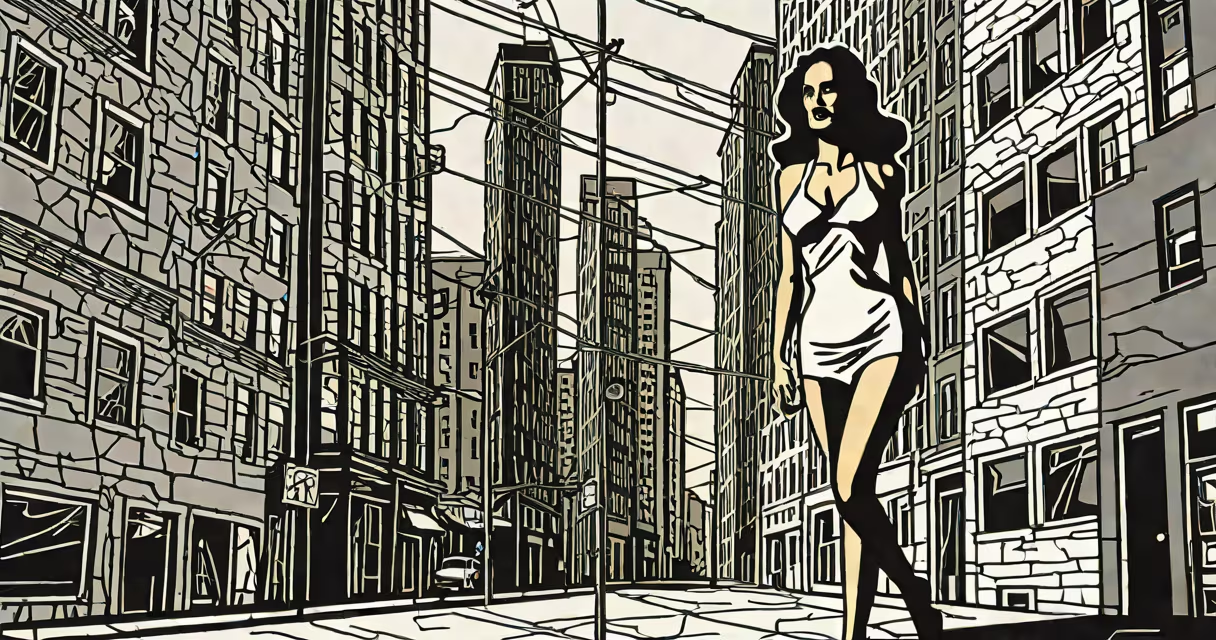
Ava Addams galleries showcase digitally rendered, emotionally charged artwork rooted in gothic, punk, and surrealist traditions. Her pieces often depict elongated figures in desolate urban environments, using stark contrasts and symbolic motifs to explore alienation, identity, and inner turmoil. These exhibitions appear primarily online, hosted on platforms like Instagram, DeviantArt, and personal websites.
Her visual language draws from 1980s alternative fashion, cyberpunk fiction, and underground zine culture. Each piece functions as a narrative fragment-often implying stories of isolation, rebellion, or transformation. She uses high-contrast lighting, exaggerated proportions, and deliberate imperfections to evoke unease and introspection. Her work is not meant to be decorative; it demands attention through psychological intensity.
Unlike traditional fine art galleries, Ava Addams' exhibitions exist in digital spaces. Viewers engage with her work via curated social media feeds, NFT marketplaces, and fan-run archives. This format allows global access but also raises questions about authenticity, ownership, and preservation. Physical prints are occasionally released through limited editions, but the original artworks remain digital artifacts.
Each gallery is structured around thematic series rather than chronological or formalist progression. A viewer might encounter a collection titled "Flesh & Wire," which features humanoid figures fused with industrial machinery, their faces obscured by shadow or mesh. These aren't random images-they form a conceptual arc exploring the loss of autonomy in modern life.
The process begins with hand-drawn sketches on tablet or paper, then transferred into layered digital paintings using software like Photoshop and Procreate. She applies textures such as grain, ink bleed, and scan noise to simulate analog decay. This technique mimics the look of old photocopied flyers or damaged film reels-echoing the DIY ethos of underground art scenes.
She avoids standard commercial branding. Her galleries rarely include titles, dates, or artist statements. Instead, viewers interpret meaning through visual cues: a missing eye, a hand reaching toward a broken mirror, a figure walking away from a city skyline. The absence of explicit context forces engagement with emotion and symbolism over literal narrative.
Ava Addams primarily creates digital illustrations, but her work appears in multiple formats:
| Format | Common Use | Example |
|---|---|---|
| Digital illustration | Primary output; shared on social media | "Static Girl" - a figure frozen mid-step, surrounded by flickering neon signs |
| NFT (non-fungible token) | Ownership verification; sale on blockchain platforms | "Echoes in the Basement" - sold for 0.8 ETH on Foundation |
| Print-on-demand | Physical display; limited availability | 12x16 inch archival prints sold via Etsy and her Patreon |
| Animated GIFs | Time-based storytelling; looping motion | "Breathing Through Walls" - a figure slowly dissolving into smoke |
She does not produce oil paintings or sculptures. Her entire practice is rooted in digital creation. This limits physical exhibition options-there are no permanent museum installations. However, her work has been featured in curated online exhibitions such as "Digital Gothic: Art After the Internet" at the Museum of Contemporary Art, Los Angeles (MOCA), which included five of her pieces in 2022.
Ava Addams galleries serve as both artistic expression and community-building tools. Fans use her work to explore personal experiences with mental health, gender dysphoria, and social anxiety. Her imagery resonates strongly with Gen Z and younger millennials who identify with outsider identities.
Brands have adopted her aesthetic for marketing. For example, in 2023, the clothing label GHOSTWALK commissioned her to design a campaign series featuring models in distorted, oversized silhouettes. The resulting visuals were posted across TikTok and Instagram, generating over 2 million views in two weeks. The campaign didn't sell products-it built brand affinity through mood and atmosphere.
She also collaborates with independent music artists. Her artwork frequently accompanies album covers for lo-fi electronic and darkwave acts. One notable example is the cover for "Silence Is a Language" by the band Hollow Echo, released in 2021. The image-a lone figure standing beneath a collapsing bridge-was later displayed in a pop-up gallery event in Berlin, curated by a local art collective.
Many assume Ava Addams galleries are purely shock or horror-themed. That's incorrect. While her work contains unsettling elements, it's not designed to frighten. Instead, it aims to provoke reflection. A figure with no face isn't meant to be scary-it's meant to represent anonymity, erasure, or the pressure to conform.
Another misconception is that her art is derivative. Critics sometimes compare her to artists like Tim Burton or H.R. Giger, but her style diverges. Burton's work leans into whimsy and melancholy; Giger's is biomechanical and erotic. Ava Addams focuses on emotional vulnerability and structural collapse-not fantasy or sexuality. Her figures don't smile or dance-they stand still, often in silence.
Her galleries are not commercial storefronts. She doesn't sell originals. All sales are of licensed reproductions or NFTs. This protects her intellectual property while allowing fans to own a version of her work. The original file remains under her control, ensuring consistent quality and attribution.
In 2022, Ava Addams released a six-part digital series titled "The Last Train." Each image depicts a different passenger on a decaying subway car, isolated from others. The characters wear mismatched clothing, have distorted features, and stare out windows showing only fog and static.
One piece, "Passenger 3," shows a person with a translucent body, revealing gears and wires beneath skin-like texture. The caption reads: "I remember the last time I felt safe. It was before the lights went out." No dialogue, no plot-just a single emotional moment captured in image form.
This series gained traction after being shared by a mental health nonprofit on Twitter. Within 48 hours, it had been retweeted over 15,000 times. Many users reported feeling seen. One wrote: "This is me during my worst panic attack. I've never seen someone draw it so perfectly."
That moment exemplifies how Ava Addams galleries function-not as entertainment, but as emotional mirrors. They don't explain trauma; they reflect it.
I once attended a virtual talk hosted by a university art department where Ava Addams spoke about her creative process. She mentioned that she often starts with a single phrase-like "I don't belong here"-and builds the image around that feeling. She doesn't plan the composition in advance. The image emerges from emotion, not technique.
When asked about audience reception, she said: "I don't want people to understand my work. I want them to feel it. If they walk away changed-even slightly-that's enough."
Ava Addams galleries offer a distinct form of contemporary visual storytelling. They blend digital art, emotional resonance, and subcultural identity into immersive, often haunting experiences. Unlike traditional exhibitions, they thrive in online spaces, reaching audiences beyond geographic or institutional barriers. Their power lies not in clarity, but in ambiguity-inviting interpretation, not instruction.