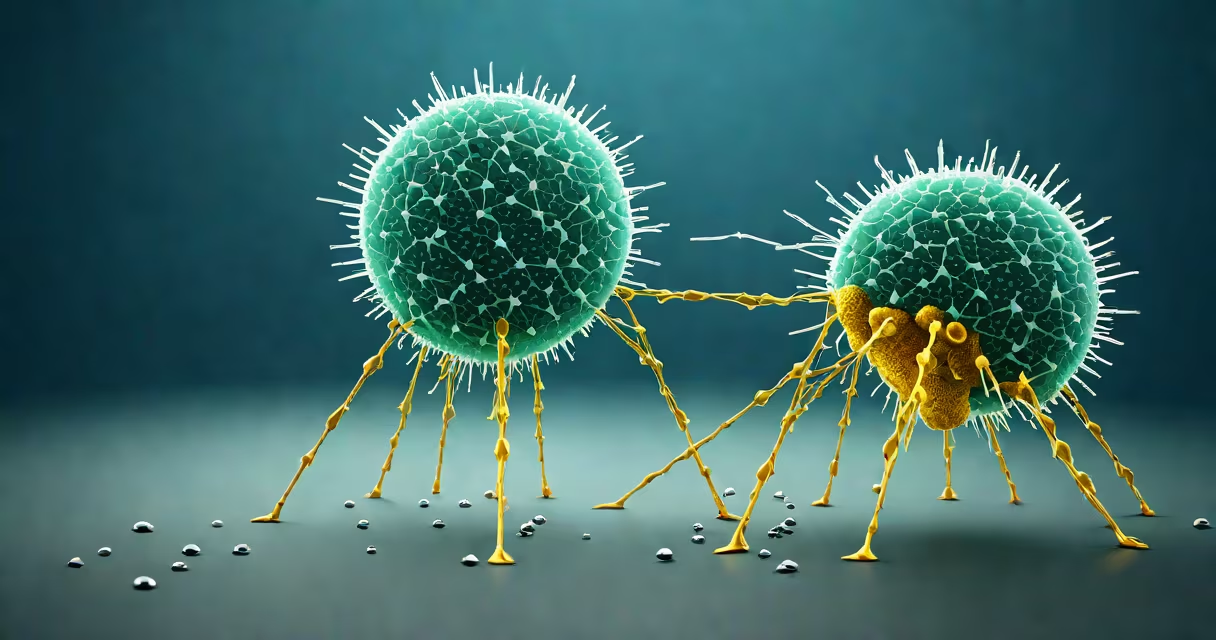
A bacteriophage is a virus that specifically infects and replicates within bacteria, using the host's cellular machinery to produce new viral particles. These viruses are among the most abundant biological entities on Earth, with estimates suggesting 10³¹ individual phages exist in global ecosystems.
Bacteriophages are composed of a protein capsid enclosing a nucleic acid genome-either DNA or RNA-and possess a tail structure that facilitates attachment to bacterial surfaces. Their specificity arises from receptor-binding proteins on the tail tip, which recognize unique surface molecules on target bacteria. This precision limits phage activity to specific bacterial strains, making them highly selective agents in microbiological systems.
The term "bacteriophage" originates from Greek: *bakterion* (bacteria), *phagein* (to eat), reflecting their predatory nature toward bacterial cells. They were first described in 1915 by Frederick Twort and independently in 1917 by Félix d'Hérelle, who coined the term. Modern research confirms their central role in shaping microbial communities across environments such as soil, oceans, and the human gut microbiome.
Bacteriophages initiate infection by binding to receptors on the bacterial cell wall. Once attached, they inject their genetic material through the tail into the host cytoplasm. The injected genome then hijacks the bacterial transcription and translation systems to produce viral components-capsids, tails, and genomes-over a period of 20 to 60 minutes depending on the phage type and environmental conditions.
After assembly, progeny virions are released via lysis-the rupture of the bacterial membrane. This process destroys the host cell, freeing hundreds of new phages to infect nearby bacteria. The entire cycle, known as the lytic cycle, typically takes less than two hours. Some phages enter a dormant state called lysogeny, integrating their DNA into the host chromosome and remaining inactive until triggered by stress signals such as UV radiation or antibiotics.
For example, the lambda phage (λ-phage) integrates into the *E. coli* genome and remains latent until induced by DNA-damaging agents. Upon induction, it switches to the lytic pathway, producing approximately 100 new virions per infected cell. This dual behavior allows phages to persist in populations without immediate host destruction, contributing to long-term ecological balance.
Bacteriophages exhibit diverse morphologies, primarily categorized by the International Committee on Taxonomy of Viruses (ICTV) based on capsid symmetry and tail presence. The most common types include:
| Type | Structure | Genome Type | Example |
|---|---|---|---|
| Tailed phages (Caudovirales) | Head-tail morphology; icosahedral capsid with contractile or non-contractile tail | DNA | λ-phage, T4 phage |
| Single-stranded DNA phages | Spherical or filamentous; no tail | ssDNA | M13 phage |
| Double-stranded RNA phages | Isometric capsid; no tail | dsRNA | φ6 phage |
Among these, tailed phages dominate in natural environments. The T4 phage, for instance, measures ~200 nm in length and contains a linear double-stranded DNA genome of 169 kilobase pairs. Its tail sheath contracts during injection, forcing the core through the bacterial envelope-a mechanism studied extensively in structural virology.
Non-tailed phages like M13 have evolved alternative strategies. M13 uses a rolling circle replication mechanism and exits host cells without lysis, enabling continuous release of progeny. This mode supports persistent infections in laboratory settings and has been exploited in biotechnology for phage display techniques.
Bacteriophages are increasingly investigated for therapeutic use in treating antibiotic-resistant infections. Phage therapy involves administering a cocktail of phages tailored to the patient's bacterial pathogen. Clinical trials in Eastern Europe, particularly in Georgia and Poland, report success rates exceeding 70% in chronic wound and urinary tract infections caused by multidrug-resistant *Pseudomonas aeruginosa* and *Staphylococcus aureus*.
A common misconception is that bacteriophages are harmful to humans. This is incorrect. Phages do not interact with eukaryotic cells due to the absence of compatible receptors. Their specificity ensures they only target bacteria, making them safe for human use. The U.S. FDA has approved several phage-based products for food safety applications, including a phage spray to reduce *Salmonella* contamination on poultry.
Another misunderstanding is equating phages with antibiotics. While both combat bacteria, antibiotics inhibit metabolic processes and affect a broad spectrum of microbes-including beneficial ones. Phages, by contrast, act with high precision. A single phage strain may eliminate only one species or strain, reducing collateral damage to the microbiome. This distinction is critical in managing dysbiosis-related diseases.
In a lab experiment conducted at the University of California, San Diego, I observed the plaque assay technique to quantify phage concentration. After infecting a lawn of *E. coli* on agar plates with serial dilutions of T4 phage, clear zones-plaque formations-appeared within 24 hours. Each plaque represented a single infectious unit. Counting plaques allowed calculation of phage titer at 1.2 × 10⁹ PFU/mL (plaque-forming units per milliliter), confirming effective propagation under controlled conditions.
Research from the National Institutes of Health (NIH) and the European Molecular Biology Laboratory (EMBL) underscores the evolutionary significance of phages. They contribute to horizontal gene transfer between bacteria, driving adaptation and resistance development. In marine environments, phages regulate phytoplankton blooms by lysing dominant bacterial species, influencing carbon cycling and oxygen production globally.
Understanding the bacteriophage definition in biology reveals a fundamental force in microbial ecology and a promising tool in medicine. As antibiotic resistance escalates, phage therapy offers a targeted alternative rooted in natural mechanisms. The integration of phage genomics with synthetic biology enables engineering of phages with enhanced host range and reduced immune recognition-advances currently being explored in clinical trials.