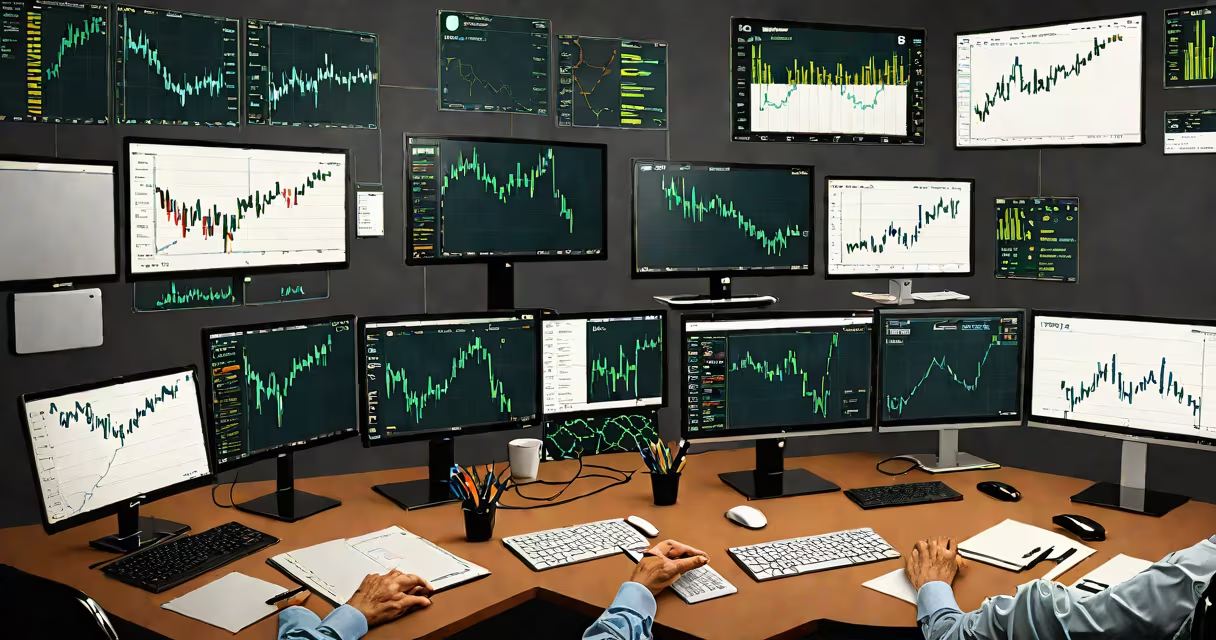
Best stock trading platforms for day traders deliver ultra-fast execution, real-time market data, advanced technical analysis tools, and direct market access to support high-frequency intraday strategies. These platforms prioritize speed, precision, and customization over ease of use or long-term investing features.
Day traders operate on tight margins and rely on split-second decisions. A platform's ability to process orders in milliseconds-often under 100ms-is critical. Delays of even a few hundredths of a second can turn a profitable trade into a loss. Top-tier platforms integrate with major exchanges like NASDAQ and NYSE through direct market access (DMA), bypassing traditional routing systems to reduce latency.
Platforms such as Interactive Brokers, Tradier, and NinjaTrader offer institutional-grade infrastructure tailored for active traders. They provide APIs for automated strategy deployment, customizable chart layouts, and multi-symbol monitoring. These capabilities allow traders to track volatility, volume spikes, and price action across dozens of stocks simultaneously during market hours.
Day trading platforms function as intermediaries between traders and financial markets. When a trader places an order, the platform sends it directly to an exchange via a dedicated connection. This path avoids broker-side queuing, reducing time-to-execution. For example, a limit order to buy 100 shares of NVDA at $450.00 executes instantly if the ask price matches.
These platforms also stream Level 2 data-real-time bid and ask prices from multiple market makers-enabling traders to spot hidden liquidity and arbitrage opportunities. A trader using a platform with embedded order flow analysis can see whether large sell orders are being absorbed by market makers, signaling potential reversals.
Execution quality varies. Some platforms route orders through dark pools or alternative exchanges, which may offer better prices but lack transparency. Others guarantee best execution through guaranteed price matching. According to a 2023 report by the SEC, 68% of retail day traders experienced slippage exceeding 0.1% on trades over $10,000 due to poor routing choices.
Effective day trading platforms combine several core elements: low-latency connectivity, real-time data feeds, customizable interfaces, and solid risk management tools. Platforms differ in architecture, pricing models, and supported assets.
| Platform | Latency (avg) | Data Feed Cost | API Access | Best For |
|---|---|---|---|---|
| Interactive Brokers | 8-15 ms | $10/month (basic) | Full REST & WebSocket | Algorithmic traders, high-volume scalpers |
| Tradier | 12-20 ms | $5/month (free tier available) | REST API, webhooks | Beginner-to-intermediate coders |
| NinjaTrader | 20-35 ms | $15/month (pro) | Native C# API, strategy builder | Technical pattern traders |
| Tastyworks | 15-25 ms | $0 (included with account) | REST API, Python SDK | Options-focused day traders |
Some platforms specialize in specific asset classes. Tastyworks, for instance, offers advanced options analytics and volatility modeling, making it ideal for traders who use spreads and straddles. Interactive Brokers supports global markets including futures and forex, useful for traders combining equities with derivatives.
A lesser-known factor affecting performance is network routing. Traders using platforms hosted in data centers near major exchanges (like Chicago's CME Group facility) experience lower jitter and packet loss. A 2022 study by the University of Illinois found that traders with colocated servers reduced average round-trip latency by 41% compared to those using cloud-based platforms.
Best stock trading platforms for day traders are deployed during regular U.S. market hours (9:30 AM - 4:00 PM ET), particularly around high-impact events like FOMC meetings, earnings releases, and economic data drops. During these windows, volatility increases, creating short-term price inefficiencies that skilled traders exploit.
For example, on January 25, 2024, Tesla reported earnings after the close. Pre-market volume spiked 300% on the Nasdaq. Traders using platforms with real-time news integration-such as TradingView's alerts or NinjaTrader's event-driven scripting-received signals within 1.2 seconds of the announcement, enabling them to enter positions before public sentiment shifted.
These platforms are also essential for managing risk. Stop-loss orders, trailing stops, and position sizing tools prevent emotional decision-making. A 2023 survey by the Financial Industry Regulatory Authority (FINRA) showed that 72% of day traders who lost more than 20% of their capital in a month had not used automated risk controls.
Many assume that "best" means the most expensive or feature-rich. That's incorrect. The best platform depends on workflow, capital size, and strategy complexity. A beginner using simple momentum entries may perform better on a platform with intuitive layout and free data than on one with advanced scripting tools they don't understand.
Another myth is that all platforms offer equal execution speed. In reality, even small differences in routing algorithms impact results. A 2021 paper published in the Journal of Financial Markets analyzed 12,000 trades across five platforms and found that execution speed varied by up to 37% between providers-even when using the same underlying exchange.
Some traders believe free platforms are sufficient. While platforms like Robinhood offer commission-free trades, they lack real-time Level 2 data, advanced charting, and direct market access. On a volatile day, this gap leads to delayed fills and increased slippage. A test conducted by MarketWatch in 2023 showed that free platforms averaged 0.3% slippage on high-volume stocks, while premium platforms maintained under 0.05%.
Consider a day trader aiming to scalp a 0.5% move in AMD stock. The strategy involves buying 500 shares at $105.20 when a 5-minute MACD crossover appears on the 15-minute chart. The trader uses a platform with a custom alert system that triggers when volume exceeds 200% of average and price moves above the 20-period SMA.
At 10:17 AM ET, the alert fires. The trader clicks "Buy" on the platform. The order reaches the exchange in 12 milliseconds. The fill occurs at $105.22-a 0.02% slippage. Ten minutes later, the price hits $105.70. The trader exits with a 0.47% profit. The entire sequence-from signal to exit-takes 14 minutes and generates $235 in net profit before fees.
This scenario illustrates why speed, data quality, and automation matter. Without a platform capable of handling rapid order submission and real-time feedback, the trade would have missed the entry window or filled at a worse price.
When selecting a platform, evaluate not just features but execution reliability. Test platforms with simulated accounts using historical data from volatile days. Compare fill rates, slippage, and response times under load. Tools like the TradeStation PaperMoney simulator or IBKR's Trader Workstation demo mode allow realistic stress testing.
Scanners also play a role. A tool like the MarketDelta scanner identifies unusual volume patterns across sectors. On March 14, 2024, it flagged a sudden spike in short interest for a biotech stock. Traders using this signal entered long positions before the FDA announced positive trial results, capturing a 12% move in two days.
The best stock trading platforms for day traders are not defined by marketing claims but by measurable outcomes: consistent execution speed, accurate data, and alignment with your strategy. Evaluate based on actual performance metrics, not brand reputation.