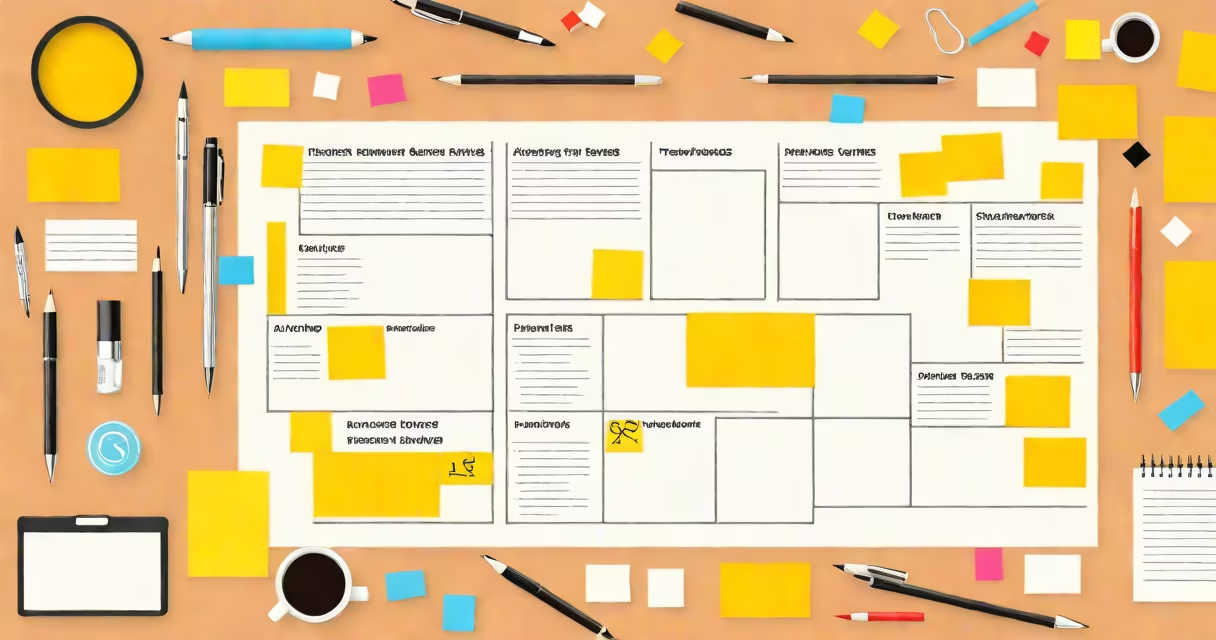
The business canvas model template is a strategic tool that maps out the key elements of a business in a single, visual document. It defines value proposition, customer segments, channels, revenue streams, key resources, key activities, key partnerships, cost structure, and customer relationships. This structure enables founders, teams, and consultants to align on business logic quickly and test assumptions early.
Developed by Alexander Osterwalder and Yves Pigneur in their 2005 book *Business Model Generation*, the template is structured as a grid divided into nine blocks. Each block captures a distinct aspect of how a business creates, delivers, and captures value. The model is not a plan-it's a hypothesis-testing tool. It forces clarity by requiring specific answers to questions like "Who pays?" and "What do we need to make this work?"
Used widely in startups, small businesses, and corporate innovation units, the template reduces ambiguity in early-stage strategy. It's not a substitute for financial modeling or market research, but it provides a shared language across departments. For example, a SaaS company might use it to clarify whether its pricing model targets enterprise clients or SMBs, and whether support is delivered via chatbots or human agents.
The template operates on the principle that every business must answer nine fundamental questions. These are not optional. Skipping any block leads to blind spots. For instance, omitting "key activities" may result in underestimating operational demands. A fitness app startup might list "developing AI-driven workout plans" and "onboarding users through video tutorials" as key activities.
Each block connects to others. Customer segments influence revenue streams. Channels affect cost structure. A change in one block often requires adjustments elsewhere. If a company shifts from B2B to B2C customers, it may need new sales channels (e.g., social media ads instead of direct sales reps), which increases marketing costs and alters customer relationship strategies.
Teams use the canvas iteratively. They draft a version, test assumptions with customers, then revise. This process is called "business model prototyping." A team at a food delivery startup used the canvas to identify that their initial focus on university campuses wasn't sustainable due to low average order values. They pivoted to targeting suburban households with higher spending power-a shift validated through surveys and pilot deliveries.
The nine components of the business canvas model template are:
| Block | Description | Example |
|---|---|---|
| Customer Segments | Who are the people or organizations the business serves? | Working parents aged 30-45 seeking meal kits for busy weeknights. |
| Value Propositions | What problem does the product or service solve? | "Deliver chef-designed meals in 30 minutes with zero prep." |
| Channels | How does the business reach its customers? | Mobile app, email newsletters, and Instagram ads. |
| Customer Relationships | How does the business maintain ongoing interactions? | Live chat support, loyalty rewards, and personalized recipe suggestions. |
| Revenue Streams | How does the business earn money? | Subscription fees ($12/week), à la carte meal orders, and premium recipe packs. |
| Key Resources | What assets are required to deliver the value? | Commercial kitchen space, proprietary recipe database, delivery drivers. |
| Key Activities | What actions are critical to making the business work? | Meal planning, ingredient sourcing, logistics coordination, app maintenance. |
| Key Partnerships | Who supports the business through collaboration? | Local farms for fresh produce, third-party delivery services, nutritionists. |
| Cost Structure | What are the major expenses? | Ingredient costs (45%), labor (30%), packaging (10%), delivery (15%). |
While the standard canvas applies to most ventures, variants exist. The lean canvas focuses on startups and prioritizes risk factors like customer acquisition cost and unit economics. It replaces "customer segments" with "problem," "solution," and "key metrics." The social business canvas adds blocks for impact measurement and stakeholder engagement. These adaptations aren't replacements-they're refinements for specific contexts.
A common mistake is treating the canvas as a static document. The model is designed for iteration. A founder who completes the canvas once and stops updating it misses opportunities to respond to market feedback. One team at a fintech startup updated their canvas monthly based on user retention data. After three months, they discovered that free trial users were dropping off because of unclear onboarding. They redesigned the onboarding flow and saw a 22% increase in conversion.
Many assume the business canvas model template is a business plan. It is not. A business plan includes detailed financial projections, executive summaries, and market analysis. The canvas is a high-level diagnostic tool. It doesn't replace a pitch deck or funding proposal-it complements them.
Another misconception is that the canvas must be filled out perfectly from the start. That's not the goal. The template encourages rapid sketching. Early versions are meant to be rough. The purpose is to surface gaps. A team building a mental health app initially listed "therapists" as key partners. After talking to users, they realized many preferred anonymous peer support. They revised the partnership block to include community moderators and AI screening tools.
Some confuse the canvas with SWOT analysis. While both assess strengths and weaknesses, the canvas focuses on structural design-not internal evaluation. SWOT examines competitive positioning, while the canvas asks: "How does this business actually function?"
One non-obvious insight: the placement of blocks matters. The top-left block ("Customer Segments") sets the foundation. Everything else flows from it. A company targeting retirees will have different channels (e.g., print flyers, local events) and customer relationships (e.g., phone-based support) than one targeting Gen Z consumers.
Consider a fictional online tutoring platform called LearnBridge. The team used the business canvas model template to define their model before launching. Here's how they mapped each block:
After completing the canvas, the team ran a pilot with 50 students. Feedback revealed that students wanted more flexibility in scheduling. The team adjusted their "channels" and "customer relationships" blocks to include a calendar integration feature. Within six weeks, session completion rates rose from 68% to 89%.
Using the canvas helped them avoid investing in expensive features that didn't match user needs. The template forced them to confront trade-offs early-like choosing between offering lower prices or maintaining high tutor quality.