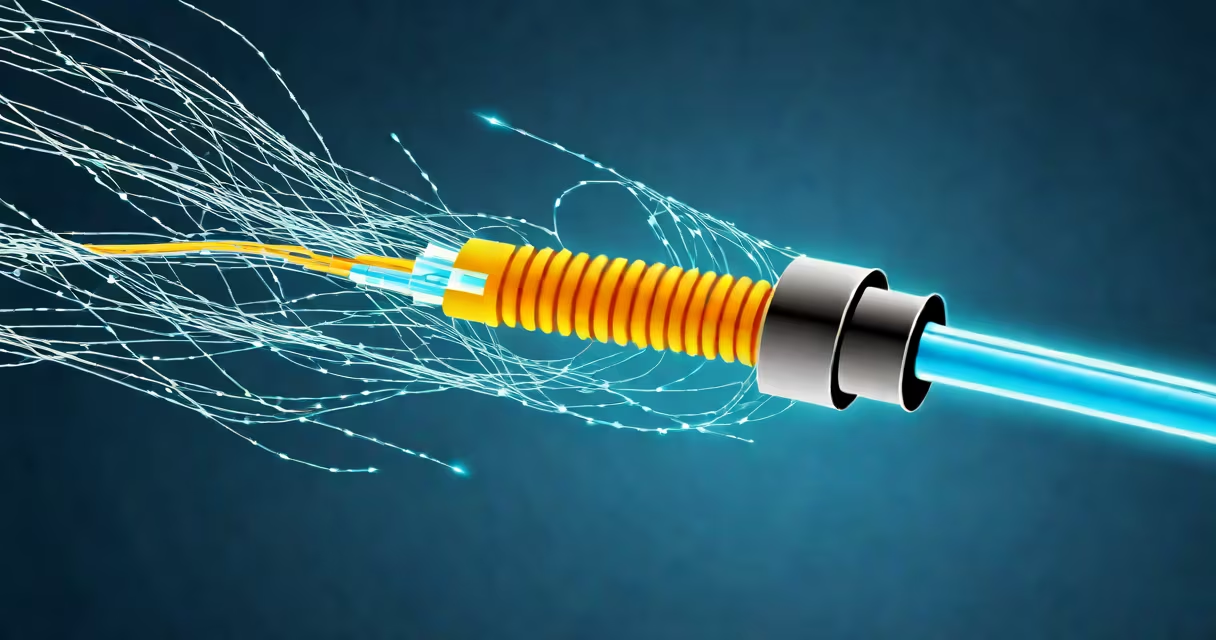
Fiber optic cable transmits data as pulses of light through thin strands of glass or plastic, enabling high-speed, long-distance communication with minimal signal loss. It forms the core infrastructure for internet, telephone, and cable TV networks.
Light travels through the core of a single strand of ultra-pure silica glass, guided by total internal reflection. This principle allows signals to move at nearly the speed of light-about 200,000 kilometers per second-over hundreds of kilometers without significant degradation. Unlike copper cables that carry electrical signals, fiber optics are immune to electromagnetic interference and do not generate heat, making them ideal for dense urban environments and data centers.
The technology was first demonstrated in the 1960s, but widespread deployment began in the 1990s. Today, fiber optic networks carry over 95% of global internet traffic, according to the International Telecommunication Union (ITU). A single fiber strand can carry more than 10 terabits per second-equivalent to streaming 1 million HD videos simultaneously.
A fiber optic cable consists of three main layers: the core, cladding, and protective jacket. The core-typically 9 to 100 micrometers in diameter-is where light travels. Surrounding it is the cladding, made of material with a lower refractive index. This difference causes light to reflect off the boundary and stay within the core, preventing escape.
At one end, a laser or LED emits light pulses representing binary data (1s and 0s). These pulses travel through the fiber until they reach a photodetector at the receiving end, which converts them back into electrical signals. The process is bidirectional; modern systems use different wavelengths of light for upstream and downstream channels.
For example, a 10Gbps connection using single-mode fiber can send data across 80 kilometers without needing signal amplification. In contrast, copper Ethernet cables max out at 100 meters for 10Gbps speeds. This makes fiber essential for undersea cables linking continents and for connecting major data centers.
Fiber optic cables come in two primary types: single-mode and multi-mode. Single-mode fiber has a narrow core (around 9 µm) and supports one light path. It's used for long-haul networks because it minimizes dispersion-the spreading of light pulses over distance. Multi-mode fiber has a wider core (50 or 62.5 µm), allowing multiple light paths. It's cheaper and easier to install but limited to shorter distances due to modal dispersion.
| Type | Core Size | Max Distance | Use Case | Bandwidth Capacity |
|---|---|---|---|---|
| Single-mode | 9 µm | up to 80 km | Long-distance telecom, undersea cables | 100+ Gbps per channel |
| Multi-mode | 50 or 62.5 µm | up to 550 m | Local area networks, data centers | 10-100 Gbps |
Materials also differ. Most long-haul cables use fused silica glass, which offers near-zero attenuation (signal loss). Plastic optical fiber (POF) is used in short-range applications like automotive networks and home audio systems, though it suffers higher losses and lower bandwidth.
One non-obvious fact: despite their fragility, fiber cables can survive extreme conditions. The transatlantic MAREA cable-laid in 2018-runs 6,600 kilometers between Virginia and Spain, crosses deep-sea trenches, and operates at 160 terabits per second. It's protected by layers of steel armor and waterproof gel, proving that fiber can endure ocean depths and seismic activity.
Fiber optic cable powers modern digital life. ISPs use it to deliver gigabit internet to homes. Hospitals rely on it for real-time MRI and telemedicine. Financial institutions use low-latency fiber links to execute trades in microseconds. Even smart cities depend on fiber for traffic control and surveillance systems.
For example, Google Fiber launched in 2010 as a municipal broadband initiative. In Kansas City, it offered 1 Gbps symmetrical internet-1,000 times faster than average U.S. broadband at the time. The rollout required digging trenches and installing fiber nodes, but residents reported no buffering during 4K video calls and instant cloud backups.
Despite its advantages, fiber isn't universal. Rural areas still depend on coaxial or copper lines due to installation cost. But the trend is shifting: the U.S. Federal Communications Commission (FCC) allocated $42.5 billion in 2021 to expand broadband access, with a focus on fiber deployment. By 2025, the FCC projects that 80% of American households will have access to fiber-based internet.
Many people assume fiber optic cable is fragile and difficult to maintain. While the glass core is delicate, the outer layers provide durability. A properly installed fiber cable can last 25 years or more. It resists corrosion, moisture, and temperature swings better than copper.
Another misconception: fiber is only for high-end users. In reality, fiber is increasingly standard. In South Korea, over 90% of households have fiber internet. In Japan, NTT Communications provides fiber to 98% of homes. These countries achieved coverage not through subsidies but through national infrastructure planning.
Some confuse fiber with wireless tech. Fiber delivers physical connectivity; Wi-Fi, 5G, and satellite are wireless. A 5G tower may connect to a cell site via fiber, but the signal from your phone to the tower is radio waves. Fiber enables the backhaul-data transport between network points-but doesn't replace local wireless access.
I once observed a technician repairing a fiber line in a New York subway tunnel. The team used a fusion splicer to join two broken strands. The machine heated the ends to 1,500°C and fused them together. The repair took 12 minutes and restored service across 15 stations. The precision required-aligning fibers within 0.1 microns-shows how advanced the tools are.
Copper cables like Cat6 Ethernet transmit data electrically. They're cheap and widely available but suffer from signal attenuation, crosstalk, and interference. A 10Gbps Ethernet over copper is limited to 55 meters. Over longer runs, performance degrades rapidly.
Fiber eliminates these issues. A single-mode fiber can carry 100 Gbps over 100 kilometers. It also handles higher power levels without overheating. For data centers, this reduces cooling costs and increases reliability. According to a 2022 study by the Optical Society, fiber-based networks consume 70% less energy per terabyte than copper-based ones.
Define fiber optic cable as a high-capacity, low-loss medium that uses light to transmit data across vast distances. Its role in modern communication is foundational. From global internet backbones to local business networks, fiber optic cable enables the speed, reliability, and scalability demanded by today's digital economy.