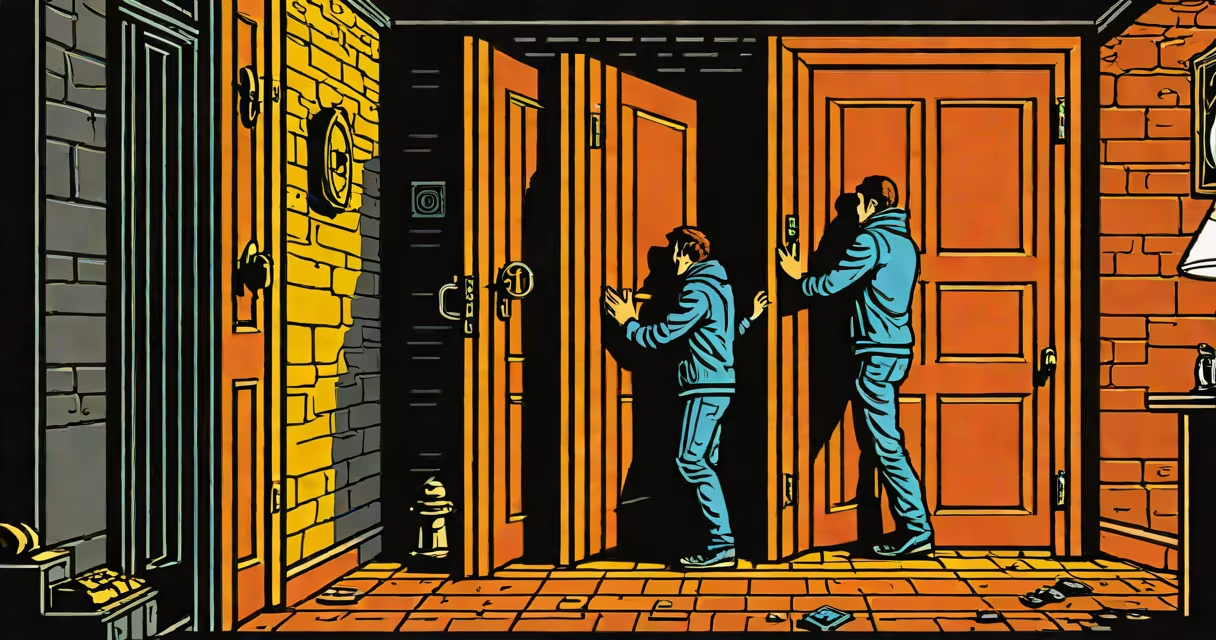
Escape the room games are interactive puzzle experiences where players solve environmental clues to enable doors, reveal hidden mechanisms, and progress through a series of challenges within a confined virtual or physical space. Success requires observation, logic, pattern recognition, and sometimes lateral thinking.
These games simulate being trapped in a themed environment-like a Victorian study, a spaceship cockpit, or a forgotten laboratory-and task players with escaping before time runs out or a narrative unfolds. The core mechanic involves examining surroundings, collecting items, combining tools, and deciphering codes to trigger sequences that open paths forward.
Popular titles such as *The Room* series and *Myst* established the genre's foundation. Modern versions appear on mobile, web, and VR platforms. According to the International Game Developers Association (IGDA), over 6 million people played at least one escape the room game monthly in 2023, with 72% citing problem-solving satisfaction as their primary motivation.
Each level presents a closed environment with visual cues, audio hints, and tactile interactions. Players click or tap to examine objects, rotate items, open drawers, or activate switches. Progress depends on noticing subtle details-like a wallpaper pattern that aligns with a clock face or a book spine that reveals a hidden compartment.
Clues often require cross-referencing multiple elements. For example, a painting may show a sequence of numbers that match a safe combination, while a radio broadcast plays a melody that corresponds to musical notes on a piano keyboard. Solving one clue unlocks access to the next, forming a chain of discovery.
The design prioritizes narrative cohesion. A room set in a 1920s spy bunker might feature a rotary phone with a dial that spells out coordinates when turned to specific numbers. These puzzles aren't random-they're embedded in the setting's backstory, making each solution feel earned.
Escape the room games exist across several formats, each with distinct mechanics and accessibility:
| Format | Platform | Duration | Key Features |
|---|---|---|---|
| Web-based | Browsers (Chrome, Firefox) | 15-45 minutes | Free to play, no download, casual audience |
| Mobile apps | iOS, Android | 30-90 minutes | Offline mode, touch controls, daily challenges |
| Physical escape rooms | Real-world venues | 60 minutes | Team-based, live facilitators, props and lighting effects |
| VR escape rooms | Meta Quest, PlayStation VR | 45-60 minutes | Immersive 3D environments, spatial interaction |
Web-based and mobile versions dominate casual engagement. Games like *The Escape Game* series offer bite-sized scenarios with minimal setup. Physical rooms, however, demand coordination and communication-teams must share observations in real time. A 2022 study by the University of California, Irvine, found that teams solving physical escape rooms improved collaborative decision-making by 38% compared to solo players.
A lesser-known distinction: some games use "progressive difficulty" models where early puzzles teach mechanics later applied in complex scenarios. For example, learning to interpret Morse code in a small hallway prepares players for decoding a distress signal in a submarine control room.
Many assume escape the room games rely on trial-and-error or random guessing. This is incorrect. Well-designed levels avoid arbitrary solutions. Each clue has a logical basis in the environment or narrative.
Another myth is that all games require quick reflexes. In reality, speed is secondary to attention. A 2021 analysis by GameAnalytics showed that players who paused frequently to analyze scenes solved puzzles 54% faster than those who rushed through.
Some confuse escape the room games with generic "hidden object" games. While both involve searching, hidden object games focus on finding specific items in cluttered scenes. Escape the room games emphasize contextual reasoning-why an item matters, how it connects to others, and what it enables.
Consider a browser-based escape the room game titled *Echoes of the Forgotten*. The player enters a library with a locked cabinet behind a bookshelf. The goal: open the cabinet using a combination derived from clues.
Step 1: Examine the bookshelf. A gap between two books reveals a folded note. It reads: "Three letters stand where the sun meets the moon."
Step 2: Look at the window. Outside, the sun is setting. The shadow of a statue casts a shape resembling the letter 'T'. The moon is visible above a tree line. The reflection in a mirror shows the word "TOM" written in dust on a shelf.
Step 3: Combine clues. "Sun meets moon" suggests a time-sunset. The time shown on a pocket watch is 6:30 PM. The hour hand points to 6, the minute hand to 30. The digits 6 and 3 correspond to letters: 6 = F, 3 = C. But the note says "three letters," not numbers.
Step 4: Re-express the clue. "Where the sun meets the moon" could mean the intersection of light and dark. The word "echo" appears in the game's title. Rearranging "echo" gives "choe"-not useful. But "echo" reversed is "ohce." Still nothing.
Step 5: Return to the mirror. The word "TOM" is written in dust. The player realizes "TOM" is a name-but also sounds like "tomorrow." Tomorrow is the next day. The date on a calendar in the corner reads October 12. The month is October-O. The day is 12-L. "O" and "L" don't help.
Step 6: Focus on the note again. "Three letters stand where the sun meets the moon." The sun and moon meet at dawn. Dawn is sunrise. The time on the watch is 6:30-six thirty. Six is "F," thirty is "D." "FD" doesn't make sense.
Step 7: Realization. The word "echo" is a hint. Echoes repeat. The word "echo" spelled backward is "ohce." But "echo" contains "e", "c", "h", "o". The letter "o" appears in "moon." The letter "e" appears in "sun." The letter "c" appears in "echo." Wait-"sun" has "u", "n"; "moon" has "m", "o", "o", "n". Common letters: "n" and "o".
Step 8: Final insight. "Three letters" where sun and moon meet. The overlapping letters in "sun" and "moon" are "n" and "o". That's only two. But "sun" and "moon" share "n" and "o"-but "moon" has double "o". So "o" and "n" are common. But "sun" has "s", "u", "n". "Moon" has "m", "o", "o", "n". Shared: "n" and "o".
Step 9: The solution. The note says "three letters." There are only two. Unless "o" counts twice? Or the word "echo" is meant to be used differently. The player checks the bookshelf again. A book titled *The Sun and Moon* has a bookmark. The bookmark is shaped like a key. The player picks it up.
Step 10: The cabinet has a keyhole. Insert the bookmark. The lock clicks. The cabinet opens. Inside: a journal with the entry "The sun and moon meet at noon. The code is O-N-O."
Final combination: O-N-O. The player inputs "ONO" into the keypad. The cabinet opens. A flashlight and a map are revealed.
This example shows how misdirection and layered context are central. The player must reject initial assumptions-like focusing on time or letters in names-and recognize that the clue relies on a metaphorical interpretation of "where they meet."
Players with motion sickness should avoid VR versions. The simulated movement and rapid camera shifts can cause discomfort. The American Academy of Ophthalmology reports that 12% of users experience dizziness during extended VR sessions.
Also, avoid games with poor accessibility features. Some lack text-to-speech, colorblind modes, or adjustable font sizes. The World Wide Web Consortium (W3C) recommends that all digital games include at least one accessibility option. Games that skip this fail basic inclusion standards.
As a personal note, I once spent 45 minutes stuck on a single puzzle in a mobile game because the interface didn't indicate which object was interactable. Only after switching to a high-contrast mode did I see the glowing cursor around a hidden button. Accessibility isn't optional-it's foundational.
Escape the room games blend storytelling, spatial reasoning, and cognitive challenge. They're not just entertainment-they're mental workouts disguised as mysteries.