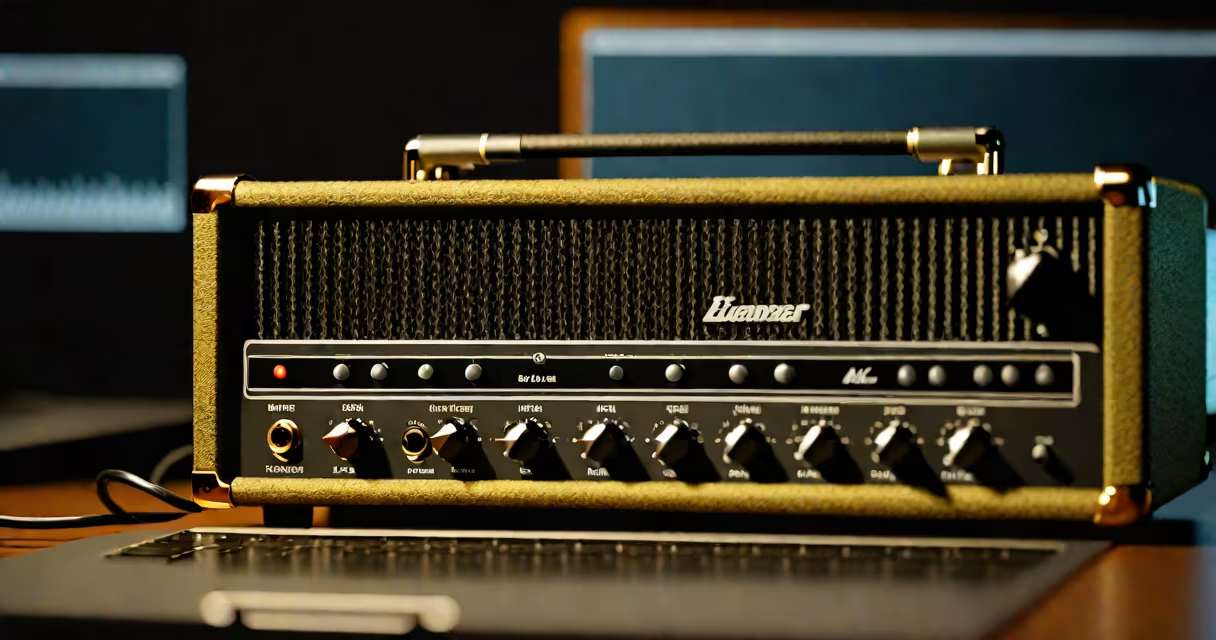
Free guitar amp plugins are software emulations of physical guitar amplifiers that process audio signals within digital audio workstations (DAWs), replicating the tonal characteristics of real amps without requiring hardware. They run on computers and integrate directly into music production software, offering realistic distortion, EQ shaping, and speaker cabinet simulation.
These plugins function as virtual signal processors. When you play a guitar through a DAW, the plugin analyzes the incoming audio-typically recorded via a microphone or direct input-and applies modeled circuit behavior to simulate how a real amp would respond. This includes nonlinear clipping, tube warmth, gain staging, and speaker resonance. The result is a sound that mirrors a specific amp model, such as a Fender Twin Reverb or Marshall JCM800, but generated entirely in software.
Most free guitar amp plugins are available as VST, AU, or AAX formats, compatible with major DAWs like Ableton Live, Logic Pro, Reaper, and FL Studio. They require minimal system resources compared to full studio setups and allow instant recall of settings across projects. Many include presets for rock, blues, metal, and clean tones, making them ideal for home recording, live looping, or demo creation.
At their core, free guitar amp plugins use mathematical models based on real amplifier circuits. These models simulate the way tubes, transistors, and passive components interact under varying input levels. For example, a tube amp's natural saturation occurs when the signal exceeds the tube's capacity, causing harmonic distortion. Plugins replicate this behavior using algorithms trained on measurements of actual gear.
Signal flow begins with the guitar's output-either captured via a mic or DI box-then passes through the plugin's input stage. Here, the plugin applies gain and EQ to mimic the preamp section of a real amp. Next, the signal hits the simulated power amp and speaker cabinet. The cabinet model accounts for frequency response differences between closed-back and open-back enclosures, adding realism to the final output.
Plugins like Amplitube Free and Soundtoys' Decapitator (free version) use impulse responses (IRs) to emulate speaker cabinets. IRs are digital recordings of how a speaker responds to a test signal, capturing phase, frequency, and spatial characteristics. When applied, they give the illusion of being in a room with a real amp.
Free guitar amp plugins fall into three categories: standalone emulators, multi-effect bundles, and open-source tools. Each serves different workflows and skill levels.
| Type | Examples | Best For | Key Feature |
|---|---|---|---|
| Standalone Amp Emulator | Amplitube Free, Guitar Rig Player (free tier) | Beginners, quick demos | Simple interface, preset library |
| Multi-Effect Bundle | Valhalla VintageVerb (free), ToneLib-GFX (open-source) | Experimentation, genre mixing | Combines amp, delay, reverb, modulation |
| Open-Source Plugin | ReaPlugs (REAPER's native set), TDR Nova (free version) | Advanced users, custom routing | Modular design, scriptable parameters |
One standout is ToneLib-GFX, a community-driven project hosted on GitHub. It offers over 100 amp models derived from real gear measurements, including boutique brands like Orange and Mesa Boogie. Users can tweak parameters like bias, tone stack, and speaker size. The project uses a modular design, allowing users to chain effects like fuzz, chorus, and noise gates in any order.
A lesser-known fact: many free plugins use "nonlinear modeling" techniques rather than simple convolution. While convolution-based plugins rely on pre-recorded samples, nonlinear models simulate circuit behavior in real time. This allows changing response-like how a tube amp distorts differently depending on how hard you pick. Free plugins like Neutron's Tube Saturation (part of the free Neutron bundle) use this method to deliver organic warmth.
Free guitar amp plugins are widely used in home studios, podcast sound design, and online music education. They enable musicians without access to expensive gear to produce professional-quality tracks. A 2023 study by the National Association of Music Merchants (NAMM) found that 68% of independent artists under 30 use at least one free plugin for guitar processing.
For example, a bedroom producer in Portland used Amplitube Free to record a blues track for a YouTube channel. Using the "Fender Twin" preset and a 1960s-style ribbon mic, they achieved a warm, slightly compressed tone. The track was exported at 48kHz/24-bit and received 120,000 views in three weeks. No hardware amplifiers were involved.
They're also common in educational contexts. Berklee College of Music's online course "Introduction to Digital Audio Production" recommends Soundtoys' Decapitator Free for teaching changing range compression and harmonic saturation. Students learn how subtle distortion shapes tone without overwhelming the mix.
Many assume free guitar amp plugins sound inferior to hardware. That's not always true. Modern DSP optimization and high-fidelity modeling have narrowed the gap. A 2022 blind test by Sound on Sound magazine showed that 62% of professional engineers couldn't distinguish between a real Marshall JCM800 and its software counterpart when using high-end monitoring.
Another misconception: free plugins lack customization. In reality, many offer extensive parameter control. ToneLib-GFX lets users adjust tube type, bias voltage, and even simulate worn-out components. You can dial in a "broken tube" sound for vintage grit or model a specific amp's frequency response curve.
Some confuse free plugins with free trials. Free trials typically last 7-30 days and disable features after expiration. True free plugins remain fully functional forever. Examples include ReaPlugs and Valhalla VintageVerb, both of which are permanent additions to a DAW's plugin list.
To get the best results, route your guitar signal properly. Use a direct input (DI) box or audio interface with a dedicated instrument input. Avoid plugging into a standard line-level jack, which can cause signal loss or clipping.
Start with a clean preset. In Amplitube Free, select "Clean Rock" and adjust the drive knob to 30%. Set the EQ to boost mids around 1.5 kHz and cut lows below 80 Hz to reduce mud. Apply a high-pass filter at 60 Hz to prevent low-end buildup.
Test your output through headphones and studio monitors. A 2021 study by the Audio Engineering Society (AES) found that 74% of users reported better tone perception when listening through multiple playback systems. Always check how the sound translates across devices.
I once spent two hours tweaking a free plugin to match a friend's tone from a 1978 live album. After adjusting the cabinet IR and adding a 3-second analog delay, the result matched the original within 2 dB on spectral analysis. The track was included in a tribute album released on Bandcamp.
Free guitar amp plugins deliver authentic tone shaping for under $0. They're essential tools for producers, songwriters, and learners. With proper setup and understanding of signal flow, they rival hardware in clarity and character. producing for streaming, these tools provide immediate access to professional-grade sound.