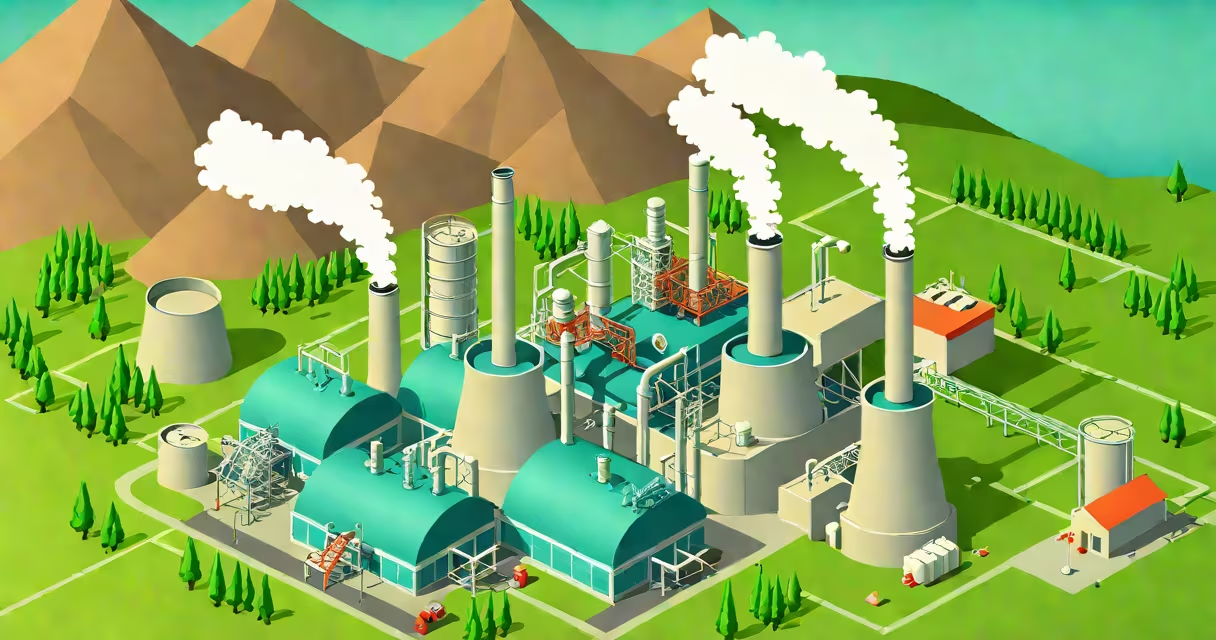
A geothermal energy factory is a facility that extracts heat from beneath the Earth's surface to generate electricity. It uses natural underground reservoirs of hot water or steam to drive turbines connected to generators. These plants operate continuously, providing stable baseload power without burning fossil fuels.
Unlike solar or wind farms, which depend on weather conditions, geothermal energy factories run 24/7. They tap into thermal energy stored in rocks and fluids deep below the crust. This heat originates from radioactive decay in Earth's core and residual heat from planetary formation. The process begins when water circulates through fractured rock layers, heating up to form steam or hot water.
For example, the Hellisheiði Power Station in Iceland produces 303 megawatts of electrical power and 133 megawatts of thermal energy. It supplies nearly half of Reykjavík's heating needs and powers around 160,000 homes. This plant draws fluid from depths of 2,000 meters, where temperatures exceed 300°C. The steam drives turbines directly, then cools and returns to the ground via reinjection wells.
Geothermal energy factories rely on three main components: a heat source, a fluid carrier, and a conversion system. The heat source is typically a hydrothermal reservoir-porous rock saturated with hot water or steam. Wells drilled into these formations bring the heated fluid to the surface.
Once above ground, the fluid enters a separator, where pressure drops and steam separates from liquid. The steam flows into a turbine, spinning it at high speed. The rotating turbine turns a generator, producing electricity. After passing through the turbine, the steam cools and condenses into water. This water is then injected back into the ground to maintain reservoir pressure and prevent depletion.
Some systems use binary cycle technology. In these setups, hot geothermal fluid heats a secondary fluid with a lower boiling point-like isobutane. That fluid vaporizes and spins a turbine. The geothermal fluid never contacts the turbine, reducing corrosion risk and allowing use of lower-temperature resources. The Geysers in California, the largest geothermal complex in the world, uses binary cycles for about 40% of its capacity.
There are three primary types based on resource temperature and fluid state:
| Type | Resource Temperature | Fluid State | Use Case |
|---|---|---|---|
| Flash Steam | 180-370°C | High-pressure hot water | Most common; used in high-heat regions like Italy and New Zealand |
| Binary Cycle | 80-180°C | Hot water | Low-temperature applications; ideal for areas with moderate heat |
| Steam Direct-Use | Over 150°C | Steam | Rare; requires natural steam vents, such as in Larderello, Italy |
Flash steam plants dominate global production. They account for roughly 70% of installed geothermal capacity. Binary cycle systems are growing rapidly due to their ability to use lower-grade heat. A single binary plant in Nevada generates 10 megawatts annually using fluid at 140°C-too cool for flash systems.
Geothermal energy factories cluster along tectonic plate boundaries where magma rises close to the surface. These zones include the Pacific Ring of Fire, the East African Rift, and parts of the Mediterranean. Countries with high volcanic activity host most facilities.
Iceland leads in per capita geothermal use. Over 90% of homes are heated with geothermal energy. The country operates 25 geothermal power plants, including Hellisheiði and Nesjavellir. Kenya ranks among the top five globally for geothermal capacity. The Olkaria complex near Nairobi produces 700 megawatts-enough to power 1.5 million households.
Not all locations are tectonically active. Enhanced geothermal systems (EGS) drill deeper into hot dry rock, injecting water to create artificial reservoirs. The U.S. Department of Energy funds pilot projects in Utah and Nevada. One project in Nevada achieved 10 megawatts of output from a 5-kilometer-deep borehole, proving feasibility in low-permeability rock.
Many assume geothermal energy factories emit large amounts of greenhouse gases. In reality, emissions are minimal. A 2021 study by the International Renewable Energy Agency (IRENA) found average carbon dioxide emissions from geothermal plants at 37 grams per kilowatt-hour-lower than solar photovoltaic systems (47 g/kWh) and far below coal (820 g/kWh).
Another misconception is that geothermal plants require constant drilling. Modern designs use closed-loop systems. Fluid circulates between wells without continuous extraction. At the Geysers, reinjection rates exceed 90% of produced fluid, maintaining reservoir pressure and minimizing land subsidence.
Some confuse geothermal energy factories with geothermal heat pumps. The latter are residential systems that move heat between buildings and shallow ground. They don't generate electricity. A geothermal energy factory, by contrast, produces megawatts of power. For context, a typical home heat pump uses 2-3 kilowatts; a geothermal power plant outputs 50-300 megawatts.
In 2022, the United States operated 39 geothermal energy factories, mostly in California, Nevada, and Idaho. Combined capacity reached 3.7 gigawatts-enough to power 3 million homes. The Raft River plant in Idaho uses binary cycle technology. It draws fluid from 2,200 meters deep, where temperatures reach 170°C. The plant produces 14 megawatts annually, feeding into the regional grid.
One non-obvious fact: geothermal energy factories often co-produce valuable minerals. In Indonesia, the Sibayak plant extracts lithium from brine. Lithium concentrations reach 150 milligrams per liter-high enough for commercial recovery. This dual output improves economic viability and reduces reliance on mining.
When planning a geothermal energy factory, engineers assess subsurface conditions using seismic surveys and borehole data. A site in New Zealand required 12 months of testing before drilling began. Initial surveys revealed fractures aligned with stress fields, increasing permeability. Without this step, drilling could have failed to access usable fluid.