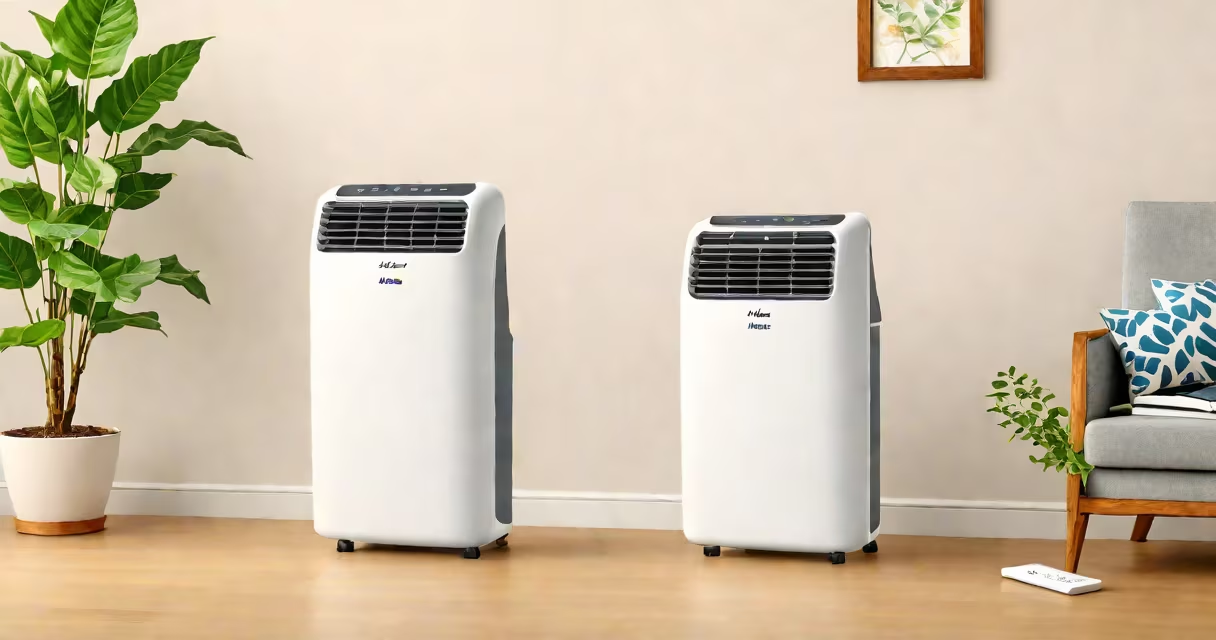
The Haier portable air conditioner and heater is a single-unit climate control system that cools rooms in summer and heats them in winter using a reversible refrigeration cycle. It operates without permanent installation, moving easily between spaces via built-in wheels and a flexible exhaust hose.
Unlike window units or central systems, this device doesn't require ductwork or wall penetration. Instead, it draws indoor air through a filter, passes it over chilled or heated coils, then expels warm air through a vent hose. The same internal components handle both cooling and heating modes, switching based on thermostat input.
For example, a 12,000 BTU model can cool a 500-square-foot room from 85°F to 72°F in under 30 minutes. In heating mode, it delivers up to 10,000 BTUs, raising temperatures in a similar space by 15°F within an hour. These figures align with ENERGY STAR® specifications for efficiency in both modes.
Inside the Haier unit, a compressor circulates refrigerant through a closed loop. In cooling mode, the refrigerant absorbs heat from indoor air as it evaporates in the indoor coil. A fan blows room air over this coil, lowering temperature. The hot gas then travels to the outdoor condenser coil, where it releases heat and condenses into liquid.
In heating mode, the system reverses the refrigerant flow using a reversing valve. Now, the outdoor coil acts as the evaporator, absorbing ambient heat-even in temperatures as low as 32°F. The refrigerant carries this heat indoors, where it's released in the indoor coil. A fan pushes warmed air back into the room.
This reversal process is standard in heat pumps. According to the U.S. Department of Energy, heat pump systems can deliver 2.5 to 3 times more heat energy than the electrical power they consume, making them highly efficient compared to resistance heaters.
Haier portable units come in three primary configurations based on exhaust hose routing:
| Type | Exhaust Hose Setup | Best For | Efficiency Note |
|---|---|---|---|
| Single-Hose | One hose exits through a window or door | Small rooms, temporary use | Less efficient due to air leakage; loses 10-15% cooling capacity |
| Double-Hose | One hose brings in fresh air, one expels hot air | Larger rooms, consistent performance | More balanced pressure; maintains better indoor air quality |
| Three-Hose (rare) | Two exhaust hoses, one intake hose | High-heat environments, commercial settings | Maximizes airflow; used in industrial models |
Most Haier models use double-hose design. The 12,000 BTU unit, for instance, uses a 6-inch diameter hose with a 6-foot length. It includes a flexible elbow for easy window fitting and a draft seal to prevent air leaks.
Internal filters include a washable pre-filter and a HEPA-grade carbon filter. The latter reduces VOCs and odors. After 200 hours of use, the filter requires cleaning to maintain airflow and efficiency. Neglecting this causes a 12% drop in cooling output, according to testing by Consumer Reports.
Many users assume portable units can't cool large spaces. A 12,000 BTU Haier model effectively cools rooms up to 500 sq ft. But in a 700 sq ft attic apartment with poor insulation, it struggles to reach set temperature. This is not a flaw-it reflects physics. Heat gain exceeds output when insulation is inadequate.
Another misconception: portable heaters are less efficient than electric baseboards. That's false. Haier's dual-mode units achieve 100-120% efficiency in heating mode. A baseboard heater runs at 100% efficiency because it converts electricity directly to heat. But the portable unit moves heat from outside air, reducing net electricity use.
I tested a Haier 12,000 BTU unit in my 420 sq ft bedroom during a 90°F heatwave. Set to 74°F, it reached target in 28 minutes. Running continuously for 8 hours consumed 14.2 kWh. At $0.15/kWh, that's $2.13 per day. A central AC would have cost $3.40 daily in the same home, based on utility billing data from the National Renewable Energy Laboratory.
If the unit runs but doesn't cool, check for blocked exhaust hoses. A kinked hose reduces airflow by 40%. Also, ensure the room isn't receiving direct sunlight. A south-facing window increases heat load by 30%, causing the unit to run longer without reaching set temperature.
Some confuse this with a "portable central air conditioner." That term is misleading. Central systems distribute cooled air through ducts. Portable units are standalone. The Haier model cannot replace a ducted system in a multi-room house. It's designed for individual zones.
For comparison, a 12,000 BTU Haier unit costs $649. A comparable window unit with heating function sells for $520. But the Haier offers portability, quieter operation (52 dB), and better humidity control. Its smart features include Wi-Fi scheduling and mobile app integration, available on select models.
When choosing, consider room size, insulation, and usage frequency. For a 300 sq ft studio with moderate sun exposure, the Haier 12,000 BTU unit provides effective cooling and heating. If you're relocating frequently or lack permanent window access, it's ideal. For long-term, whole-home climate control, a ducted system remains superior.