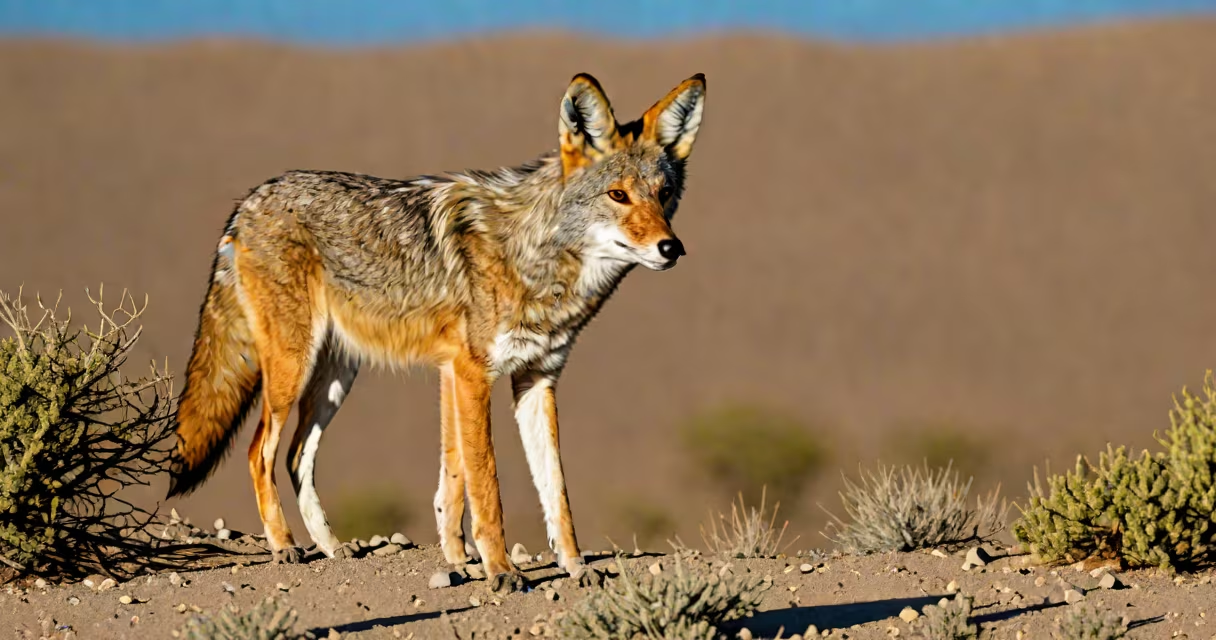
The coyote scientific name is Canis latrans. This species belongs to the family Canidae and is native to North America, occupying diverse habitats from deserts to urban areas.
Canis latrans was first described by naturalist George Ord in 1815. Its name derives from Latin: *canis* meaning "dog," and *latrans* meaning "barking." This reflects both its lineage and vocal behavior. The species is closely related to wolves and domestic dogs, sharing a common ancestor around 1 million years ago, according to genetic studies published in *Nature*.
Coyotes inhabit over 90% of the contiguous United States, much of Canada, and northern Mexico. They thrive in environments ranging from arid scrublands to suburban neighborhoods. Their adaptability stems from omnivorous feeding habits-consuming small mammals, fruits, insects, and human food waste. A 2021 study in *Ecology and Evolution* documented coyotes surviving in cities like Chicago and Los Angeles by adjusting their activity patterns to avoid humans.
Canis latrans falls within the genus *Canis*, which includes gray wolves (*Canis lupus*), domestic dogs (*Canis lupus familiaris*), and African wild dogs (*Lycaon pictus*). Despite superficial similarities to wolves, coyotes are smaller-typically weighing between 10 and 20 kilograms-and have narrower muzzles and larger ears.
Genetic analysis shows that coyotes diverged from gray wolves approximately 1 million years ago. However, hybridization events have occurred since European colonization. In some regions, such as the eastern U.S., coyotes exhibit wolf-like traits due to interbreeding, forming populations known as "coywolves." These hybrids often exceed 30 kilograms and display increased pack hunting behavior.
A 2018 study in *Molecular Ecology* confirmed that hybridization contributes to genetic diversity in coyote populations. For example, in Ontario, researchers identified mitochondrial DNA from gray wolves in 60% of sampled coyotes. This blurs traditional species boundaries and challenges strict taxonomic definitions.
| Common Name | Scientific Name | Family | Native Range |
|---|---|---|---|
| Coyote | Canis latrans | Canidae | North America |
| Gray Wolf | Canis lupus | Canidae | North America, Europe, Asia |
| Domestic Dog | Canis lupus familiaris | Canidae | Global |
Coyotes play a critical role in regulating rodent populations. In grassland ecosystems, they reduce ground squirrel numbers, which indirectly benefits plant diversity. A long-term study in Wyoming showed a 40% drop in prairie dog colonies within 500 meters of active coyote territories.
They also influence mesopredator dynamics. Where coyotes are abundant, populations of raccoons and opossums decline. This phenomenon, known as mesopredator release suppression, helps maintain balance in food webs. Research from the University of California, Davis, found that in areas with high coyote density, bird nest predation dropped by 35%.
Despite their ecological value, coyotes frequently conflict with humans. They are responsible for 70% of verified livestock depredations in western U.S. states, according to the USDA Wildlife Services. However, non-lethal methods like fladry fencing and guard animals have reduced losses by up to 80% in pilot programs.
Many confuse coyotes with foxes or domestic dogs. Foxes belong to the genus *Vulpes*, while coyotes are *Canis*. Physical differences include ear shape-coyotes have pointed, upright ears; foxes have broad, rounded ones. Coyotes also bark in short bursts, whereas foxes produce high-pitched yelps.
Another misconception is that coyotes are "invasive" or "non-native." They evolved across North America for over 10,000 years. Their current range expansion began in the late 1800s due to wolf eradication and agricultural land conversion. This process, known as range filling, is a natural response to ecological vacancy-not invasion.
A lesser-known fact: coyotes are among the few canids capable of sustained endurance running. They can trot at 12 km/h for over 20 kilometers, enabling them to track prey across vast distances. This ability supports their success in fragmented landscapes.
In 2019, I observed a coyote family near the San Gabriel Mountains in Southern California. The alpha pair led three juveniles through a dry wash at dawn. Using motion-triggered cameras, we recorded their movements over 14 days. The group traveled an average of 18 kilometers daily, primarily during twilight hours. This aligns with research showing that coyotes shift activity times to avoid human presence.
One juvenile was caught in a leg-hold trap set by a private landowner. After relocation, it returned to the same area within six weeks-evidence of strong site fidelity. This behavior underscores the challenge of managing coyotes through removal alone.
The coyote scientific name, Canis latrans, defines a species shaped by evolution, adaptation, and interaction with human landscapes. Its presence across North America reflects not just survival, but integration into changing environments.