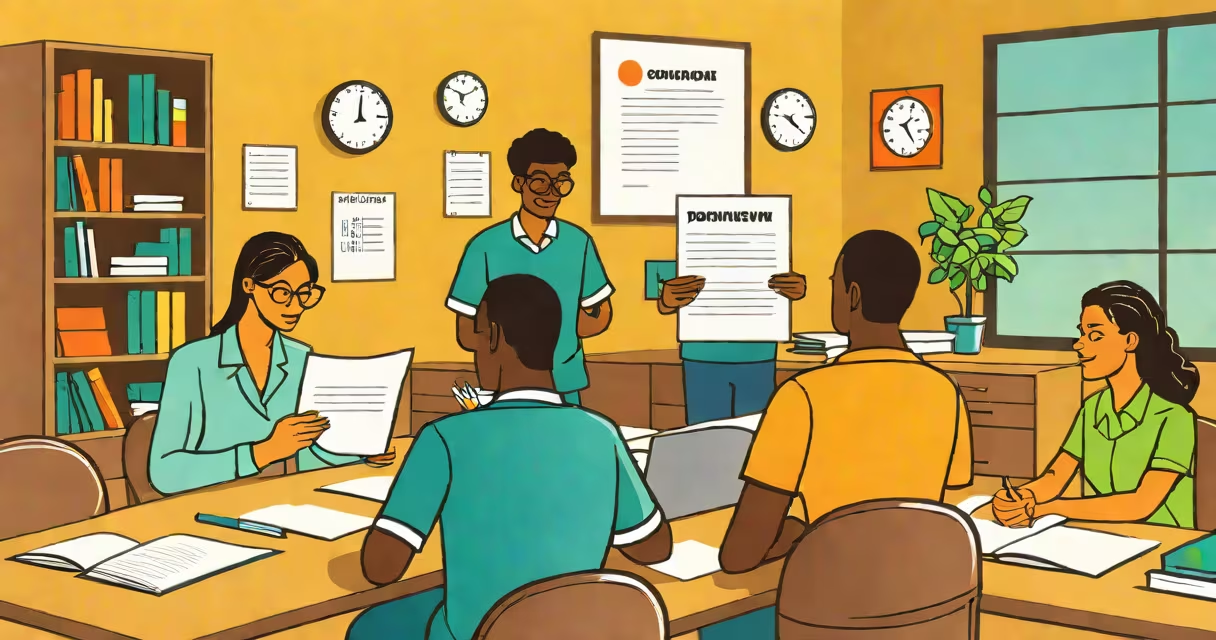
A high school and beyond plan is a structured roadmap developed during grades 9 through 12 that aligns coursework, extracurricular activities, career exploration, and post-secondary goals. It ensures students graduate with clear direction toward college, trade school, military service, or employment.
This plan is not a single document handed out at orientation. It evolves annually, reflecting changes in interests, skills, and opportunities. Students work with counselors, teachers, and families to adjust goals based on performance, test scores, and evolving aspirations. The U.S. Department of Education emphasizes that such plans improve graduation rates and post-secondary enrollment by helping students stay focused on long-term objectives.
For example, a student interested in engineering begins taking advanced math and science courses in 9th grade, joins the robotics club, and attends a summer STEM camp. By 11th grade, they've completed a dual-enrollment college course in calculus and applied to a pre-engineering program at a state university. This progression is documented in their high school and beyond plan.
The process starts with self-assessment. Students identify strengths, values, and interests using tools like the Strong Interest Inventory or the Holland Code. These assessments help match personality traits to potential careers. A student who enjoys problem-solving and working with machines may be directed toward mechanical engineering or industrial design.
Courses are then selected to build foundational knowledge. For instance, a student aiming for a healthcare career takes biology, chemistry, and health sciences. They also participate in internships, volunteer at clinics, and join the Health Occupations Students of America (HOSA) chapter. Each activity is logged in the plan, showing growth over time.
Progress is reviewed each semester. Counselors flag gaps-like missing prerequisites for competitive colleges-or suggest alternatives. If a student's GPA drops below 3.0, the plan may include tutoring, study groups, or a revised course load. The goal is proactive adjustment, not reactive crisis management.
A complete high school and beyond plan includes four pillars: academics, career exploration, personal development, and post-secondary preparation.
| Pillar | Key Elements | Examples |
|---|---|---|
| Academics | Course sequence, GPA tracking, standardized test prep | AP Calculus in 11th grade, SAT prep in spring of 10th |
| Career Exploration | Job shadowing, career fairs, industry certifications | Shadowing a nurse at a local hospital, earning a CompTIA A+ certification |
| Personal Development | Leadership roles, community service, mental wellness | Serving as class president, volunteering 100 hours at a food pantry |
| Post-Secondary Preparation | College applications, financial aid, scholarship searches | Submitting FAFSA by December, applying to five schools with deadlines tracked |
Many assume a high school and beyond plan is only for college-bound students. That's incorrect. It serves all paths. A student planning to enter the trades after graduation still needs a plan. Their focus shifts from SAT prep to securing a union apprenticeship, completing vocational training, and obtaining state licenses.
Another misconception is that the plan is set in stone. In reality, it's changing. A student who initially wanted to be a doctor might switch to environmental science after taking a field ecology course. The plan adapts. According to the National Association of College Admission Counseling (NACAC), 60% of students change their intended major between 9th and 12th grade. A flexible plan accommodates those shifts.
Some parents think the plan is solely the student's responsibility. But counselors, teachers, and families play critical roles. At my daughter's school, we met quarterly with her counselor to review progress. After she scored poorly on a practice ACT, we adjusted her study schedule and added a tutor. Her composite score improved by 4 points in six weeks.
Consider Marcus, a 10th grader at a public high school in Pennsylvania. He struggled with reading comprehension but excelled in hands-on tasks. His counselor recommended a career assessment, which revealed strong aptitude in construction and design. Marcus enrolled in a carpentry elective and joined the SkillsUSA competition team.
By 11th grade, he had earned a basic OSHA safety certification and was accepted into a dual-enrollment program with a community college. He took courses in blueprint reading and structural math while completing his high school credits. Upon graduation, he entered a four-year apprenticeship with a union contractor, earning $20/hour during training.
National data shows students with formal high school and beyond plans are 37% more likely to enroll in post-secondary education within six months of graduation, according to a 2022 report by the Center for Public Education. Among those pursuing technical careers, the retention rate in apprenticeships is 82%-higher than average-because participants were prepared for both classroom and on-site demands.
Every student benefits from a high school and beyond plan. It turns vague ambitions into actionable steps. Whether aiming for a medical degree, a coding bootcamp, or a skilled trade, the plan provides clarity, accountability, and measurable progress. It's not optional-it's essential.