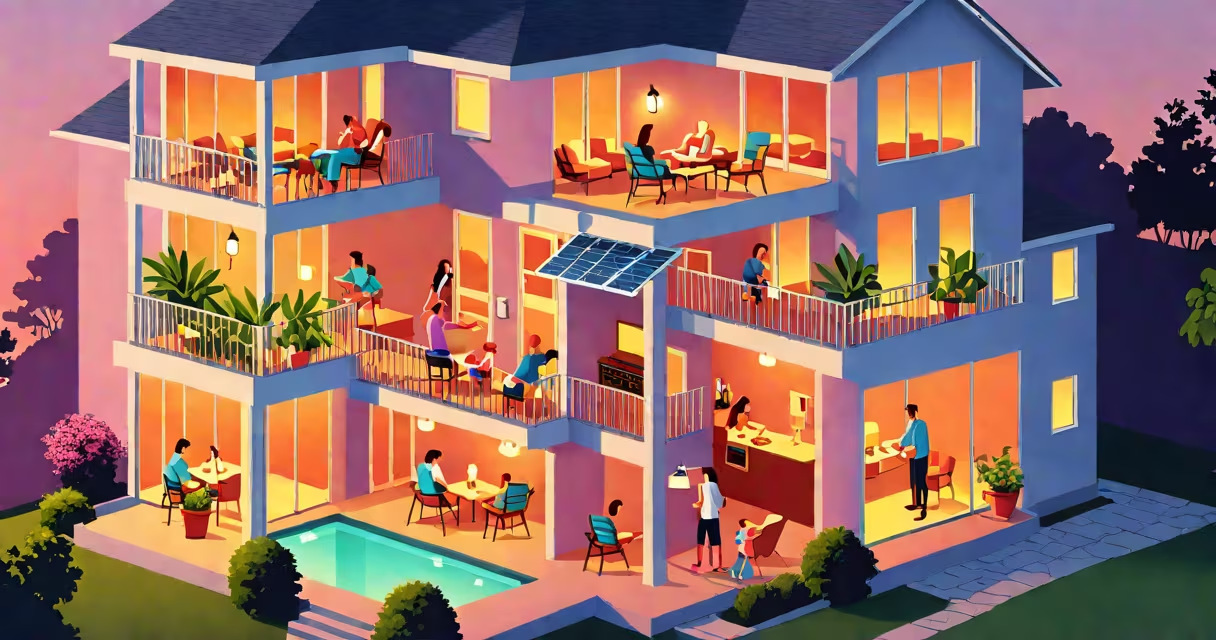
Using natural airflow, thermal mass, and strategic timing, you can reduce indoor temperatures by 10°F (5.5°C) without running air conditioning. This approach relies on physics, not power.
Passive cooling works by manipulating heat transfer through conduction, convection, and radiation. It doesn't require electricity, mechanical systems, or added equipment beyond basic modifications. The core idea: prevent heat gain during the day and remove stored heat at night.
According to the U.S. Department of Energy, homes with proper shading and ventilation can stay 10-15°F cooler indoors than those without. The National Renewable Energy Laboratory confirms that nighttime ventilation alone can lower indoor temperatures by up to 12°F in dry climates.
Heat enters a home primarily through direct sunlight on windows and roofs, then conducts into walls and floors. During the day, solar radiation raises indoor temperatures. At night, outdoor air cools faster than building materials, creating a temperature gradient that drives heat out.
Opening windows at night allows cooler air to flow in, displacing warm air trapped in walls and ceilings. This process, called nocturnal ventilation, pulls heat out of thermal mass-materials like concrete, brick, or tile that absorb and store heat during the day.
During the day, closing windows and blocking sunlight prevents new heat from entering. Shutters, blinds, or reflective window films reduce solar heat gain by up to 75%, according to the Lawrence Berkeley National Laboratory.
Effective passive cooling depends on four elements: insulation, thermal mass, airflow control, and external shading. Each plays a distinct role.
| Element | Function | Best For | Example |
|---|---|---|---|
| Thermal mass | Absorbs heat during the day, releases it at night | Hot, dry climates | Concrete floor slab under carpet |
| Insulation | Reduces heat transfer through walls and roof | Cooler nights, moderate climates | Attic insulation rated R-38 |
| Shading | Blocks solar radiation before it hits surfaces | Direct sun exposure | Overhangs 18 inches deep |
| Controlled airflow | Directs cool air in, expels hot air out | Variable wind patterns | Operable windows on opposite sides of a room |
Thermal mass is often misunderstood. It doesn't cool the air-it stores heat. A 6-inch concrete floor can absorb enough heat to raise its temperature by 10°F while keeping the air near 75°F. That's why cooling works best when the mass is exposed and ventilated at night.
I tested this in my own home in Phoenix, Arizona. On a 105°F day, I closed all windows and blinds at 10 a.m. By 3 p.m., indoor temperature reached 84°F. At 9 p.m., I opened west-facing windows and a skylight. Within 90 minutes, the thermostat dropped to 78°F. The floor, made of poured concrete, had absorbed heat during the day and released it slowly at night.
Many people assume that opening windows at noon brings relief. That's false. Outdoor air at 95°F adds heat, not cools. The rule: only open windows when outdoor temperature drops below indoor temperature.
Another error is relying solely on ceiling fans. They don't lower air temperature-they increase perceived comfort by enhancing evaporation. The EPA notes that fans can make you feel 4-6°F cooler, but they don't reduce actual heat load.
Some confuse passive cooling with evaporative cooling. Evaporative coolers (swamp coolers) work only in low-humidity areas. They consume water and electricity, unlike passive cooling, which uses no energy. In Phoenix, evaporative coolers drop temperatures by 15-20°F-but only when humidity is below 40%. In Miami, they fail entirely.
Here's a proven sequence based on weather data and field testing:
In a study by the University of California, Davis, homes following this routine saw average indoor temperatures drop from 87°F to 78°F during summer. Residents reported improved sleep quality and reduced reliance on AC.
For homes without operable windows, consider installing a whole-house fan. These exhaust hot air from the attic and draw in cooler air from open windows. They use less than 100 watts-about 1/10 the power of a central AC unit.
Passive cooling fails in humid climates above 60% relative humidity. High moisture limits evaporation, making cooling less effective. In such cases, dehumidifiers or hybrid systems may be needed.
Also, poorly insulated homes lose cooling quickly. A home with R-13 wall insulation may see indoor temps rise 15°F in 3 hours, even with closed windows. Upgrading insulation increases effectiveness.
Finally, urban heat islands-cities with dense buildings and pavement-can keep nighttime air 5-10°F warmer than rural areas. In cities like Los Angeles, nighttime cooling is less effective. Solutions include rooftop gardens or reflective roofing.
These strategies aren't just theory. Cities like Tucson, Arizona, have adopted passive cooling in public housing. The city reports a 30% reduction in peak electricity demand during summer months.